The snap elections for the parliament of Greenland last Tuesday (6 April 2021) attracted unusual interest from major powers who have been watching the political and economic impact of the election results on their interests in the Arctic region. Among them, the Chinese, who have invested in the Kvanefjeld mine on the island. Maximiliaan van Lange analyses the background to the recent Greenlandic general elections, and the island's geostrategic position in the Arctic in this article for commonspace.eu.
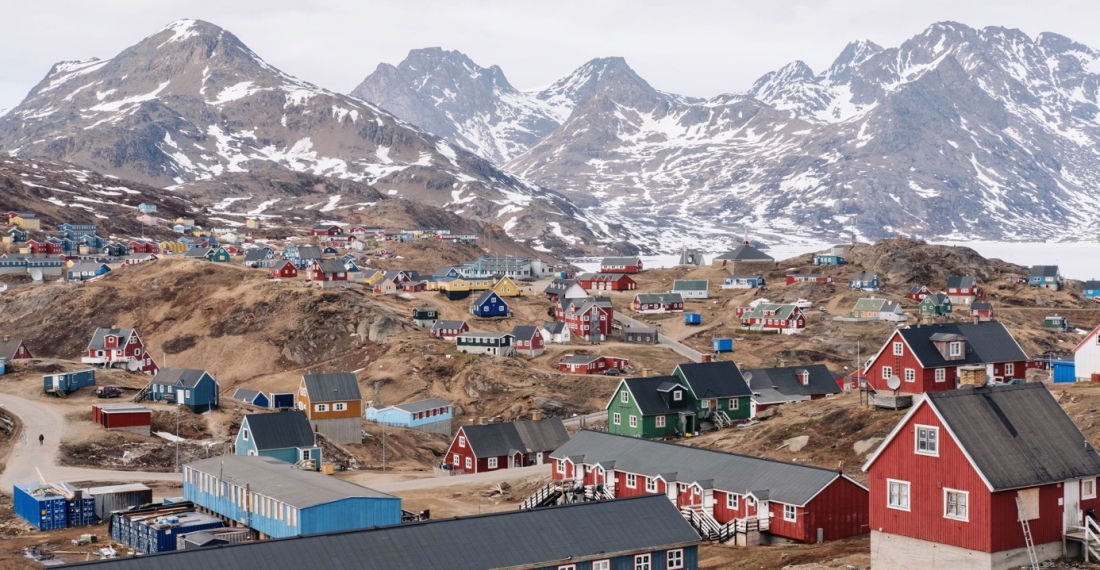
Last Tuesday (6 April 2021), general elections were held in Greenland so that a new government could be formed. The reason for these snap elections was the failure of Greenlandic Prime Minister, Kim Kielsen, to form a new coalition government, leading the parliament of Greenland to agree to early elections. Normally, such elections only attract interest in Greenland's mother country, Denmark, but with 56,000 inhabitants and 40,000 people entitled to vote, the future position of the world's largest island appeared at risk. Greenland is an autonomous Danish dependent territory with limited self-government and its own parliament with 31 seats, the Inatsisartut.
Greenland's economy is dependent on fishing and tourism, and Danish subsidies. The Danish subsidies will be phased out in the future in line with the increase in revenues from the mining industry. However, due to melting ice – caused by global warming – mining projects for the exploitation of uranium and rare earth elements (REE) by the Perth-based Australian mining company Greenland Minerals, with Chinese investors, became a matter of significant discussion during the elections. In particular, the indigenous Inuit population is against the project for environmental reasons. These environmental concerns are also shared by hunters and fishermen from other communities. Greenland Minerals has already spent more than $100 million preparing the mine, and has proven processing technology through its Chinese partner Shenghe Resources Holding. The Chinese partner, based in Chengdu, owns 9,6 per cent of the Greenland mine holding.
The latest exit poll indicates that the left-wing Inuit Ataqatigiit Party (IA) has won the snap election. To the displeasure of Australia and China, this election result means a provisional halt on new license applications to operate the Kvanefjeld mine and the completion of pilot plant operations. IA is not against mining as such, but against 'dirty mining'. The party fears serious ecological damage from radioactive waste. Supporters of the project in Kvanefjeld, however, see it as a potential source of jobs and prosperity. On Wednesday (7 April 2021), the IA had already pledged to oppose the mining project for the time being after winning the parliamentary elections with more than a third of the votes. The further development of the mining project has thus been put on hold.
Greenland is sending a powerful signal to international mining companies that want to mine the island's unexploited mineral resources. It was not without reason that former President of the United States Donald Trump wanted to buy Greenland two years ago. Trump's interest in Greenland reveals a neo-imperialist vision of American national security strategy characterised by spheres of influence. This is a return to the approaches to international relations that prevailed before 1940 and led to world wars.
Due to Trump's offer, which outraged Denmark, the geopolitical importance of Greenland became the focus of increased attention in the international community. After all, China dominates the global market for REEs - an essential Trump justification for the trade conflict with the United States (US). The Kvanefjeld mine could become one of China's most vital sources of rare earth elements outside the country.
Rare earth elements are critical to a wide range of modern technologies, including electric cars, wind turbines, and electronic chips. China produces nearly 60 per cent of all REEs, and processes 95 per cent. In the US, 80 per cent of these indispensable raw materials come from China, and in the European Union (EU) as much as 90 per cent. Even though production has increased in other countries in recent years, China has a particularly effective means of leveraging power here. This predominance of China is a key factor in overtaking the US to become the world's largest economy.
International interest in Greenland also increases as the major powers – the US, China and Russia – rush to establish their presence in the Arctic region. The administration of the new US President, Joe Biden, already declared in early 2021 that they will review vital US supplies, including REEs, to ensure that other countries cannot weaponise them against the US. This applies also to the EU, which needs to develop alternative sources of REEs to reduce its dependence on China. REEs are of crucial importance to Europe’s economy. For the EU, reliable and unhindered access to certain materials is a growing concern. It is not without reason that the European Commission has drawn up a list of critical raw materials for the EU, which is regularly reviewed and updated.
This also highlights why Greenland has not signed the Paris Climate Agreement, which came into force in 2016. The treaty lets states determine their own measures to meet the common goal of keeping global warming below two degrees Celsius. Keeping this agreement open is meant to enable large-scale mining in Greenland, according to Arctic specialist Marc Jacobsen. Greenland wants to grow its economy by developing fishing, agriculture and tourism, as well as mining in the southern part of the island.
Greenland is on the front line of global warming, with a record loss of ice every year. The retreating ice has increased the possibility of mining and allowed container ships to pass more easily through the Arctic, which could shorten global shipping routes. It presents a challenge for Western countries seeking to counterbalance Russia's military build-up in the Arctic. The existing treaty between Denmark and Greenland permits the US to have facilities on the island and to expand them, as well as to access scarce raw materials, provided that it engages in dialogue with Denmark.
Greenland can in the future play a key role in the EU's Arctic policy, and its strategy to be less dependent on China for materials such as Rare Earth Elements. The European Commission needs to work closely with the member state of Denmark in this direction.