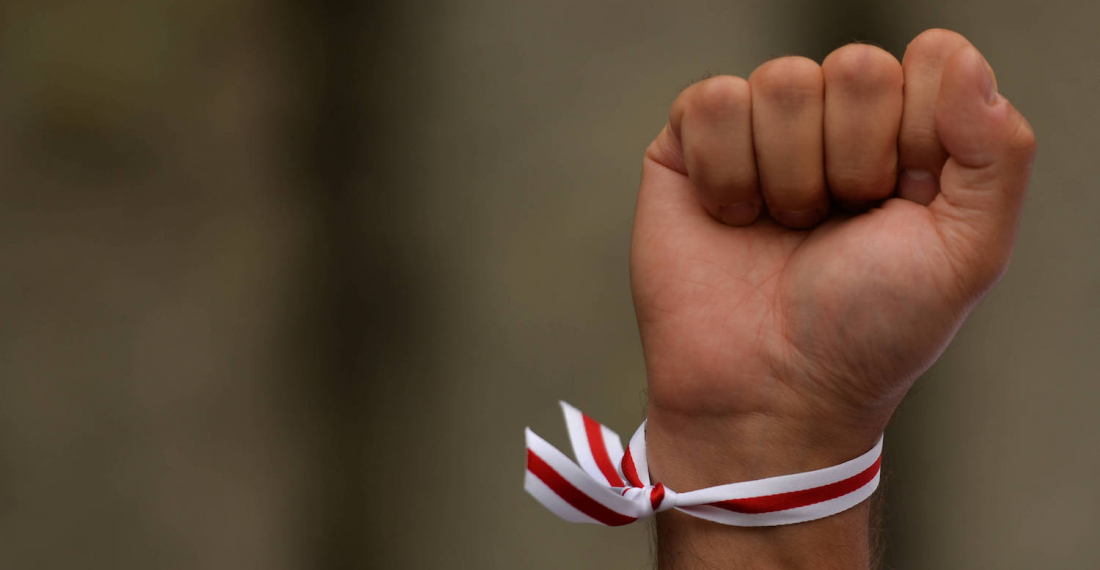
In recent weeks, Alexander Lukashenko’s regime in Belarus has ordered the mass closure of NGOs, calling them “bandits and foreign agents”. One year to the day since the disputed 9 August 2020 presidential elections, for commonspace.eu, Maryia Ditchkowska looks at some of the organisations targeted, why it is unlikely to seriously impact support for the pro-democractic movement, and what has prompted this particular crackdown.
In Belarus, what do an art space, a business school and a disability support centre have in common? All of them, and at least 182 others, made it onto Alexander Lukashanko’s list of non-governmental organisations (NGOs) to be forcibly liquidated – virtually nearly every organisation of note in a country where state control is tightening ever further. The list, initially published on 23 July, was updated in the following weeks to include most of the major NGOs in the country, focusing on a wide range of sectors. While another attack on the civil society and pro-democratic movement in Belarus seems like old news, it still provides some food for thought and a moment for reflection. One year to the day since the widely contested Belarusian presidential election that triggered the wave of protests against Lukashenko, what are the reasons behind such assault and the messages it intends to send to both domestic and international audiences?
From human rights, to art, to the environment
Among those liquidated in July is Human Constanta, a human rights organisation focused on the legal support for foreign citizens and stateless persons and promoting anti-discrimination in Belarus. Another example is Art-Siadziba: an art and culture space that organised many cultural events and exhibitions in Minsk, supporting contemporary art. In turn, the Centre for Environmental Solutions was working to promote environmentally friendly initiatives and provide green resources. The news of the NGO closures comes as the Belarusian Association of Journalists is also likely to be liquidated by a court order on 11 August, while many news media organisations have already been forced to cease their operations or move their activities abroad.
According to the law, there is no requirement to provide justification for an organisation’s closure. However, those registered outside the capital got the explanation that their activities “were outside their prescribed mission”, possibly alluding to their perceived support of the opposition movement. Such closures not only mean an attack on the civil society; these NGOs were there to “plug the holes”, supporting citizens in situations where the government could not or did not want to do so. This is part of the total “clean-up” of any organisation that is friendly or perceived to be friendly to the opposition. Unsurprisingly, in the current circumstances, nearly anyone can be labelled as unfriendly to the government, including an art space or environmental advocates.
The desire of the Belarusian government to play a central role in every aspect of citizens’ lives is nothing new, proudly continuing this tradition from the Soviet times and thus winning the support of the now-rare pro-Lukashenko electorate. Such a push for total control is particularly prominent in the current atmosphere of distrust, further induced since the elections last year. Hence comes, unsurprisingly, the hostility towards any non-governmental organisation and private enterprise in the country. At the same time, the wave of liquidations also means that the gaps in support required by the Belarusian people widen, especially given the already difficult situation in the country politically and economically. The Belarusian government is unlikely to set up its own initiatives to replace the recently closed NGOs, essentially shooting itself in its foot with the latest measures. This, in turn, will almost definitely lead to a further decline in the quality of life of underprivileged and minority groups, further human rights abuses, and a further reduction in social and economic support.
Sanctions against the West or his people?
Unsurprisingly, there was never a clear official statement on the reason behind these closures. For those few that still follow state media, these NGOs were labelled by Lukashenko as “foreign agents” and straight-out “bandits” that were “brainwashing people” and facilitating a brain-drain from the country instead of working to improve it. The proposed improvements, of course, were assumed to be done through the established governmental channels, but, essentially, citizens were not encouraged to show any initiative at all. Perhaps the only truthful allegation against the liquidated NGOs was their support towards the protest movement in Belarus. For some, this meant the legal help they gave those accused of the “mass disturbances”; for others, for the government, the existence of such organisations was an eyesore that highlighted the state's inefficiencies and its inability to deal with the country’s issues.
“Collaboration” with the West was given as the primary reason for the liquidations. Lukashenko accused them of being sponsored from abroad to promote their “hostile” interests in Belarus. However, these closures are unlikely to stop the pro-democratic movement in the country. The protests in the past year have shown that the pro-democratic movement and its support comes primarily from the grassroots movement, without the organisation and fixed structures of those most likely to be targeted by the regime. Moreover, the majority of the politically active movements and media outlets have already moved their operations outside the country; all while a significant proportion of Western funds is focused on aiding those relocating due to repression.
Despite the brave face the Belarusian government is trying to pull, Western sanctions against key economic sectors and the ban on air travel hurt not only the ego of Lukashenko, but also his wallet. Therefore, the continued purge of civil society is seen by some as a vendetta of the Belarusian regime in response to Western sanctions. There are good reasons to see it this way. The Belarusian minister of foreign affairs, Vladimir Makei, has previously threatened to close the NGOs in the country as a response to the EU and the US for the sanctions. While the Belarusian government can talk about a measured response to these sanctions, in reality, there is little they can do to retaliate. In turn, their gaze has shifted to Belarusian civil society, which was already an eyesore for the regime. Once proudly calling himself the last dictator in Europe, Lukashenko has already accused civil society of over-stretching his tolerance towards democratic movements.
***
To a certain extent, the closure of these NGOs is a retaliation against the Belarusian people themselves: for protesting, being disloyal to the regime, and no longer willing to put up with Lukashenko. At the same time, some see the recent events as preparation for the first anniversary of the elections, today, and the deepening paranoia over anyone deemed disloyal to the current regime. As its obvious opponents have already fled the country or are in jail, the time has come for those remaining, as the distrust against the citizens and within the apparatus itself persists. While active protests in the country might have been muted, the regime has not won any additional supporters in the past year, with many living in fear, emigrated, persecuted, or feeling the consequences of government action in their private lives. Thus, there is a good reason to fear the anniversary of the elections: at the end of the day, people are looking forward to a collective trigger for the new wave of protests to start.