


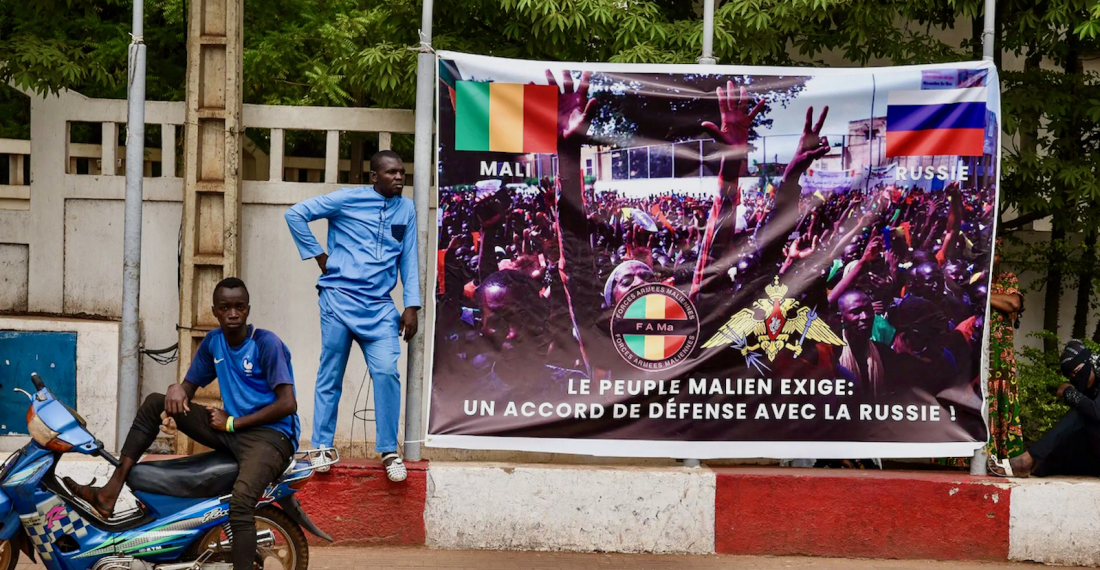
Analysis: Russia's "Wagner group" poses a threat to peace and security in the Sahel

While the world’s attention is focused on Russia’s invasion of Ukraine, Russia’s presence in Africa, and particularly in Mali, increasingly represents a threat to international security, writes Camille Victor for commonspace.eu.

Russia’s presence in Mali has generated considerable controversy since the end of 2021, with many Western powers denouncing the activities of the Russian “Wagner Group” paramilitary mercenaries in the country, accusing them of violating human rights and the rule of law. Indeed, while Mali had been cooperating closely with France in the fight against terrorism since 2013, the Malian junta that seized power in a coup in May 2021 has drastically changed its foreign policy, now turning to Moscow to help stabilise the security situation by employing the services of this shady Kremlin-linked private security group.

This major pivot of Malian foreign policy towards Russia comes as relations between Mali, its African neighbours, and the West, and France in particular, have continually deteriorated since May 2021. On the one hand, the Economic Community of West African States (ECOWAS) long condemned the Malian junta for its failure to respect its promises of a democratic transition initially scheduled for February 2022. ECOWAS also initially stayed true to its values by suspending Mali's membership of the community soon after the coup, and imposing strong economic and financial sanctions against the Malian military government on 9 January 2022. ECOWAS then lifted sanctions on 3 July 2022, following the government’s promise to hold elections in February 2024.

On the other hand, relations with France deteriorated sharply over the past year, thus paving a way for Russo-Malian rapprochement. Indeed, after nine years of military presence in Mali, first through Operation Serval in 2013 followed by Operation Barkhane from 2014 onwards, France was pushed out by Mali’s military authorities six months after the arrival of paramilitaries from the Wagner Group. Shortly after the junta expelled the French ambassador to Mali, the Élysée Palace decreed on 17 February 2022 that "the political and operational conditions were no longer met to remain engaged in Mali", and that France had therefore decided to reorganise Operation Barkhane "outside Malian territory". This resulted in the withdrawal of the last French troops from Mali on 15 August.
Image
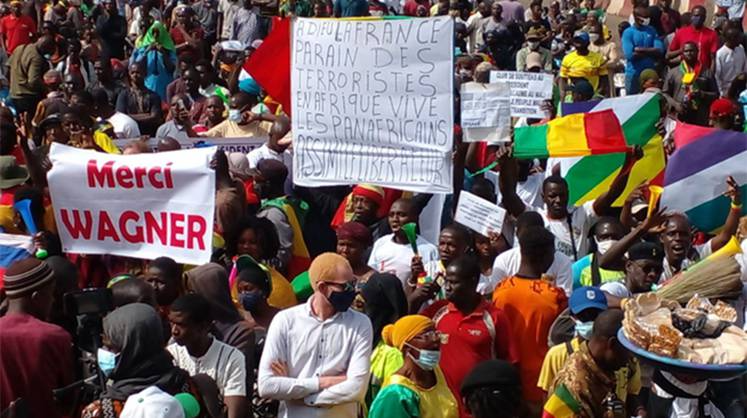
Mali protest
A protest in Mali in 2022 celebrating the withdrawal of French forces, with a banner reading "Thank You Wagner"

In a region crippled by insecurity for a decade, this development will likely generate significant political and economic risk further threatening national and regional stability. Russia deployed Wagner to the Sahel to counteract Western agendas and as an alternative to the G5 Sahel Joint Task Force; however, Moscow is now entangled in a power struggle between an anaemic Malian government, Islamist militants, and dissident forces, and may face a reaction if the military junta loses power or fails to transition to a democratic system. The Wagner Group's reputation for poor discipline and inadequate leadership also means that they are unprepared to replicate France’s stabilising presence, and are unlikely to limit their 1,000-strong force to only training small units and executive protection. Brutal tactics will most likely boost rebel recruitment, while state collapse may discredit Russia as a reliable partner or effective security supplier.

Since the arrival of Wagner in Mali, the number of human rights abuses against the population – which were which were already excessively high before the paramilitaries’ presence – are increasing in number, threatening national security. Indeed, an alliance with Moscow offers African governments the freedom to conduct counterterrorism and counter-insurgency operations without restrictive human rights obligations imposed by Western powers. According to a report by the NGO Acled, the Russian mercenaries targeted civilians in more than 70% of their activities. One example that remains in everyone's mind is the appalling massacre in the village of Moura in central Mali at the end of March 2022.

Moura was the object of an “anti-terrorist operation” carried out by the Malian army (FAMa) with the support of Wagner paramilitaries over several days, leaving 300 civilians dead, mainly men from the pastoralist Peuhl, or Fulani, ethnic group. According to a report issued by Human Rights Watch (HRW), the massacre was “the worst single atrocity reported in Mali's decade-long armed conflict”. Such abuses create additional instability and political risk as they further fragment Mali’s population by increasing entrenched tensions between its ethnic communities. Rebel recruitment will most likely be bolstered, and a more general loss of trust in the state’s ability to ensure the civilians’ security will probably lead to an even more significant lack of communication and cooperation between the population and security forces. This may also predispose a shift towards seeking out alternative security providers for protection, further undermining the FAMa’s ability to contain the terrorist threat.

Another consequence of Wagner’s presence in Mali is the ongoing failure to counter the rise of jihadist terrorism in the country, which not only represents a threat to national security but also jeopardises regional stability. Since the start of the Islamic State in the Greater Sahara (IS-GS) offensive in north-eastern Mali last March, more than 900 civilians have been massacred, mostly in the villages of Tamalat, Anderamboukane and Inekar. Whilst the Movement for the Salvation of Azawad (MSA) has ensured the protection of the populations in the north of the country for more than six months, it still seeks the FAMa’s assistance. However, the army seems unable to fulfil its role as a main security guarantor despite Wagner’s presence; so far, it has not deployed any men on the ground, neither at the time of the fighting, nor since then, to protect or rescue displaced civilians. Indeed, thousands of them are currently living in makeshift camps and seeking shelter in the towns of Gao and Kidal, or in Algeria. General Gomou's appeal asking them to take refuge in the big cities if anything illustrated how much the situation on the ground had deteriorated.
Image
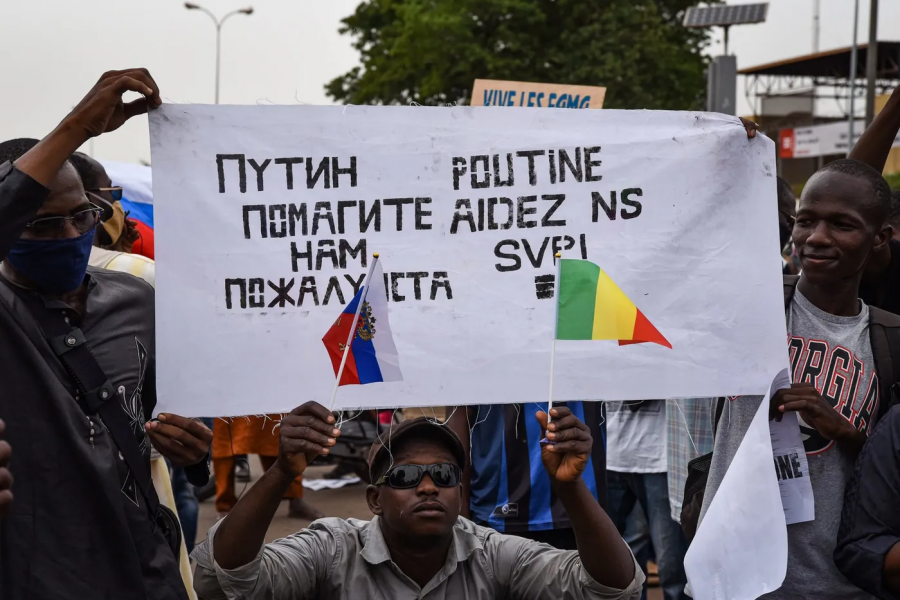
Mali-Putin
A protest in the Malian capital Bamako, in 2021. The sign reads, "Putin, please help us!" in Russian and French.

Despite its relatively new deployment in Mali, Wagner has already significantly impacted the security climate of the conflict-ridden country. Mirroring its influence in other African nations where it has embedded itself over the past years, such as the Central African Republic, Libya, Sudan, Madagascar and Mozambique, Wagner negatively impacts conflict dynamics through its operations, particularly civilian safety. As the group progressively expands its footprint, there is a considerable risk that additional regions may witness similar trends to those seen in Mali and neighbouring areas. 

Given that Mali’s security is currently in the hands of forces that not only fail to effectively counter an increasing terrorist threat, but also to fail to respect human rights and the rule of law, all the while facing zero accountability for their abuses, ensuring that the junta upholds its commitment to conduct democratic elections in 2024 must remain a priority. In the meantime, an integrated security risk management and peacebuilding strategy should include measures that encourage transparency and accountability for abuses and breaches to the rule of law committed by security forces, notably through strengthening civilian institutions and oversight mechanisms.

source: Camille Victor is a Research Associate at LINKS Europe focusing on North Africa and the Sahel. She is currently pursuing post-graduate studies at King's College, London
photos: La Croix and Ekspert

Latest

Editor's choice
Monday Commentary
Monday Commentary: PEACE IN OUR TIME?

Monday Commentary: PEACE IN OUR TIME?

Making peace between Armenia and Azerbaijan was never going to be simple, nor easy, nor quick. It is taking time, writes Dennis Sammut in this Monday Commentary. “There is a sense of realism coming from the leaders of the two countries – President Ilham Aliyev of Azerbaijan and prime minister Nikol Pashinyan of Armenia, that frankly, is necessary and welcome”, he writes. At a time when conflicts are raging all over the world – from Ukraine to the Gulf, from Africa to South Asia, the prospect that Armenia and Azerbaijan had finally, after decades of conflict that left thousands of dead and many more displaced, decided on embarking on a journey of peace was welcomed. Peace between Armenia and Azerbaijan can be top-down up to a point. Both leaders have spent political capital preparing for a peace deal. But both are aware that their people are not ready for peace yet. In fact, in Armenia, most of the elite are negative toward a peace deal with Azerbaijan. Pashinyan needs time to persuade his countryfolk. That is why 2031 is realistic. Ilham Aliyev runs a tighter shop, but he is also not immune to public opinion. Every time someone hits a landmine in Karabakh, which unfortunately happens often, peace comes into question. Which is why Aliyev chooses to sound hardline, more often than not. In pursuing the peace agenda, both Aliyev and Pashinyan need to proceed cautiously. But they are right in making peace the central issue in their agenda. It is the main issue, and the one that will define them in history. So forward, cautiously but resolutely! In pursuing the peace agenda, Aliyev and Pashinyan need to be supported clearly and unambiguously. There are too many people in Baku and Yerevan who are sitting on the sides, waiting. The international community is not doing enough. It is time to be counted. Otherwise, the spoilers will win, and the region will go back to its bad habits. (Click the image to read the full commentary).

Popular

Editor's choice
Monday Commentary
Monday Commentary: European-Azerbaijan relations need an intensive and multifaceted dialogue that is frank and honest

Monday Commentary: European-Azerbaijan relations need an intensive and multifaceted dialogue that is frank and honest

Last week I visited Baku, Azerbaijan. My visit was relatively short, but very intensive, and had many meetings with stakeholders and colleagues. When I arrived in Baku first time in 1996,  Azerbaijan was a different country: weak, poor, and shaken by defeat in war. For thirty year the Karabakh issue dominated the agenda: the political agenda but also the popular mindset. Now, thirty years later, Azerbaijan has returned to Karabakh, and peace with Armenia is on the horizon. It is a new era for Armenia-Azerbaijan relations, for the South Caucasus, but also for Europe.  But we cannot be complacent: the Peace agreement has been initialed but not signed; borders remain closed; TRIPP is ambitious but remains an idea; and there are spoilers who want to turn the clock back. We must not allow them, and in this Europe and Azerbaijan must work together. Europe’ vanguard organization is the European Union – it is a free union of 27 member states; it is a strong global economic force, and increasingly a diplomatic and military force too. But it remains “work in progress” and can often appear dysfunctional. It often lacks collective and institutional memory. In its dealings with Azerbaijan the EU has made many mistakes – not least opening the delegation here late – in 2008. It sometimes appears condescending. Some utterances from the European Parliament and from some quarters in some member states are not understandable even for me. They irritate the Azerbaijanis, but serve no other purpose But Azerbaijan has also not handled relations with the EU well. It has failed to respond when the hand of friendship reached out; and it confused irritating actions, sometimes by well-meaning people; sometimes by outright spoilers, with strategic action. In short, EU-Azerbaijan relations have suffered from a lack of proper dialogue. This dialogue must be frank, honest and multi-faceted involving different segments of society on both sides.   Is Azerbaijan Europe? When Azerbaijan applied to join the Council of Europe in the 1990s, there were some who opposed, saying this was not Europe. I was one of the people who argued that Armenia and Azerbaijan may be on the periphery of the continent geographically, but were European in essence. Certainly their elites. During the discussion on 4 September in Baku, my friend Farhad Mammedov, mentioned that Azerbaijan is not interested in joining the EU, and was now close to the Central Asian countries in the 5 plus 1 format. Neither things mean that Azerbaijan is not Europe. There are several European countries that are not in the EU, and do not want to be, for example Norway and Switzerland. Iceland has recently voted to stay out of the EU. The UK was a member and left. Europe is bigger than the EU, and the holding of the European Political Community summit in Baku in 2027 proves that. Despite all the rhetoric, I never heard the president of Azerbaijan  saying that Azerbaijan is not Europe, nor have I heard any European president say it either. Not wanting to join the EU and forging close relations with neighbouring regions does not make Azerbaijan any less European. It is only logical that when Europeans talk to Azerbaijan they talk like family. The conversation is often frank. It must also be honest, and Europeans need always to remember this too. A frank, honest and multi-faceted dialogue A frank, honest and multifaceted dialogue will contribute to relations between Azerbaijan and the rest of Europe: it will avoid misperception, which unfortunately is very common on both sides; it will provide a forum where problems can be discussed and resolved, and it will increase mutual trust, so that together common problems can be addressed. (click image to read the full Monday Commentary)
Editor's choice
Monday Commentary
Monday Commentary: “The barren rocks of Aden” and “These lands of Yemen are so ruthless”

Monday Commentary: “The barren rocks of Aden” and “These lands of Yemen are so ruthless”

There are two early 20th-century tunes that mark foreign attempts to occupy and “pacify” Yemen. The Scottish tune “The barren rocks of Aden” marks the mobilisation of Highland soldiers, enlisted to be deployed to the Yemeni port of Aden, that in 1837 became the last colony to be incorporated into the British Empire. The tune talks of the harshness of the terrain, but is celebratory, It was even played as a farewell tune to Sir William Luce at the parade in Sharjah celebrating his end as “British Viceroy” in the Middle East in 1966. The second tune is an Anatolian lament. As Ilker Sezer reminded us this weekend, in his weekly feature on “Turkiye Today”, it “mourns the tragic fate of Ottoman soldiers dispatched to the harsh, remote deserts of Yemen during the fall of the empire, young men who marched away from their villages and never returned home. Most of their names, and numbers, were never recorded. Yet, their fate left a mark on the Turkish psyche.” Subsequent invaders have discovered that Yemen is a grave that cannot be overcome by the strength of modern technology, and that whilst Yemeni society is splintered and divided, building a reliable alliance with Yemeni factions is difficult. These are the harsh lessons facing Saudi Arabia, as the Kingdom faces its biggest challenge in its modern history. The leadership of the Kingdom now has to respond decisively. At stake is their very credibility. This is likely to be a long and messy conflict. Saudi military objectives need to be focused: to box in the Houthis rather than destroy them. This is likely to include: (a) regaining territory lost on the Red Sea coast; (b) control over Bab el Mandeb Strait; (c) some kind of cordon sanitaire on the Saudi-Yemeni border; and if things go well (d) the capture of Sanaa. All this would not eliminate the Houthi problem, but it will contain it. In the end the Saudis will have to continue managing Yemen with a mixture of carrot and stick. For the moment, the stick is likely, but the carrot cannot be forgotten either. (click the image to read the Monday Commentary in full)

