Francois Rochebloine: Timing of Ailham Aliyev's visit to France is not right
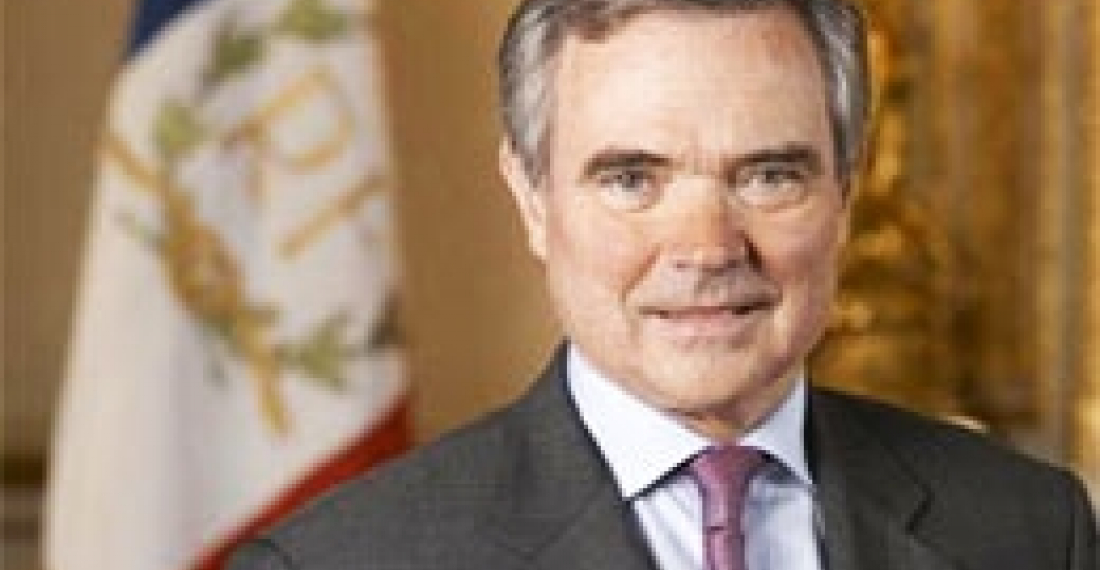
 French Member of Parliament from Loire, Francois Rochebloine condemned the visit by Aliyev. Rochebloine claimed that the timing of the visit is not right, as it is happening only a few days after the pardoning of Safarov, who murdered Armenian officer Gurgen Margaryan.

He added that Azerbaijan's habit of creating unwanted provocations is making it difficult to maintain the peace and stability in the South Caucasus region.

"Safarov case aroused condemnation in Armenia and in all democratic countries," he said.

Earlier on August 31 the Armenian authorities adopted a decision to suspend diplomatic relations and official contacts with Hungary. President of Armenia Serzh Sargsyan made public the decision at a special meeting with the heads of diplomatic missions on Friday after the Hungarian authorities extradited Azeri officer Ramil Safarov, who was sentenced by a Hungarian court to life in jail for killing sleeping Armenian officer Gurgen Margaryan with an axe in Budapest in 2004. Both the officers were undergoing an English language course under the NATO PfP program. The same day after Safarov's extradition, Azeri President Ilham Aliyev decreed to pardon the criminal.

Related articles

Editor's choice
News
EPC summit in Armenia was an expression of European support for Nikol Pashinyan

EPC summit in Armenia was an expression of European support for Nikol Pashinyan

Leaders from more than 45 European countries and beyond gathered today in Yerevan for the eighth summit of the European Political Community (EPC). The summit was the largest gathering of European leaders ever held in the South Caucasus. Apart from the set piece events in plenary session, many leaders also held private bilateral meetings. commonspace.eu special correspondent, Alex Verge, was at the summit, from where he filed this report: European Union Commission President Ursula von der Leyen, France President Emmanuel Macron, Italian Prime Minister Giorgia Meloni, UK Prime Minister Keir Starmer, and Ukrainian President Volodymyr Zelensky were amongst the myriad of European leaders that gathered on Monday for 8th summit of the European Political Community. Prime Minister of Canada Mark Carney was also present, making him the first non-European leader to take part in an EPC summit. The summit marked the first of two days of high-level diplomacy in Yerevan, with the city also hosting the first ever bilateral EU-Armenia summit tomorrow. Both summits are signals of support from Europe for the policies of Armenian Prime Minister Nikol Pashinyan, in power since 2018. In particular, the Pashinyan administration has looked to develop new foreign partnerships, reduce Armenia’s reliance on historic partner Russia, and pursue a difficult peace process with Azerbaijan. A polarising figure in Armenian politics, Pashinyan is seeking re-election in June this year in parliamentary elections. (click image to read the report in full).

Popular

Editor's choice
Interview
Thursday Interview: Murad Muradov

Thursday Interview: Murad Muradov

Today, commonspace.eu starts a new regular weekly series. THURSDAY INTERVIEW, conducted by Lauri Nikulainen, will host  persons who are thinkers, opinion shapers, and implementors in their countries and spheres. We start the series with an interview with Murad Muradov, a leading person in Azerbaijan's think tank community. He is also the first co-chair of the Action Committee for a new Armenian-Azerbaijani Dialogue. Last September he made history by being the first Azerbaijani civil society activist to visit Armenia after the 44 day war, and the start of the peace process. Speaking about this visit Murad Muradov said: "My experience was largely positive. My negative expectations luckily didn’t play out. The discussions were respectful, the panel format bringing together experts from Armenia, Azerbaijan, and Turkey was particularly valuable during the NATO Rose-Roth Seminar in Yerevan, and media coverage, while varied in tone, remained largely constructive. Some media outlets though attempted to represent me as more of a government mouthpiece than an independent expert, which was totally misleading.  Overall, I see these initiatives as important steps in rebuilding trust and normalising professional engagement. The fact that soon a larger Azerbaijani civil society visits to Armenia followed, reinforces the sense that this process is moving in the right direction." (click the image to read the interview in full)