Foreign Ministry of Armenia: The resolution passed by Australia's New South Wales state will be adopted to pave way to the international recognition of Nagornyy Karabakh
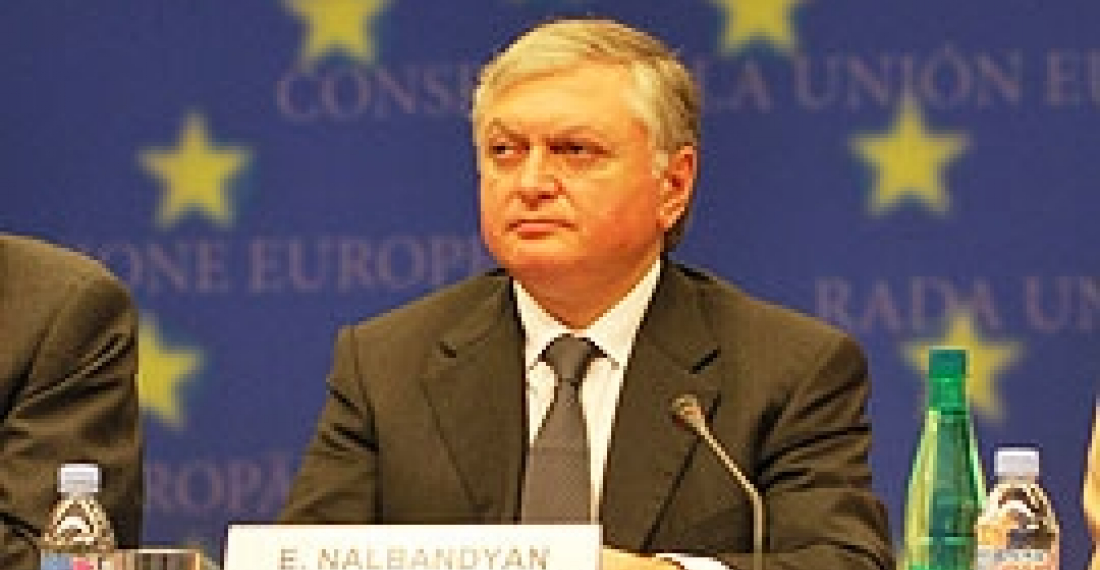
 Armenia's FM Edward Nalbandyan started his official visit to San Jose with an October 25 meeting with Costa Rica's parliament speaker, Victor Emilio Granados.

As press-service of the Foreign ministry reported, Nalbandyan briefed Grenados on the Nagorno-Karabakh conflict settlement process, saying that Armenia's approaches are in line with the international community's positions reflected in the statements by the OSCE Minsk Group co-chairing states. He also addressed Azerbaijan's continuing rejections of the proposals made. "The more Azerbaijan keeps hampering the three co-chairs' efforts towards resolving the conflict, the more commendable decisions like the resolution passed by Australia's New South Wales state will be adopted to pave way to
the international recognition of Nagornyy Karabakh," he said.

Later in the day, Nalbandyan met with the chairman of Costa Rica parliament's Standing Committee on International Relations and Foreign Trade, Maria Jeannette Ruiz Delgado, and Foreign Minister Enrique Castillo Barrantes.

Nalbandyan and his Costa Rican counterpart agreed on elaborating documents for accrediting resident ambassadors and appointing honorary consuls in Yerevan and San Jose, expanding the legal contractual cooperation, establishing a closer partnership in international organizations and relaxing visas. They both agreed to sign the documents in the course of Barrantes' scheduled visit to Yerevan.

Related articles

Editor's choice
News
Marijana Kujundzic: "Our message is clear and consistent: no one should live in fear of the ground they walk on"

Marijana Kujundzic: "Our message is clear and consistent: no one should live in fear of the ground they walk on"

The 4th International Mine Action Conference, was held in Baku, Azerbaijan, on 2-3 September 2026. It was organised by the Azerbaijani national agency for humanitarian demining, ANAMA, and the United Nations. The Head of the European Union Delegation in Baku, Ambassador Marijana Kujundzic addressed the conference on 3 September, and reaffirmed the determination of the European Union to work globally for the eradication of landmine contamination. She said, "mine action is about far more than clearing contaminated land. It is about creating the conditions for people to return, for homes and public infrastructure to be rebuilt, and for communities to recover a sense of normality, stability and hope" The title — “Humanitarian Demining for Urban Recovery: Setting Standards of Excellence for Safe Settlements” — captures both the urgency of the task and the level of ambition required to meet it. It reminds us of a fundamental truth: urban recovery cannot begin where land is unsafe, where infrastructure is contaminated, and where communities cannot return with confidence. Humanitarian demining is therefore not only a security imperative, but also a precondition for recovery, reconstruction and human dignity. I know from my own country’s experience that mine action is about far more than clearing contaminated land. It is about creating the conditions for people to return, for homes and public infrastructure to be rebuilt, and for communities to recover a sense of normality, stability and hope. Croatia’s experience has shown that mine action and reconstruction must go hand in hand. Recovery is most effective when it is guided by long-term planning, strong institutions and, above all, the needs of affected communities. In Azerbaijan, this reality is especially visible. The EU recognises and praises Azerbaijan’s major efforts on the ground, especially the work led by ANAMA and all operational actors involved in surveying, clearing, educating, and assisting affected communities. We are proud to stand with Azerbaijan in this effort. This is why the conference theme is so timely. If we speak of urban recovery, we must also speak of standards. If we speak of safe settlements, we must also speak of excellence. A settlement is not safe simply because explosive hazards have been removed. A settlement is safe when: families can return without fear; children can walk to school securely; public services can function again; reconstruction can proceed according to clear standards; and communities can rebuild their lives with confidence in the future. (read her remarks to the conference in full by clicking the picture).

Popular

Editor's choice
Interview
Thursday Interview: Murad Muradov

Thursday Interview: Murad Muradov

Today, commonspace.eu starts a new regular weekly series. THURSDAY INTERVIEW, conducted by Lauri Nikulainen, will host  persons who are thinkers, opinion shapers, and implementors in their countries and spheres. We start the series with an interview with Murad Muradov, a leading person in Azerbaijan's think tank community. He is also the first co-chair of the Action Committee for a new Armenian-Azerbaijani Dialogue. Last September he made history by being the first Azerbaijani civil society activist to visit Armenia after the 44 day war, and the start of the peace process. Speaking about this visit Murad Muradov said: "My experience was largely positive. My negative expectations luckily didn’t play out. The discussions were respectful, the panel format bringing together experts from Armenia, Azerbaijan, and Turkey was particularly valuable during the NATO Rose-Roth Seminar in Yerevan, and media coverage, while varied in tone, remained largely constructive. Some media outlets though attempted to represent me as more of a government mouthpiece than an independent expert, which was totally misleading.  Overall, I see these initiatives as important steps in rebuilding trust and normalising professional engagement. The fact that soon a larger Azerbaijani civil society visits to Armenia followed, reinforces the sense that this process is moving in the right direction." (click the image to read the interview in full)