


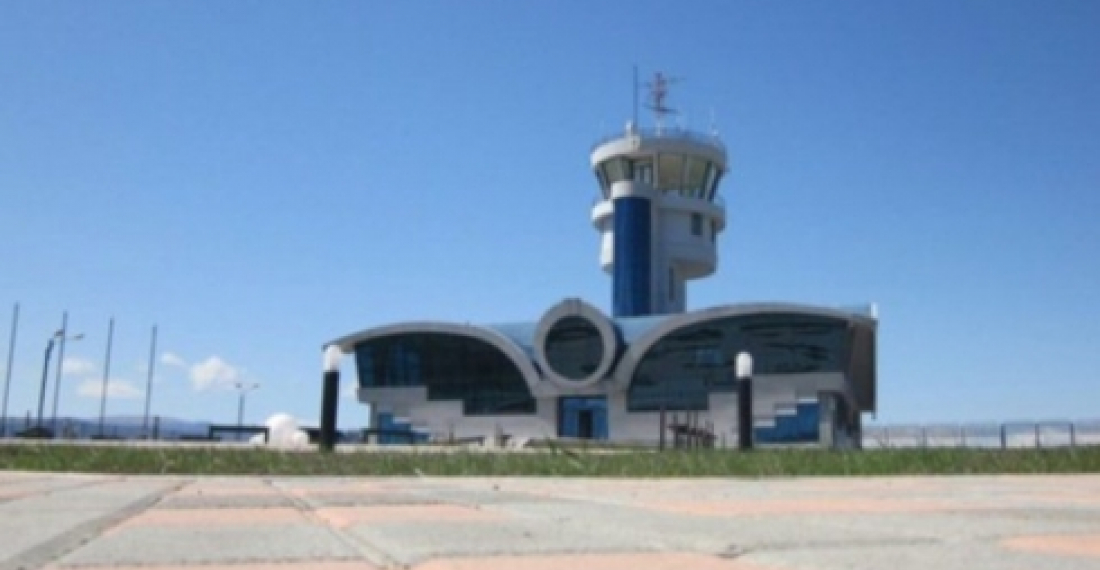
Fears opening of airport may trigger new crisis. EU calls for a diplomatic solution to the issue of airport in Karabakh

There are increased fears that the opening of an airport in Nagorno-Karabakh may trigger another crisis in the tense relations between Armenia and Azerbaijan. The airport, called Stepanakert Airport by Armenians and Khojali Airport by the Azerbaijanis, has been reconstructed by the authorities of the de fact Nagorno-Karabakh Republic and has been ready for operation for several months. Azerbaijan insists that as Nagorno Karabakh is recognised internationally as part of its territory it cannot operate without its permission.

Azerbaijan has heightened its rhetoric on the issue since the New Year. The Azerbaijani News Agency APA quoted an official of the Azerbaijani Air and Air Missile Defence Forces as saying that they were monitoring activity around the airport and were ready to prevent "unpermitted" flights to this airport.

Media reports say that the issue of the airport was raised in a meeting this week in Brussels between the Speaker of the National Assembly of Armenia, Hovik Abrahamyan and the EU Commissioner for Enlargement and Neighbour Hood Policy, Stefan Fule. Fule is reported to have urged all sides from taking actions that may increase tensions, and to solve the issue of the airport through diplomatic means.

Commonspace.eu political editor said in a comment that

"Baku sees the issue of the opening of the airport as a further attempt by the Stepanakert authorities and their allies in Yerevan to assert the independent character of Nagorno-Karabakh, something that Baku rejects outright.

The de facto authorities of the Nagorno-Karabakh Republic have done little to soothe Baku's fears in this regard, and the issue has all the potential to spiral into a much more serious crisis, especially if flights are started and Baku tries to interfere with them.

A solution could be found if the airport is put under some kind of international supervision, and the opening presented as a neutral confidence building measure with a humanitarian dimension rather than a provocative political act.

The fact that the OSCE Minsk Process designated to resolve the Karabakh conflict is currently stalled does not help, but on the issue of the airport, as on many other aspects of the conflict the international community needs to be more proactive than it has shown a willingness to be so far."

source: commonspace.eu

photo: The newly reconstructed terminal of the airport in Nagorno-Karabakh (archive picture)

Related articles

Editor's choice
News
Aden under curfew, as problem in Yemen's south deepens

Aden under curfew, as problem in Yemen's south deepens

The port city of Aden, in Yemen's south, has been put under curfew, as the rift in the country between  the Saudi led coalition which  backs Yemen's presidential governing council, and the southern forces led by the Southern Transitional Council (STC), deepens. Abdul Rahman al-Mahrami, a member of the Yemeni Presidential Governing Council and commander of the al-Amalik brigades, has ordered a curfew in the temporary capital, Aden, "to maintain security". "A curfew has been imposed throughout Aden Governorate from 9:00 p.m. to 6:00 a.m., in accordance with the instructions of Commander Abdul Rahman al-Mahrami, a member of the Presidential Management Council," the statement said. It states that only security and military personnel, as well as medical and technical teams with approved permits, will be allowed to move in the area during these hours. Yemen's presidential council, which is backed by Saudi Arabia and which already is in a struggle with the Houthi Movement in the north of the country who also occupy the capital Sanaa, two days ago issued an order for the arrest of the head of the Southern Transitional Council (STC),, Aidarous al Zubaidi. The STC have wide support among people in the South, and advocate that South Yemen restores its independence. The coalition warned of further escalation in Aden, long regarded as an STC stronghold, as the Presidential Leadership Council (PLC) chief accused STC leader Aidarous Al Zubaidi of “high treason” and announced the revocation of his membership in the governing body. The moves mark a sharp escalation in tensions within the anti-Houthi camp, despite National Shield Forces, rivals of the STC and former allies, having recently retaken control of Hadhramaut and Mahra from southern fighters. The STC’s takeover of the two regions last month angered Saudi Arabia and contributed to igniting the current internal conflict. (click the picture to read more)

Popular

Editor's choice
Interview
Thursday Interview: Murad Muradov

Thursday Interview: Murad Muradov

Today, commonspace.eu starts a new regular weekly series. THURSDAY INTERVIEW, conducted by Lauri Nikulainen, will host  persons who are thinkers, opinion shapers, and implementors in their countries and spheres. We start the series with an interview with Murad Muradov, a leading person in Azerbaijan's think tank community. He is also the first co-chair of the Action Committee for a new Armenian-Azerbaijani Dialogue. Last September he made history by being the first Azerbaijani civil society activist to visit Armenia after the 44 day war, and the start of the peace process. Speaking about this visit Murad Muradov said: "My experience was largely positive. My negative expectations luckily didn’t play out. The discussions were respectful, the panel format bringing together experts from Armenia, Azerbaijan, and Turkey was particularly valuable during the NATO Rose-Roth Seminar in Yerevan, and media coverage, while varied in tone, remained largely constructive. Some media outlets though attempted to represent me as more of a government mouthpiece than an independent expert, which was totally misleading.  Overall, I see these initiatives as important steps in rebuilding trust and normalising professional engagement. The fact that soon a larger Azerbaijani civil society visits to Armenia followed, reinforces the sense that this process is moving in the right direction." (click the image to read the interview in full)


