


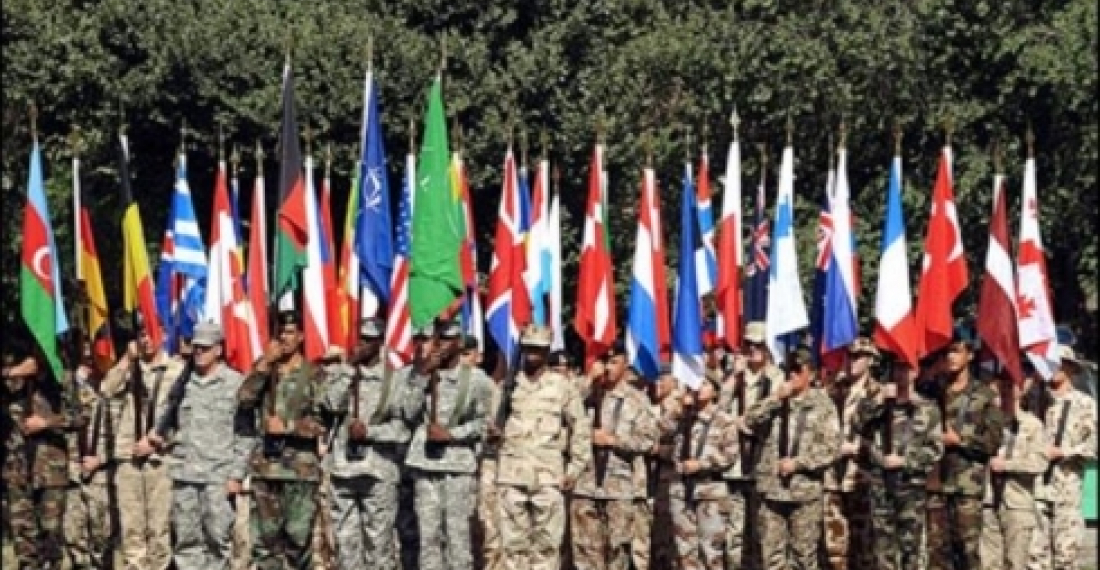
NATO marks 20th anniversary of Partnership for Peace. Armenia, Azerbaijan and Georgia are active members of PfP.

NATO is marking the 20th anniversary of Partnership for Peace (PfP), a program through which it co-operates with a number of countries that are not full members of the alliance.

Armenia, Azerbaijan and Georgia are all active members of PfP. The three countries have also participated in NATO led missions, such as ISAF in Afghanistan. The three countries however have different visions on their future relations with the alliance. Georgia wants to be a full member and has been pushing for a time table for this, both under the previous government of President Saakashvili, and under the new government led by the Georgian Dream coalition. Georgia contributes a large contingent to ISAF and participates in other NATO led operations.Armenia is a member of the Russia led Collective Security Treaty Organisation and as such is not seeking any deeper relations with NATO. It does however participate enthusiastically in PfP programmes and has sent small contingents to NATO operations. Azerbaijan is also an enthusiastic participant of Partnership for Peace, and also participates in peacekeeping missions, but has declared that it is not at the  moment seeking membership of either NATO or CSTO.

PfP was designed as a flexible program that could enable countries with different visions to engage with NATO on practical issues.

In a message, issued in Brussels on Saturday, the NATO Secretary General Anders Fogh Rasmussen said,

"Twenty years ago today, at the Brussels Summit, NATO Heads of State and Government took a far-reaching decision: to create a Partnership for Peace with the countries of the Euro-Atlantic area. Their vision was of a partnership that would reach across borders and ideological divides of the past; a partnership that would build peace and security through consultation, cooperation, and common action based on shared values of democracy, fundamental freedoms and human rights.

Today, we can proudly say that vision has become reality. The Partnership for Peace has successfully contributed to peace and stability in the Euro-Atlantic area. Partners have joined our operations, working alongside NATO Allies to protect security in the Euro-Atlantic area and beyond. Allies and partners join in exercises and training activities every year to promote reforms, build capabilities, and improve our capacity to work together on shared security challenges. Twelve of the original partners from Central, Eastern, and South Eastern Europe have become NATO Allies.

Partnership for Peace will continue to foster peace and stability in the Euro-Atlantic area and help develop NATO's growing network of partnerships. As our Strategic Concept makes clear, cooperative security is one of NATO's core tasks. In September, when we gather for the NATO Summit in Wales, we will mark an Alliance whose partnerships are broader, deeper, and richer than ever before."

source: commonspace.eu

photo: Soldiers from the Nato-led force, Isaf, including from Armenia, Azerbaijan and Georgia, hold flags during a change of command ceremony at their headquarters in Kabul, Afghanistan
Related articles

Editor's choice
News
Borrell tells the European Parliament that the situation in Afghanistan was critical, but the EU will remain engaged

Borrell tells the European Parliament that the situation in Afghanistan was critical, but the EU will remain engaged

Borrell underlined that the European Union will make every effort to support the peace process and to remain a committed partner to the Afghan people. "Of course, we will have to take into account the evolving situation, but disengagement is not an option.  We are clear on that: there is no alternative to a negotiated political settlement, through inclusive peace talks.
Editor's choice
News
Germany accuses Russia of cyberattacks and disinformation campaign

Germany accuses Russia of cyberattacks and disinformation campaign

The German government holds Russia responsible for a cyberattack on German air traffic control, and for targeted disinformation campaigns before the last federal election. According to the German Foreign Office in Berlin, the incidents could be clearly attributed to the Russian military intelligence service, the GRU. In response, the Russian ambassador to Berlin was summoned to the Foreign Ministry. "We have been observing a massive increase in threatening hybrid activities by Russia for some time now," a spokesperson for the Foreign Ministry stated. These range from disinformation campaigns and espionage to cyberattacks and sabotage attempts. The aim is to divide society, sow distrust, and undermine confidence in democratic institutions. The spokesperson added that with these actions, Russia is "very concretely threatening our security, not only through its war of aggression against Ukraine, but also here in Germany."  The Foreign Ministry spokesperson explained that the cyberattack on air traffic control in August 2024 was clearly attributed to the hacker collective "APT28," known as "Fancy Bear," and to the responsibility of the Russian military intelligence service, the GRU. Furthermore, it could now be "conclusively stated" that Russia had attempted "to influence and destabilize both the last Federal election and the ongoing internal affairs of the Federal Republic of Germany." There was "absolutely irrefutable evidence" for this". The so-called "Storm 1516" campaign, which has been running since 2024, is allegedly backed by "reliable information" that the Moscow-based think tank "Center for Geopolitical Expertise" is behind it. The Center is also said to be supported by Russian military intelligence. Its primary aim is to influence democratic elections in the West. (Click the image to read more).

Popular

Editor's choice
News
Germany accuses Russia of cyberattacks and disinformation campaign

Germany accuses Russia of cyberattacks and disinformation campaign

The German government holds Russia responsible for a cyberattack on German air traffic control, and for targeted disinformation campaigns before the last federal election. According to the German Foreign Office in Berlin, the incidents could be clearly attributed to the Russian military intelligence service, the GRU. In response, the Russian ambassador to Berlin was summoned to the Foreign Ministry. "We have been observing a massive increase in threatening hybrid activities by Russia for some time now," a spokesperson for the Foreign Ministry stated. These range from disinformation campaigns and espionage to cyberattacks and sabotage attempts. The aim is to divide society, sow distrust, and undermine confidence in democratic institutions. The spokesperson added that with these actions, Russia is "very concretely threatening our security, not only through its war of aggression against Ukraine, but also here in Germany."  The Foreign Ministry spokesperson explained that the cyberattack on air traffic control in August 2024 was clearly attributed to the hacker collective "APT28," known as "Fancy Bear," and to the responsibility of the Russian military intelligence service, the GRU. Furthermore, it could now be "conclusively stated" that Russia had attempted "to influence and destabilize both the last Federal election and the ongoing internal affairs of the Federal Republic of Germany." There was "absolutely irrefutable evidence" for this". The so-called "Storm 1516" campaign, which has been running since 2024, is allegedly backed by "reliable information" that the Moscow-based think tank "Center for Geopolitical Expertise" is behind it. The Center is also said to be supported by Russian military intelligence. Its primary aim is to influence democratic elections in the West. (Click the image to read more).

