


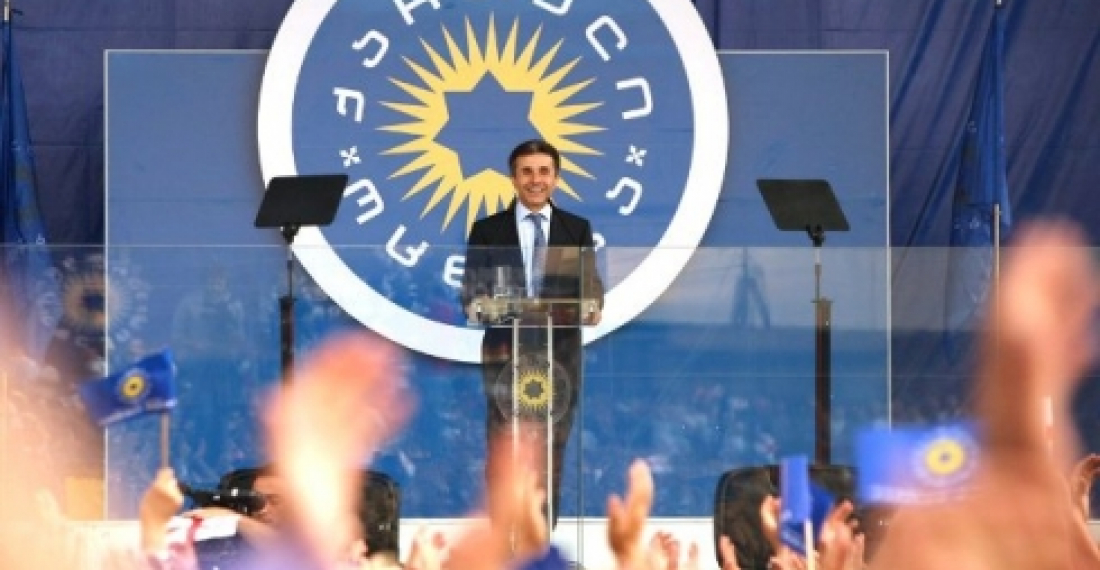
Ivanishvili advocates reconciliation with Ossetians. Ivanishvili told supporters in Gori, "We will find ways to reach out to our Ossetian brothers and sisters."

The leader of the opposition "Georgian Dream" coalition, Bidhzina Ivanishvili has spoken in detail for the first time about his views on Georgia's unresolved conflicts. Addressing thousands of supporters in the town of Gori, which is in close proximity to the South Ossetian conflict zone, Ivanishvili spoke about the August 2008 war, and of the need of reconciliation with the Ossetian people.

"I do not think that Georgia started the war. We have not crossed into the Russian territory, but we cannot shun away from the fact that in response to shelling of the Georgian villages the Georgian authorities launched military actions without calculating possible consequences. No one can be happy about it," Ivanishvili said, adding that authorities acted "shamefully" during the war.

"It is immoral to claim almost a victory in the war, which resulted into occupation of over hundred villages. We should say the truth no matter how bitter it might be," he said.

He also spoke about the need for reconciliation and also about the need to find strength "to admit our own guilt".

"Together we will find strength and we will be able to forgive. We will be able not only to forgive, but also to admit our own guilt and to repent," Ivanishvili said. "We will extend our condolences to Ossetian mothers, we will help them to find their missing children, we will carry out fair investigation, we will correct what is still possible to rectify."

"We will find ways to reach out to our Ossetian brothers and sisters and we will definitely restore relations with them," Ivanishvili said. "We will launch direct dialogue with our Ossetian brothers, we will use public diplomacy, we will find shared interests on which our future relations will be based."

Ivanishvili also criticised the decision of the Georgian government in 2004 to close the Ergneti Market, which had developed as a trading area for Georgians and Ossetians, and promised to restore it on coming to power. He stated: 

“That was the place not only where they [Georgians and Ossetians] were meeting each other, but also a venue for being engaged in joint businesses… At that time Georgians and Ossetians rediscovered that they needed each other,” Ivanishvili said.

“If the authorities cared about the peaceful resolution of the conflict, they would not have closed down Ergneti market so thoughtlessly. Closure of that market was a result of our government’s reckless policy,” he said.

“Only we can rectify that mistake,” he continued. “After coming into power, we will restore Ergneti market legally in frames of the law. We will calculate everything thoroughly and take into consideration all the risks.”

In his speech Ivanishvili also spoke about his foreign policy, and reiterated that Georgia’s pro-Western orientation, EU and NATO integration “is our strategic choice, which has no alternative.”

“But we cannot choose neighbors. Regardless of everything, we will have to normalize relations with Russia. I think that after coming into power we will be able to return Georgian products back to the Russian market. Unlike authorities, which have incorrect and unprincipled policy, our policy towards Russia will be correct, but principled,” he said.

source: commonspace.eu with agencies

photo: Leader of the Opposition Georgian Dream Coalition addressing supporters in the town of Gori, close to the Ossetian conflict zone.

Related articles

Editor's choice
News
Council of Europe launches new International Claims Commission for Ukraine

Council of Europe launches new International Claims Commission for Ukraine

Thirty-four countries and the European Union have signed a new convention establishing an International Claims Commission for Ukraine at a diplomatic conference co-hosted by the 46-nation Council of Europe and the Netherlands in the Hague. The diplomatic conference was attended by leaders and high-level representatives from over 50 states, including the President of Ukraine, Volodymyr Zelenskyy, the President of the Republic of Moldova, Maia Sandu, and the Prime Minister of the Netherlands, Dick Schoof.  “Today marks a major step forward in ensuring accountability for Ukraine. The International Claims Commission represents justice and hope for tens of thousands of victims—our determination that those who have suffered will not be forgotten. I call for quick ratifications so we can get the commission rapidly up and running for the people of Ukraine,” said Council of Europe Secretary General Alain Berset. Ukrainian President Volodymyr Zelenskyy said: “We expect that every mechanism for compensation from the Register of Damage and Claims Commission to the actual payments – will start working and receive strong and sufficient international support, so that people can truly feel that any kind of damage caused by the war can be compensated. This war, and Russia’s responsibility for it, MUST become a clear example – so that others learn not to choose aggression.” “Accountability is about creating the conditions for peace that endures. And therefore, accountability is a condition of security – today and for the future. But accountability is not only about Ukraine. And it is not only about one aggressor and one victim. Accountability is about Europe. About every country in Europe. It is about whether Europe, as a whole, is willing to defend its peace,” said Maia Sandu, President of the Republic of Moldova, which currently holds the Presidency of the Council of Europe’s Committee of Ministers. The Prime Minister of the Netherlands, Dick Schoof, said: “Every day Russia is deliberately bombarding homes, destroying businesses and damaging infrastructure in Ukraine. Russia must compensate Ukraine for the damage caused. That is why we have launched the International Claims Commission for Ukraine and we are honoured to host it.” The International Claims Commission will be the second part of a comprehensive compensation mechanism related to Russia’s war of aggression, building on the existing Register of Damage for Ukraine. The claims commission will be established within the framework of the Council of Europe and will also be open to other countries. The Register of Damage for Ukraine, created in 2023, collects and records compensation claims submitted by individuals, organisations and public bodies in Ukraine. Forty-four states and the European Union have so far joined the Register, which has already received 86,000 claims. The International Claims Commission will review, assess and decide upon claims submitted to the Register of Damage for Ukraine and determine the amount of compensation, if any, which is due in each case. The convention establishing the commission will enter into force once it has been ratified by 25 signatories, as long as sufficient funds have been secured to support its initial work.

Popular

