


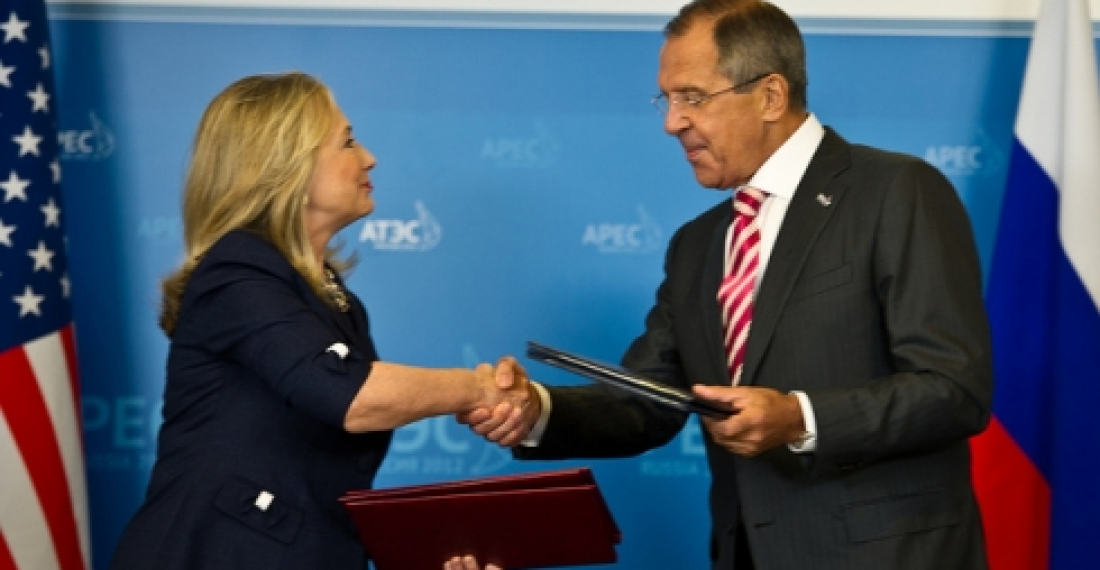
Clinton and Lavrov discuss Karabakh over blini and caviar. A "normal Minsk" with "no expectation of a breakthrough" will take place in New York.

US Secretary of State Hilary Clinton and Russian Foreign Minister Sergei Lavrov discussed Karabakh during a working breakfast in the Russian Pacific Port of Vladivostok on Saturday, ahead of the opening of the Summit of the Asia-Pacific Nations.

According to a spokesperson for the US State Department they discussed a range of international issues over breakfast, which included blini and caviar.

The State Department spokeperson speaking to journalists on the record said that

"they also compared notes briefly on the Nagorno-Karabakh. As you know, we had this incident that we were quite unhappy about where an Azerbaijani who had been incarcerated in Hungary was recently released. And there again, in the context of the UN General Assembly, we generally try, as Minsk Group partners, to do some kind of Nagorno-Karabakh event. So the question becomes whether that makes sense now, whether we can be supportive in calming tensions between Armenia and Azerbaijan."

Asked what were the expectations from such meeting the American official said

"traditionally  the UN General Assembly has been a time when Minsk Group countries have been able to – have pulled together either at the Assistant Secretary level or higher to try to encourage progress, et cetera. The environment is more difficult this year in light of this past incident. So they had a general conversation about trying to stay in touch and see whether we could cool things down and try to improve the environment heading into UNGA since everybody is usually there."

When asked if that 'would be sort of a normal Minsk?", the State department official replied: "Yeah, yeah, yeah. There’s not an expectation of a breakthrough."

source: commonspace.eu with the US State Department

photot: Hilary Clinton and Sergey Lavrov in Vladivostok (picture courtesy of the US State Department)


Related articles

Editor's choice
News
Lula wins fourth term in Brazil, Vucic loses in Serbia

Lula wins fourth term in Brazil, Vucic loses in Serbia

In elections on both sides of the Atlantic, that are likely to have deep implications for their respective regions, one incumbent won, another lost. In Brazil, Latin America's biggest country, left-wing President Lula won a fourth term in office, defeating his right-wing challenger Flávio Bolsonaro. The 80-year-old, took just under 52% of the vote in a run-off on Sunday. Lula thanked cheering supporters in São Paulo and said he had defended Brazil's democracy. His opponent, Flavio Bolsonaro - who won the first round - says the result is "inexplicable" and called for it to be annulled. His father, ex-president Jair Bolsonaro, is currently serving a jail sentence under house arrest for plotting a coup after losing the last election. This election was bitterly fought - and it bucks a wider regional trend towards right-wing leaders. On the other side of the Atlantic, in Serbia, long-standing leader Aleksandar Vučić has admitted defeat to the student-led protest movement in snap parliamentary elections. "We still do not have final results... it is clear that we have lost these elections," the right-wing populist leader said as he conceded late on Sunday. Preliminary figures from Serbia's election commission indicated a record high turnout, which commentators had suggested would favour the student movement. Celebrations erupted after Vučić conceded. Vučić called the snap elections after two years of protests triggered by the collapse of a train station canopy in the city of Novi Sad, which killed 16 and was seen as emblematic of corruption and negligence. Both election results are going to have a deep impact on their respective regions.

Popular

Editor's choice
Interview
Thursday Interview: Murad Muradov

Thursday Interview: Murad Muradov

Today, commonspace.eu starts a new regular weekly series. THURSDAY INTERVIEW, conducted by Lauri Nikulainen, will host  persons who are thinkers, opinion shapers, and implementors in their countries and spheres. We start the series with an interview with Murad Muradov, a leading person in Azerbaijan's think tank community. He is also the first co-chair of the Action Committee for a new Armenian-Azerbaijani Dialogue. Last September he made history by being the first Azerbaijani civil society activist to visit Armenia after the 44 day war, and the start of the peace process. Speaking about this visit Murad Muradov said: "My experience was largely positive. My negative expectations luckily didn’t play out. The discussions were respectful, the panel format bringing together experts from Armenia, Azerbaijan, and Turkey was particularly valuable during the NATO Rose-Roth Seminar in Yerevan, and media coverage, while varied in tone, remained largely constructive. Some media outlets though attempted to represent me as more of a government mouthpiece than an independent expert, which was totally misleading.  Overall, I see these initiatives as important steps in rebuilding trust and normalising professional engagement. The fact that soon a larger Azerbaijani civil society visits to Armenia followed, reinforces the sense that this process is moving in the right direction." (click the image to read the interview in full)

