|
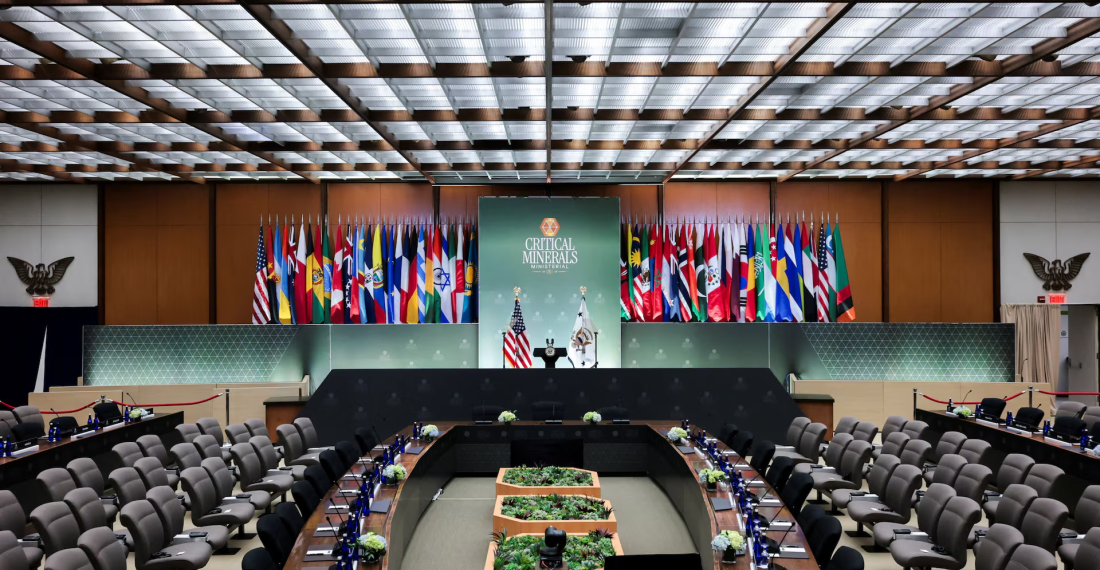
On Wednesday, February 4, the Kyrgyz government, in coordination with the Center for International Private Enterprise (CIPE), kicked off a two-day B5+1 business forum in Bishkek. This meeting was announced back in December and covered in a previous Central Asia Concise newsletter. As a reminder, the B5 + 1 format is supported by the U.S. Department of State and aims to foster relations as well as high-level engagement between government and business leaders to ultimately advance U.S.-Central Asia economic cooperation in the region. The B5+1 serves as the business counterpart to the political level C5+1 format. Crucially, the C5+1 was traditionally held between Central Asian and U.S. foreign ministers but recently took place at the heads of state level at the White House in November 2025. The December Central Asia Concise newsletter noted that the upgrading of the C5 + 1 not just shows increased U.S. interest in the region but may indicate if the U.S. is serious about translating its general policy objectives of increasing economic cooperation with the region to concrete outcomes and collaboration with key regional business stakeholders. Although the 2-day forum has not yet concluded, the unprecedented size and prominence of the U.S. business delegation, including over 50 representatives from major corporations, all but confirms this interest. In parallel, on the same day, the U.S. hosted the inaugural ‘Critical Minerals Ministerial’ summit in Washington, D.C. As the name suggests, the meeting was of a high-level nature and was attended by over 50 countries, including all the G7, and a delegation from the European Union. U.S. Secretary of State Marco Rubio set the tone in his opening remarks, explaining that the “goal is to have a global market that’s secure, a global supply that’s enduring and is available to everyone, every nation, at an affordable price.” The summit, aiming to create a trade bloc to challenge China’s dominance on critical mineral supply and processing, resulted in several proposals to implement price floors and create critical mineral stockpiles. These proposals aside, in practice, the most important measure to loosen China’s grasp on critical minerals is for countries to diversify and look elsewhere to guarantee their security of supply. This fact is not lost on Central Asian countries that possess a substantial share of global reserves. Kazakhstan, which sent Foreign Minister Yermek Kosherbayev to the ministerial, has the world’s largest chromium reserves as well as significant zinc, copper, and bauxite stocks (needed for aluminium and gallium), and stands out as a heavyweight in critical mineral supply. Additionally, Uzbekistan, a global leader in uranium and copper supply, with further reserves in a plethora of other minerals needed for low-carbon technologies, also remains a particularly attractive source of minerals for a trading bloc seeking to diversify from China. Unsurprisingly, they also attended, sending their Foreign Minister, Bakhtiyor Saidov, along with a delegation. Central Asia’s mineral wealth has, of course, not gone unnoticed by other geopolitical players. The European Union’s Global Gateway strategy and Critical Raw Minerals Act explicitly highlight Central Asia’s importance for diversifying away from China. The U.S. is also not addressing the minerals topic with Central Asia for the first time during this week’s ministerial summit, but has already been busy laying the political groundwork, such as launching the C5+1 Critical Minerals Dialogue 2 years ago in February 2024. However, currently, most of Central Asia’s critical raw minerals need to pass through Russia and China for further processing and refining, making any E.U. or U.S. critical mineral efforts in the region more complex than just signing a trade deal, but conditional on either significant investment into the region’s mineral processing capabilities or onboarding processing of minerals within their own countries. Nevertheless, critical mineral processing is an undertaking that comes with inherent risks in terms of greenhouse gas and other environmental issues, creating a potentially politically toxic issue for domestic E.U./ U.S. politicians. Regardless of these barriers in processing capacity, the ‘Critical Minerals Ministerial’ serves as a significant step in the U.S. and its allies’ plans to curb China’s production and market dominance. Interestingly, the historically underdeveloped processing capacities and industrial bottlenecks in Central Asia, coupled with the fact that most of the region’s geological data comes from legacy surveys conducted in the Soviet era, could mean that Central Asian countries are still below their true potential as critical mineral exporters. Given that the region can find the right trade deals and robust foreign investment, Central Asian countries may be able to increase their mining outputs and, crucially, upscale their processing capacities to move away from exporting ores and other raw materials to Russia and China for refinement, but control the entire means of production themselves. In this regard, it is important to keep an eye on both the conclusions on the political level, while observing the concrete actions from industrial players and if they align with those directives. Therefore, the results of the B5+1 meeting, and more importantly, any industry moves or foreign investments made in its wake, can be a key indicator of how well the lofty goals of the ‘Critical Minerals Ministerial’ to diversify their supply translate to the Central Asian region. Intensifying Russian rhetoric In much less positive news for the region, tensions with Russia have flared up in the wake of several provocative comments made on Russian television. Specifically, the latest incident comes from Vladimir Solovyov, Russia’s most inflammatory and egregious propagandist, who reignited tensions by agreeing with a guest analyst on his show ‘Evening with Vladimir Solovyov’ who bitterly described Central Asian countries as being ‘spoiled’ by Russia and living at their expense. The clip quickly spread across social media in Central Asia, causing indignation and reactions that describe the rhetoric as infantilising, arrogant, and of a dangerous imperial nature. This is not the first of these comments by Solovyov. In January, the television host suggested that Russia could conduct ‘special military operations’ in Central Asia and Armenia because the regions are of great national importance to Russia and described them as “our Asia”, a rightful part of Russia’s sphere of influence. He justified his remarks by claiming that international law and the international order are no longer relevant, possibly referring to recent U.S. actions in Venezuela as evidence that the world has become more permissive for powers to pursue aggressive expansion in breach of territorial integrity and national sovereignty. Solovyov, although being the most prominent voice, is not the only one, with Russian propagandist and far-right philosopher Aleksandr Dugin having also publicly dismissed Central Asian states’ sovereignty this January as well as a video circulating on social media of Russian State Duma deputy Nikolai Valuev calling for Russia to shift from a “carrots” to a “sticks” approach to Central Asia, although Valuev was quick to dismiss the video as an AI deepfake. It is important not see these comments in isolation. As detailed in last week’s newsletter, overall hostility towards Central Asian labour migrants has significantly increased, with the death of an Uzbek labour migrant at the hands of Russian law enforcement sparking outrage in Uzbekistan. Additionally, Uzbek national Ahmadjon Kurbanov was sentenced to life in prison 2 weeks ago for the assassination of key Russian General Igor Kirillov in 2024, which the Ukrainian Security Service (SBU) claimed responsibility for. The trial was conducted behind closed doors, with the main evidence resulting from an interrogation where Kurbanov admitted to being recruited by the SBU. The opaque nature of the trial, as well as the fact that the other defendants are of Ingush and Azerbaijani origin continue to contribute to the picture of ethnic minorities being continuously scapegoated within the Russian Federation. An underreported development last month, but a contextually important one, was Kazakhstan’s Mazhilis (lower house of parliament) accepting two draft laws regulating the activities of the Collective Security Treaty Organization (CSTO). According to Mazhilis deputy Aigul Kuspan. The first law ratifies the amendments to the Agreement on the Status of Forces and Assets of the CSTO Collective Security System that expand the grounds for sending formations to the territory of the participating member states, including crisis prevention, humanitarian assistance and surprise inspections, whereas the second law looks to improve the legal framework for military transportation. Considering the increasingly hostile rhetoric from Russia, the accepted draft laws should certainly raise questions in Kazakhstan’s parliament as well as civil society. Vladimir Solovyov does not speak for the Russian state, but his shows have a clear track record of often floating narratives, talking points, and rhetoric that later become Kremlin policy, most famously framing Ukraine’s government as a corrupt ‘nazi’ infested regime oppressing its people. Overall, for Central Asian countries, which are still dependent on Russia in numerous ways, their response to this rhetoric, but more importantly, any forging of new economic ties, on critical raw minerals, for example, will be important to redefining their relationship with this historically imperial neighbour. |
|
|
|
Source: This Briefing was prepared by the editorial team of Commonspace.eu and first published on Central Asia Concise on 5 February 2026 |
Commentary
B5+1 in Bishkek and critical minerals in Washington