In this op-ed Dennis Sammut reflects on lessons that need to be learnt from how the conflict over South Ossetia spiralled into a short but bitter war between Georgia and Russia in 2008. Based on two decades of personal engagement with the issues surrounding the conflict he argues that the war left everybody a loser, and warns that a similar scenario now exists in the conflict between Armenia and Azerbaijan over Nagorno-Karabakh.
Five years is not a long time, but it is enough for the dust to have settled from the short but bitter war fought between Russia and Georgia in August 2008. Many have written about who fired the first shot, and of all the subsequent actions and reactions, and the high price paid by thousands of civilians caught in the middle. No one comes out of this part of the story with great honour. The pain of the suffering of civilians in Tskhinvali, Gori, the Georgian villages in South Ossetia and in other parts of the region as two Council of Europe members fought each other in the first decade of the 21st century shames both of them, and shames all Europeans.
The background
 When I arrived in Georgia on my first visit in March 1992 South Ossetia was very much in discussion, despite the fact that the rest of the country was in total collapse. Edward Shevardnadze had just returned from Moscow to head the State Council. Stabilising the situation in South Ossetia, a region of Georgia that in Soviet times had the status of an autonomous region, and where a conflict provoked by nationalist extremists on both sides had been ongoing, was a priority. An arrangement of a sort, involving Russia and Georgia, North and South Ossetia came into being. The region was at that time too far away, politically as much as geographically, for Europe and others to be involved directly, but the CSCE, the precursor of the OSCE, established a Mission to give the agreement international blessing, and to keep an eye on things. Its mandate grew over the years and it became an essential part of the peace-making mechanism.
From 1992 to 2003 several processes emerged and all gave hope that this problem could be resolved peacefully. First, there were the four-sides discussions (Georgia-Russia-North Ossetia -South Ossetia) established by the 1992 agreement. The OSCE joined the process and became an important part of it soon after. This was important for Georgia for it internationalised the process and balanced somehow the Russian presence. After 1998 the European Union started getting involved - initially with humanitarian and post-conflict rehabilitation assistance, but eventually with a seat at the negotiating table, even though its role was somehow semi-detached. Until 1999 the personalities of Yeltsin and Shevardnadze overshadowed the process. Both wanted the problem solved if possible, but understood the virtue of patience, and were willing to focus on normalising the situation first and postpone the political solutions till later. The roadblocks and checkpoints of the early 1990s were dismantled, and by the end of the millennium, you could drive from Tbilisi to Tskhinvali and back as easily as to any other part of Georgia.
Civil society had played an important role in this process, offering some alternative frameworks for contacts and discussions. Today some dismiss this as waste of time but at the time they were extremely important. Because they were mainly western driven the Russians did not like them at all, and tried in different ways to make obstacles. In July 1995 I was involved in the first attempts, through a project supported by the EU, to set up a Track 2 dialogue between the Georgians and the Ossetians. The Georgians (or at least some of them) were keen, the Ossetians cautious but interested. After dozens of visits to Tskhinvali, a few first steps were taken. An Ossetian delegation, led by Dimitri Medoev, currently South Ossetia's Ambassador to Moscow and then holding the title of Minister of Foreign Affairs, came to Batumi for a conference we were organising. Also, there was Zurab Zhvania who later was to become Chairman of Parliament and eventually Prime Minister, until his untimely death in 2005. I sat with Medoev and Zhvania for an informal conversation which lasted several hours. From this meeting an informal but sustained process developed which enabled South Ossetian and Georgian politicians and civil society activists to meet often - in Tskhinvali, Vladikafkaz, Batumi, and eventually (although the Ossetians needed some persuasion on this), in Tbilisi. The process lasted for five years. The Norwegian Refugees Council, with Harvard University, had a complimentary process; somewhat more structured and ambitious. Its meetings were held mostly in the United States. It then became a habit for the rotating Chairmanships of the OSCE to host an annual meeting for Georgians and Ossetians in their respective capitals. What started as a well-intentioned initiative quickly degenerated into an annual outing for a few officials of the two sides to exotic European destinations.
This formal and informal political dialogue was essential to reduce tensions. People-to-people contacts became very frequent. This also had its complications. South Ossetia was outside the jurisdiction of the central government of Georgia since it had declared itself de facto independent, although nobody recognised this at the time. It became something of a black hole, between Russia and Georgia, and smuggling through this twilight zone flourished. The market in Ergneti became a great meeting point between Georgians and Ossetians who seemed not to care less about the political issues, but this was also causing economic problems for Georgia.
The new Georgian government of President Saakashvili, after the November 2003 collapse of the Shevardnadze administration, was eager, energetic and impatient. It wanted results quickly and South Ossetia seemed the place to achieve it. This was evident for everybody to see.
Things however had changed in Russia too. In 1999 Vladimir Putin became first Prime Minister and then President. The laisez faire times in domestic and foreign policy of the Yeltsin years were over. Chechnya was reined in, and Russian policy in its immediate neighbourhood became increasingly more assertive. Even in the best moments of Yeltsin, there were those in the Kremlin who saw virtue in keeping the status quo and not allow Georgia to regain the regions that had seceded. And on the Georgian side, Shevardnadze had the habit of surrounding himself with idiotic advisors who missed many opportunities to take the peace process forward. But at least, whilst the two old presidents were there, problems were kept within bounds.
Around this time political changes also occurred in both North Ossetia and South Ossetia. The South Ossetian leader Ludwig Chibirov and the North Ossetian President Dzasokov wanted relations with Georgia normalised. I always felt that given the right moment and under the right conditions they would have been ready to accept a creative compromise. Those who succeeded them were less interested in a solution and supporters of the harder Putin line. From 2004 onwards the situation degenerated into a spiral of hostile rhetoric, political provocations and violent incidents. By 2008 all the conditions for violent conflict were in place, and evident for everybody to see. Talk among the chattering classes in 2008 was not if war would happen but whether it would be in Abkhazia or South Ossetia. The sequence of events in August 2008 has been well documented and reported. Indeed since it all took place under intense media scrutiny no degree of spinning by either side can change the facts as they were well recorded. The cost of human suffering was appalling.
Learning the lessons of 2008.
There are three important questions that need to be asked, not to justify anyone's actions in the past, or to attribute blame, but to avoid repetitions in the future, in the hope that another war in the Caucasus, be it in Georgia or elsewhere, can be avoided:
(1) Could war have been avoided?
(2) Where there winners and losers?
(3) Is there a prospect that these conflicts can be resolved in the future, or indeed is another war in the Caucasus inevitable sooner or later?
The war could have been avoided if the spiral of violence around Georgia's secessionist regions that intensified after 2004 and the warmongering on all sides could have been stopped. In fact, after 2004 political dialogue never looked as if it had a chance and civil society initiatives were dismissed as irrelevant or worse by both the Georgians and the Ossetians; both sides were set on a collision course. The Georgians wanted a quick fix, and South Ossetia seemed to be the place to achieve it even if this was a clear case of misperception. The Russians had obligations as mediators in the conflict and as peacekeepers. They allowed themselves to be perceived as biased against the Georgian position, and by insisting on maintaining the status quo they in fact became part of the problem. The international community got complacent. They had got used to the seasonality of conflict - a bit of shooting, a few dead, as the summer temperatures rose, but everything calms down by the autumn. There is a persuasive case to argue that the OSCE took its eye off the ball at just the wrong moment. There was an air of inertia in the Mission in Tbilisi when high alert would have been more appropriate. However, world capitals could have done more too. What President Sarkozy did once the shooting started he, or somebody of a similar stature in Europe or the US, should have done before. Those who see a very similar pattern emerging around the Nagorno-Karabakh conflict are of course correct.
A war of many losers
Once the shooting started where there were neither winners nor losers. Even if one puts aside the human suffering that affected all sides, despite some short-term jubilations by some, the conflict has left everybody a loser, and indeed in a more difficult position than before. The Georgians are perceived to have lost the war. Their claims to Abkhazia and South Ossetia are now further away from the reality on the ground than ever; in 2008 they lost territory in Akhalgori and Kodori since the Russians failed to honour their promise to return to the status quo ante, and they now have to face the reality that Abkhazia and South Ossetia are recognised by Russia, and a handful of other countries, as independent states.
However, the Russians are losers too. Despite all of Putin's bravados, their position in the South Caucasus is weaker today than it has ever been since Tsarist times. Georgia has left the CIS and has broken off diplomatic relations. Even with improved relations, after the election of the Ivanishvili government last year, normalisation is clearly limited to some areas only. Russia now has to subsidize two protectorates in the South Caucasus that are completely dependent on it financially and economically, militarily and diplomatically. They are also finding that small is not necessarily beautiful. The political crisis around the presidential election in South Ossetia in 2011 left the Russians with egg on their face. Its recognition of Abkhazia and South Ossetia, thus altering the borders that had existed in the USSR, has created serious disquiet in a number of CIS countries. Russia\'s failure to secure the recognition of the two entities beyond a handful has exposed how Russia's influence as a global power has declined.
Neither are the Ossetians and the Abkhaz outright winners. They say they feel more secure now, but this security is not based on international legitimacy, but on a line of Russian troops. The conflicts remain an open wound and unless healed can again become deadly unexpectedly. Beyond that, the sustainability of both Abkhazia and South Ossetia depends to a certain extent on good relations with Georgia. In the case of South Ossetia, this is even more so. It is possible to argue that there are even smaller countries in the world than South Ossetia, but there are very few whose geography makes them so completely dependent on their neighbours, as South Ossetia is on Georgia. This geographic reality is a much more powerful factor than any act of diplomacy can ever be. Both Abkhazia and South Ossetia need closure in their dispute with Georgia. The war has not given them that; it just changed the configuration of the conflict.
To break the impasse grand gestures are needed.
Finally, is there a prospect for a comprehensive and peaceful solution, or is another war inevitable? There is, it is true, at the moment no appetite for another war in the Georgian context. This gives a breathing space during which a solution should be sought. It is doable.
As already mentioned no one emerged from 2008 as a clear winner. The Russians by recognising Abkhazia and South Ossetia may have made a big strategic mistake that has greatly narrowed their manoeuvrability. The Georgians should not glee at this Russian discomfort. They need to use it creatively. There are few signs that the government of Ivanishvili has any strategy in this regard. The statements coming out of Tbilisi remain vague and Georgian officials seem to lack creative thinking and are often taking refuge in repeating the clichés of the past. It is not solely their fault. If the world expects grand gestures from the Georgians, as indeed from the Russians, it must create the right choreography. The Geneva process should prepare for this - it is not however the setting from where grand gestures can be expected.
In the rest of the region the scenario leading up to 2008 is repeating itself in the conflict around Nagorno-Karabakh: same spiral of violence and hostile rhetoric; same belief that violence can provide quick fixes; same adherence to an unsustainable status quo; and a peace process that plods along whilst looking increasingly distinctly tired and irrelevant. Unblocking the impasse in both the Georgian and the Armenian-Azerbaijani scenarios needs a concerted effort.
Let's hope that the shame of allowing August 2008 to happen will trigger the will to do everything to avoid a repetition.
Dennis Sammut has written extensively on the Caucasus Region and has over the last two decades been part of a number of initiatives supporting the resolution of the conflicts in the regions. He contributed this article for CommonspaceEXTRA
(c) Commonspace.eu
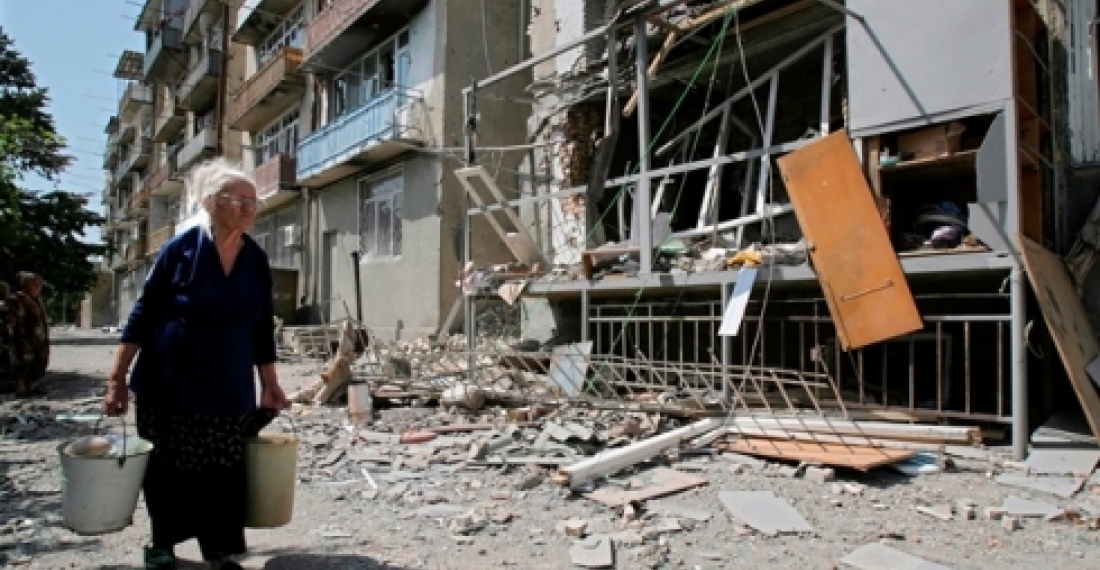
photo: A woman carries water through the rubble of a bombed building in the South Ossetian capital Tskhinvali during the August 2008 war. (picture courtesy of EPA)
Related articles on commonspace.eu
Interview with Dimitri Medoev, South Ossetia's envoy in Moscow (published on 7 August 2013)
Never Again! Ten questions about the August 2008 Georgia-Russia War (published on 6 August 2013)
Russia builds an artificial fence in the heart of the Caucasus (published 5 August 2013)