


Aliev and Sargsyan speak on NK ahead of St Petersburg meeting with Putin

President Ilham Aliev of Azerbaijan and president Serzh Sargsyan of Armenia have both spoken about the current state of negotiations on the Nagorno-Karabakh conflict ahead of their meeting on Monday in St Petersburg with Russian President Vladimir Putin

APA news agency reports from Baku that President Aliev addressed the issue whilst speaking at an Iftar ceremony marking the Holy Muslim month of Ramadan hosted by the Chairman of the Board of Caucasus Muslims Sheikh-ul-Islam Allahshukur Pashazade on Friday, (17 June). Aliev refereed to the fighting that took place in the Nagorno-Karabakh conflict zone in April and said that it was "a signal to the mediators and to the world community that it is not a frozen conflict". The Azerbaijani president added, "if someone believes that we will continue to negotiate meaninglessly in the next twenty years, he is mistaken. We do not intend to conduct negotiations meaninglessly. We will not negotiate for the sake of imitation. We expect immediately and unconditionally to begin meaningful and substantive talks. In this case, can expect a peaceful solution to the issue". 

President Aliev said that in May there was a meeting in Vienna and that this will be followed up next week in Saint Petersburg. "We hope that this issue can and must find a solution through peaceful means. To achieve this, Armenia should abandon its aggressive policy and liberate our lands", the President said.

In the meantime the Armenian newspaper Hraparak, quoted by news.am, reported that Armenian president Serzh Sargsyan spoke about the St Petersburg meeting when addressing members of his ruling Republican Party last week.  The newspaper said that president Sargsyan described the St Petersburg meeting as "a continuation of the Vienna meeting" that will focus on discussions about the implementation of what has been agreed in Vienna.  The President said that under discussion shall be the matter of installation of an investigative mechanism in the Nagorno-Karabakh conflict zone.  Hraparak quoted president Sargsyan as saying, "The ball is in Azerbaijan's court," adding that no document will be signed in Saint Petersburg, [and that] the negotiations will be reset, so that next time they would move forward from that point.

In the meantime it is as yet unclear what role if any will the OSCE Minsk Group co-Chair have in the St Petersburg meeting. Earlier media reports in Russia and Azerbaijan, based on a news story disseminated by the Russian News Agency TASS, suggested that the OSCE will have no role in the meeting. However later, Natacha Rajakovic, Acting spokesperson of the OSCE in Vienna wrote on the commonspace.eu facebook page that her comments to the Tass News Agency had been misrepresented. "I NEVER said that the OSCE will not participate in the meeting. I said to Mr. Konstantin Pribytkov of TASS that I could not give him information about the date or modalities of the meeting, or comment on it, as the OSCE is not organizing it. That is all I said, not one word more".

Commonspace.eu political editor said in a comment:

"One should not have high expectations from the St Petersburg meeting. The Russian side is trying to maintain the initiative, and to continue playing the game that it has played around the Karabakh conflict for twenty-five years. On the one hand it projects itself as a partner of the international community and working in harmony with the other two co-Chair of the Minsk Group - France and the United States. On the other hand Russia has consistently maintained a strategy of separate diplomatic initiatives quite distinct and quite detached from the Minsk process. Some analysts consider that this Russian ambiguity has been one of the reasons why the work of the Minsk Process has so far failed to yield any results. This week in St Petersburg Russian president Putin will once more project himself as a peacemaker. But people in both Armenia and Azerbaijan know full well that it is Russia that has fuelled the conflict by flooding the region with the latest military equipment.

It is also clear from their comments ahead of the summit that president Aliev and president Sargsyan are going to St Petersburg with very different expectations. The Russians will have to come up with some rather ingenious wording if they are to get the sides to agree to any common statement at the end of the talks. However, notwithstanding all this, it is a positive step that the presidents continue to meet and continue to reaffirm their support for a peaceful solution to the conflict."

Source: commonspace.eu with APA and news.am

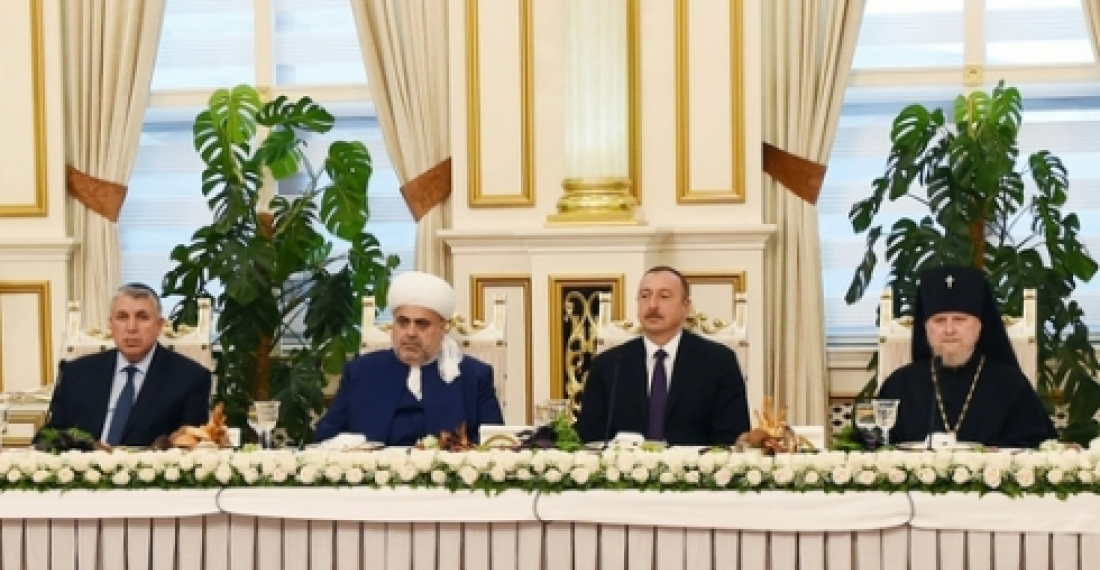
Photo: President Aliev of Azerbaijan flanked by leaders of the Muslim, jewish and Christian communities of Azerbaijan at an Iftar ceremony held on 17 June 2016. (Picture courtesy of the press service of the President of Azerbaijan.)


Related articles

Editor's choice
News
UAE says it will withdraw from Yemen, but division emerges in Yemeni presidential council

UAE says it will withdraw from Yemen, but division emerges in Yemeni presidential council

In a move seen as an attempt to de-escalate a crises with Saudi Arabia, the United Arab Emirates, on Tuesday (30th December) announced that it was heeding a call to withdraw its troops from Southern Yemen. UAE says that its presence included counter-terrorism teams that were crucial in fighting against Islamist groups. UAE sources said that parts of Yemen not controlled by the Houthis have had Al Qaeda in the Arab Peninsula (AQAP) operatives using the territory to launch attacks on Europe, the US and Middle East. UAE teams have co-ordinated with American and British special forces and intelligence. The sources added that Emirati forces and their Yemeni allies also helped reverse Houthi gains in the south. including the liberation of Aden port. The small UAE contingent has remained in place since the UAE withdrew most of its military personnel in 2019. The leading English-language newspaper in Abu Dhabi, The National, said that the main UAE force was based at Riyan Mukalla International Airport, with access to fixed-wing aircraft and helicopters, but also operated smaller contingents in the port town Balhaf and Shabwa. "It is understood it also flew a number of drones from the airbase that were able to track terrorist movements, pass information back to its allies and assisted special forces' missions." Meanwhile a division has emerged in Yemen's presidential council after four members denounced what they called the 'unilateral decisions' by the chairman. Four of Yemen’s eight Presidential Leadership Council members on Tuesday denounced an announcement by the council’s chairman accusing him of breaching the governing agreement. Tension between Yemeni leaders has been rising for weeks, underscoring the fragility of the country's already fractured political landscape and further complicating efforts to confront the Iran-backed Houthi rebels. The latest rift took an unprecedented turn on Tuesday morning, marked by a Saudi-led coalition “limited operation” striking combat vehicles Riyadh linked to the Southern Transitional Council, which has three members in the PLC. The PLC Chairman, Rashad al Alimi, on Tuesday said that he was seeking to cancel the joint defence agreement with the UAE. “What has been issued … constitutes a clear violation of the Declaration of the Transfer of Power [agreement], which explicitly stipulates that the Presidential Leadership Council is a collective body whose decisions are taken by consensus, or by majority when consensus is not possible,” the statement by the four members said. “It does not, under any circumstances, allow for unilateral decision-making on sovereign, military, or major political matters." The statement was signed by STC chief Aidarous Al Zubaidi, Faraj Al Bahsani, Tariq Saleh and Abu Zaraa al Muharrami. (click the picture to read the full article).

Popular

Editor's choice
News
UAE says it will withdraw from Yemen, but division emerges in Yemeni presidential council

UAE says it will withdraw from Yemen, but division emerges in Yemeni presidential council

In a move seen as an attempt to de-escalate a crises with Saudi Arabia, the United Arab Emirates, on Tuesday (30th December) announced that it was heeding a call to withdraw its troops from Southern Yemen. UAE says that its presence included counter-terrorism teams that were crucial in fighting against Islamist groups. UAE sources said that parts of Yemen not controlled by the Houthis have had Al Qaeda in the Arab Peninsula (AQAP) operatives using the territory to launch attacks on Europe, the US and Middle East. UAE teams have co-ordinated with American and British special forces and intelligence. The sources added that Emirati forces and their Yemeni allies also helped reverse Houthi gains in the south. including the liberation of Aden port. The small UAE contingent has remained in place since the UAE withdrew most of its military personnel in 2019. The leading English-language newspaper in Abu Dhabi, The National, said that the main UAE force was based at Riyan Mukalla International Airport, with access to fixed-wing aircraft and helicopters, but also operated smaller contingents in the port town Balhaf and Shabwa. "It is understood it also flew a number of drones from the airbase that were able to track terrorist movements, pass information back to its allies and assisted special forces' missions." Meanwhile a division has emerged in Yemen's presidential council after four members denounced what they called the 'unilateral decisions' by the chairman. Four of Yemen’s eight Presidential Leadership Council members on Tuesday denounced an announcement by the council’s chairman accusing him of breaching the governing agreement. Tension between Yemeni leaders has been rising for weeks, underscoring the fragility of the country's already fractured political landscape and further complicating efforts to confront the Iran-backed Houthi rebels. The latest rift took an unprecedented turn on Tuesday morning, marked by a Saudi-led coalition “limited operation” striking combat vehicles Riyadh linked to the Southern Transitional Council, which has three members in the PLC. The PLC Chairman, Rashad al Alimi, on Tuesday said that he was seeking to cancel the joint defence agreement with the UAE. “What has been issued … constitutes a clear violation of the Declaration of the Transfer of Power [agreement], which explicitly stipulates that the Presidential Leadership Council is a collective body whose decisions are taken by consensus, or by majority when consensus is not possible,” the statement by the four members said. “It does not, under any circumstances, allow for unilateral decision-making on sovereign, military, or major political matters." The statement was signed by STC chief Aidarous Al Zubaidi, Faraj Al Bahsani, Tariq Saleh and Abu Zaraa al Muharrami. (click the picture to read the full article).

