


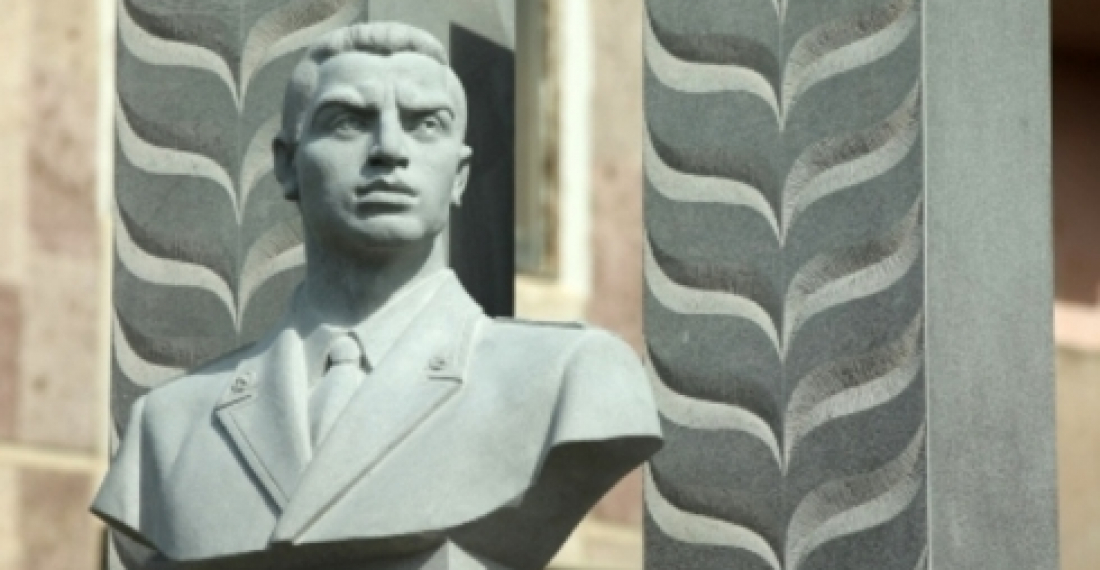
A tragedy remembered. Budapest marked low point in troubled relations between Armenia and Azerbaijan, and remains a highly sensitive issue.

A monument to Gurgen Margaryan, an Armenian officer killed by an Azerbaijani officer, Ramil Safarov, while both were on a NATO training course in Budapest in 2004, was unveiled in Yerevan on Saturday.

The inauguration of the monument coincided with the birthday of the Armenian officer who would have turned 35 on September 26. Margaryan's mother and British parliamentarian, Baroness Cox inaugurated the monument.

News.am reported that the ceremony was attended by representatives of the Defence Ministry, students of a school bearing Gurgen Margaryan's name, public figures and representatives of diplomatic missions

In her address, Lady Cox said she, being a mother, shares the feelings of the Margaryan family. She talked about how she was shocked by the reports of the murder of a sleeping man, and later when Ramil Safarov was pardoned in Azerbaijan after his extradition from Hungary.

Comnmonspace.eu political editor said that "the Budapest tragedy marked a low point in the troubled relations between Armenia and Azerbaijan, and remains a highly sensitive issue in different ways in both countries.The unveiling of the monument will bring some closure to the family of the deceased. In time both societies will need to examine the incident and the conditions that caused it and other tragedies over the last twenty five years. When the dust of battle settles a healing process is going to be necessary before both societies can return to normality. The unveiling of the monument to Margaryan helps to remind everybody of how much work needs to be done."

source: commonspace.eu with news.am
photo: Monument toGurgen Margaryan unveiled in Yerevan on 28 September 2013 (picture courtesy of news.am).
Related articles

Editor's choice
News
"Peace Bridge" between Armenia and Azerbaijan takes next step

"Peace Bridge" between Armenia and Azerbaijan takes next step

From 10 to 12 April 2026, within the framework of the “Peace Bridge” Initiative, another bilateral roundtable with the participation of representatives of Azerbaijani and Armenian civil society is taking place, this time in Azerbaijan. "Peace Bridge" was launched in November 2025 with the support of the governments of Armenia and Azerbaijan, to foster dialogue and direct engagement between civil society representatives from Azerbaijan and Armenia. On Friday, 10 April, an Armenian group arrived in Azerbaijan via the land border, crossing through a formally delimited and demarcated section and undergoing all relevant border and passport control procedures.  According to the website of the Armenian public broadcaster, 1lurer.am, this weekend's meeting  includes discussions on the current state of the peace process; the activities undertaken by participants in the “Peace Bridge” Initiative in their respective countries and the results of those efforts; as well as the situation in the region. The meeting agenda also includes separate sessions devoted to efforts to advance peace at the societal level and to increase trust during the next stages of the peace process. (click picture to read the news item in full)

Popular

Editor's choice
Interview
Thursday Interview: Murad Muradov

Thursday Interview: Murad Muradov

Today, commonspace.eu starts a new regular weekly series. THURSDAY INTERVIEW, conducted by Lauri Nikulainen, will host  persons who are thinkers, opinion shapers, and implementors in their countries and spheres. We start the series with an interview with Murad Muradov, a leading person in Azerbaijan's think tank community. He is also the first co-chair of the Action Committee for a new Armenian-Azerbaijani Dialogue. Last September he made history by being the first Azerbaijani civil society activist to visit Armenia after the 44 day war, and the start of the peace process. Speaking about this visit Murad Muradov said: "My experience was largely positive. My negative expectations luckily didn’t play out. The discussions were respectful, the panel format bringing together experts from Armenia, Azerbaijan, and Turkey was particularly valuable during the NATO Rose-Roth Seminar in Yerevan, and media coverage, while varied in tone, remained largely constructive. Some media outlets though attempted to represent me as more of a government mouthpiece than an independent expert, which was totally misleading.  Overall, I see these initiatives as important steps in rebuilding trust and normalising professional engagement. The fact that soon a larger Azerbaijani civil society visits to Armenia followed, reinforces the sense that this process is moving in the right direction." (click the image to read the interview in full)

