


Trending
Armenia and Kazakhstan move to lessen their dependency on Russia
27 September 2026
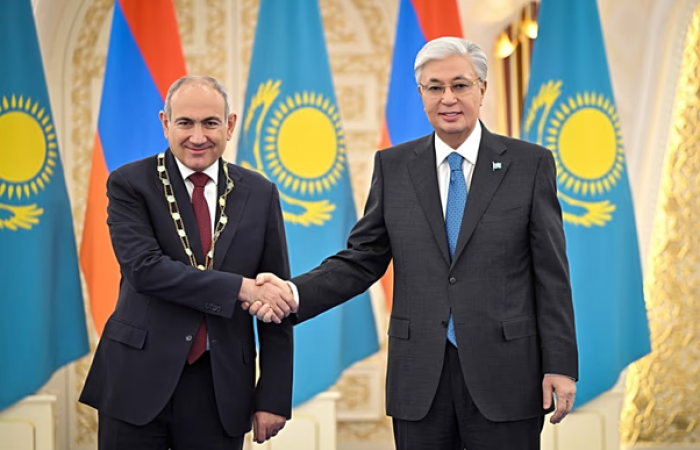
In this analysis for commonspace.eu, Anna Szedlacsek argues that Kazakhstan and Armenia, two countries that Russia had considered in its sphere of influence, appear increasingly eager to ensure that Moscow is no longer their only option.
Armenia and Kazakhstan both reached their strategic turning points between 2020 and 2022, driven by security failures, Russia's invasion of Ukraine, and severe economic vulnerabilities.
Among these reasons, the war in Ukraine sheds a particularly long shadow. In Kazakhstan, Russia’s “special military operation” substantially damaged Moscow's image among ordinary Kazakh citizens and reignited anxieties about revanchist Russian rhetoric regarding northern Kazakhstan. Almaty is heavily challenged by having to navigate its deep economic and transit interdependence with Russia. Kazakhstan is aggressively developing alternative transport links, such as the Trans-Caspian International Transport Route (Middle Corridor) through Baku, Azerbaijan, to reach European and global markets without crossing Russian territory. This also reflects a move away from Russia as its main trading partner – this position has been earned by China, or, if considered as a bloc, the European Union (EU).
Armenia, on the other hand, began its pivot away from Moscow’s orbit after the 2020 Second Nagorno-Karabakh War and reached a point of no return following Azerbaijan's final capture of Nagorno-Karabakh in September 2023. This is due to the fact that despite hosting a Russian military base and belonging to the CSTO, Armenia received no military assistance from Russia during either of these conflicts. Moscow remained neutral – and thus turned untrustworthy in the eyes of Armenians – because it wished to safeguard its expanding economic, energy, and transit partnerships with Azerbaijan and Turkey. The Armenian parliament also passed a law to initiate the EU accession process, while ministries are recruiting Western-educated professionals to restructure the civil service away from the Kremlin.
The question, is not simply whether Russia is losing its allies. It is whether Russia is losing its ability to make those allies dependent on it.
As of September 2026, the evidence does not point to a definitive answer. Russia has not been pushed out of either country – but both Kazakhstan and Armenia appear increasingly eager to ensure that Moscow is no longer their only option. (click the image to read the analysis in full)
