Theme

Conflict and Peace

Stories related to violent conflicts, diplomatic tensions, and conflict prevention, mediation and resolution.

Editor's choice
Young voices
Opinion: The children of Sudan that the world forgot to see

Opinion: The children of Sudan that the world forgot to see

Sudan’s latest war began in April 2023, though the seeds of its violence were planted long before. The Sudanese Armed Forces and the Rapid Support Forces did not collide out of nowhere; they emerged from decades of political rot, unaddressed grievances, ethnic persecution, and military rule that carved deep fractures into the country’s social fabric. When fighting exploded across Khartoum and later consumed Darfur, Kordofan, and the east, it unleashed one of the worst humanitarian catastrophes of the 21st century. In this op-ed, Ioana-Maria Ungureanu, Junior Research Assistant at LINKS Europe, takes a heartfelt look at the plight of Sudan, and its children. When the latest war started, whole cities emptied. Markets burned. Families fled on foot. And a famine began tightening its grip, slow and suffocating. And yet, the world remained mostly silent. Sudanese death is too often framed as an unfortunate feature of the region, a tragedy that feels expected rather than outrageous. Even when evidence of atrocity is abundant, it fails to command the same emotional weight. Sudan should not have to beg for visibility. It deserves it. Because its people deserve to live. And their lives deserve the same respect, safety, and hope that we demand for our own. (read the op-ed in full by clicking the image above)
Editor's choice
News
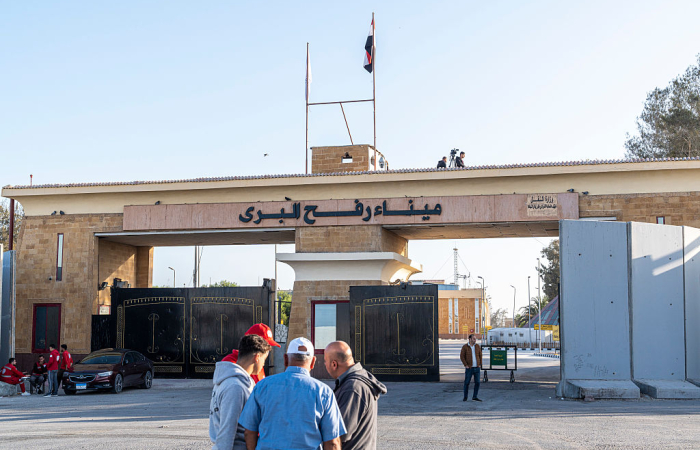
Egypt rejects Israeli "offer" for an exit only Rafah checkpoint in Gaza

Egypt rejects Israeli "offer" for an exit only Rafah checkpoint in Gaza

Egypt has rejected an Israeli "offer" for opening for exit only the Rafah checkpoint in Gaza. According to the Egyptian State Information Service, Egyptian authorities refuted on Wednesday afternoon reports that Israel claims it will open the Rafah crossing, the only lifeline for Gaza to the outside world, but only for those wishing to leave the besieged coastal enclave.  Citing an Egyptian official, the service stated that ''any agreement to open the crossing will cover both entry and exit, in line with US President Donald Trump's plan for humanitarian and political arrangements following the ceasefire.'' Cairo reaffirmed its adherence to the plan and UN Security Council Resolution 2803, including the right of return for Palestinians and maintaining two-way operations at the crossing. Earlier in the day, Israel's Coordinator of Government Activities in the Territories (COGAT) announced that the Rafah crossing would reopen ''within the next few days,'' marking the first such move since February 2025. According to the statement, departures would require prior Israeli security approval and would follow mechanisms previously implemented under EU supervision. Notably, the statement made no mention of the entry of humanitarian aid, which continues to flow through the Kerem Shalom crossing. A Palestinian official also echoed the Egyptian denial of Israel's claim. The announced agreements stress that no Palestinians will be forced to leave Gaza. Those who choose to travel will have the right to return, while humanitarian aid will continue through UN agencies, the International Red Cross and Crescent, and other independent organisations. A European Union official, who requested anonymity and is familiar with the matter, told TNA that the EU has received no official notification from Israel regarding new arrangements, stressing that "no changes exist beyond the January agreements, and we await Israel's formal approval for crossing operations under the Trump plan. "Reopening the crossing will follow mechanisms jointly supervised by the EU and the Palestinian Authority to ensure oversight and transparency, according to the EU official.

Filter archive

Publication date
Editor's choice
Opinion
External interventions undermine Armenia-Azerbaijan peace process

External interventions undermine Armenia-Azerbaijan peace process

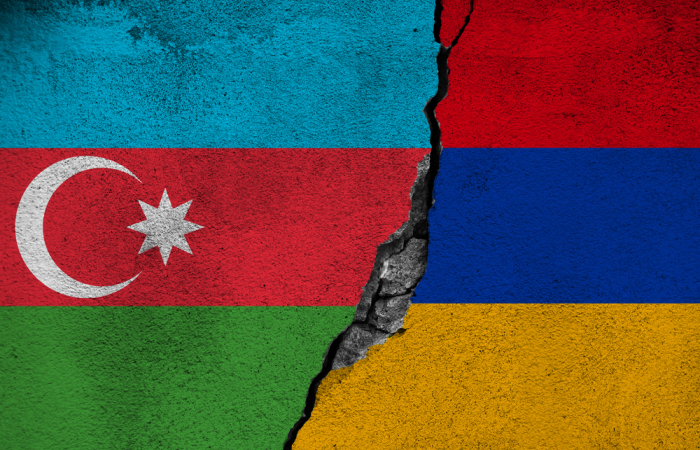
The conflict between Armenia and Azerbaijan, two republics in the South Caucasus, has never been solely about their bilateral relations. Regional and distant powers have long sought to influence the conflict, pursuing their own strategic interests. This dynamic persisted even after the Second Karabakh War (27 September – 10 November 2020), which ended the core dispute between Armenia and Azerbaijan by bringing an end to the occupation of Azerbaijan’s Karabakh region. As the fourth anniversary of the war’s onset – also known as the 44-Day War – approaches, Baku and Yerevan continue to struggle with the peace process. Meanwhile, the most significant post-war initiative, the reopening of regional transportation and communication links, is facing increasing complications. Today, the often destructive involvement of external powers has become a major obstacle to the normalisation of Armenia-Azerbaijan relations and the implementation of regional transport projects.
Editor's choice
News
Russian air strikes kill seven people in Lviv, Ukraine

Russian air strikes kill seven people in Lviv, Ukraine

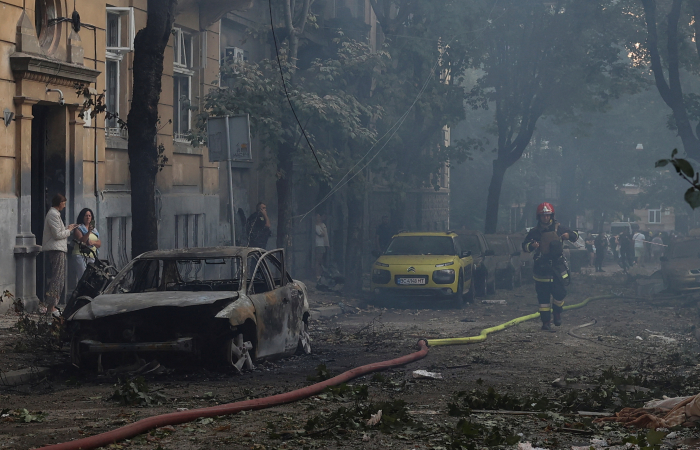
A major Russian air strike on Lviv, a city in western Ukraine near the border with NATO member Poland, killed seven people, wounded more than 30 and caused extensive damage to historic buildings in the city centre, regional officials said on Wednesday (4 September). The attack came a day after Russia's deadliest single attack this year, when two ballistic missiles hit a military institute in the central Ukrainian city of Poltava, killing 50 people and injuring hundreds more. Meanwhile, neighbouring Poland scrambled jets to secure its airspace for the third time in eight days.
Editor's choice
Opinion
Armenia–Azerbaijan normalisation is unlikely without solving humanitarian issues

Armenia–Azerbaijan normalisation is unlikely without solving humanitarian issues

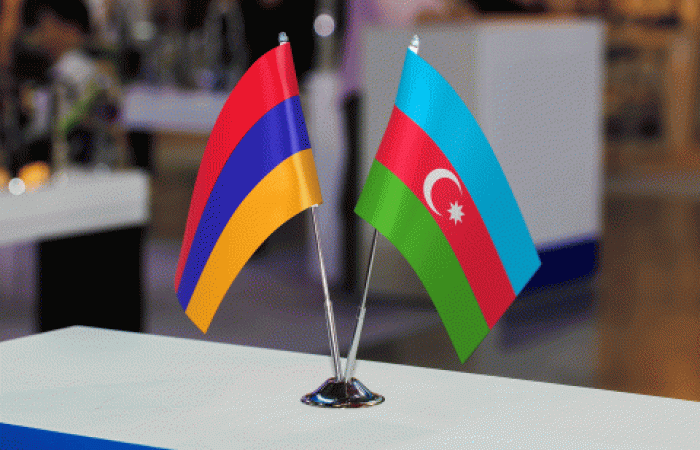
Since the 2020 Nagorno-Karabakh War, negotiations between Armenia and Azerbaijan have gone through a series of ups and downs that often resemble a rollercoaster. Periods of heightened optimism have been followed by abrupt breaks in talks, as seen in late 2022 and 2023. After Armenia and Azerbaijan signed a joint statement in December 2023, early 2024 brought renewed hope to the process. In March-April 2024, Yerevan accepted Azerbaijani demands concerning four villages along the northern part of their shared border. Azerbaijan announced its intention to make the COP29 United Nations Climate Summit in Azerbaijan in November 2024 a “COP of peace,” fostering a growing belief that an agreement might be reached by that date. However, the new or reinforced sine qua non-preconditions by President Aliyev—such as amendments to the Armenian constitution and the dissolution of the Organization for Security and Cooperation in Europe (OSCE) Minsk Group established to seek a peaceful solution to the Nagorno-Karabakh conflict—have significantly dampened expectations that even a framework agreement outlining basic principles could be signed by the end of 2024.
Editor's choice
News
Greek-flagged oil tanker attacked in Red Sea not leaking oil

Greek-flagged oil tanker attacked in Red Sea not leaking oil

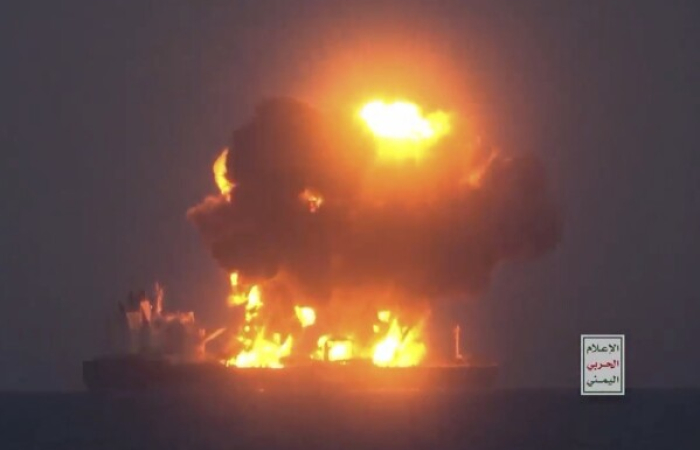
The European naval mission Aspides in the Red Sea says the Greek oil tanker Sounion, which was attacked by Houthi rebels, does not appear to be leaking oil. The tanker is carrying 150,000 tonnes of crude oil. If it leaked into the sea, it would cause an environmental disaster.
Editor's choice
News
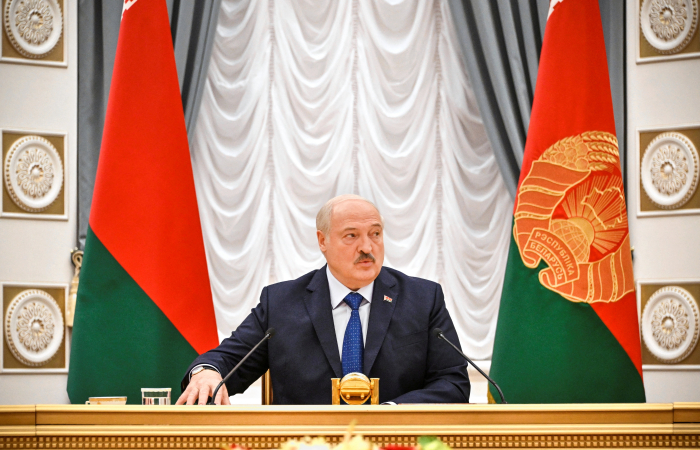
Belarus says it has increased military presence near Ukrainian border

Belarus says it has increased military presence near Ukrainian border

Belarus said on Monday (19 August) that it had sent more troops to its border with Ukraine. A day earlier, President Alexander Lukashenko said nearly a third of the Belarusian army was stationed on the border, although he did not give exact figures. Belarusian General Andrei Lukyanovich said this included anti-aircraft troops.
Editor's choice
News
US strengthens military fleet in Middle East

US strengthens military fleet in Middle East

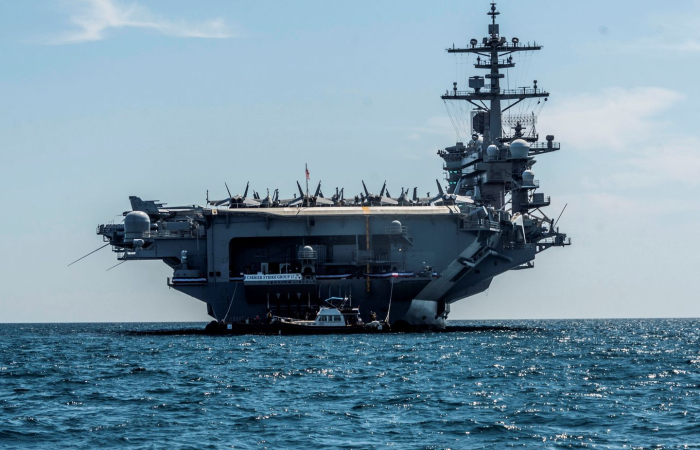
In a telephone conversation with his Israeli counterpart Gallant, US Defence Secretary Lloyd Austin promised that an aircraft carrier already on its way to the Middle East would be speeded up. The US is also sending a nuclear submarine with guided missiles - the USS Georgia - to the region. The US aircraft carrier USS Theodore Roosevelt has been in the region for some time and will soon be joined by the USS Abraham Lincoln, which will carry advanced Joint Strike Fighter jets.