


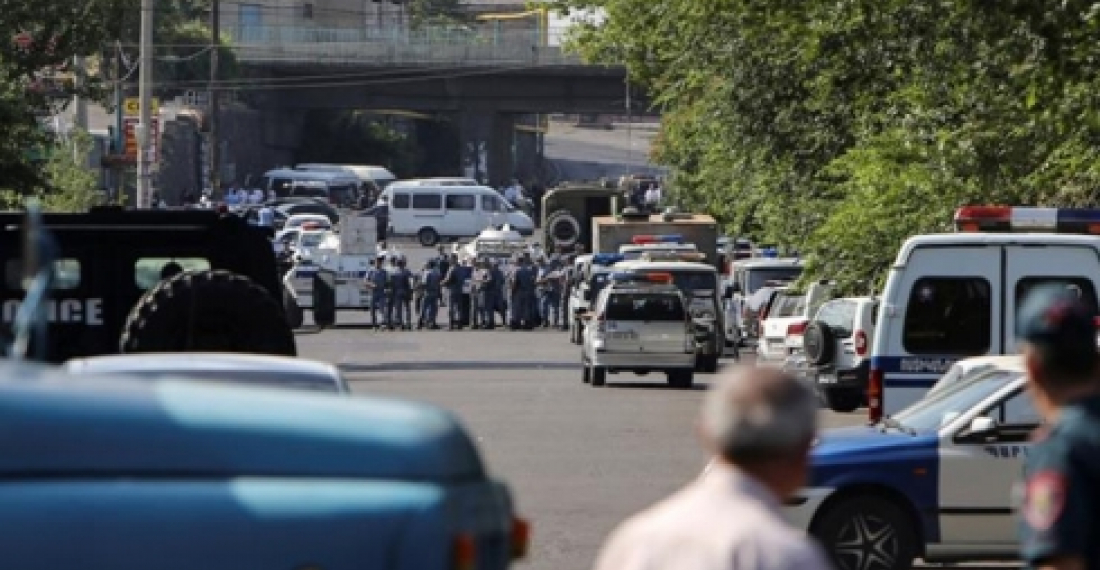
A standoff is taking place in Yerevan between the Armenian authorities and a group of armed men who stormed a police station on Sunday. Hostages have been taken following the assault, which left four policeman wounded and one, named as Artur Vanoyan, killed.
The armed men come from the anti-government Founding Parliament group. Authorities have rejected their demands, which include the release of their leader, Zhirayr Sefilian, a fierce critic of the current government.
On Monday security forces had surrounded the police station, which is in the Erebuni district, in preparation for an assault.
"If they don't listen to our appeal we will neutralize them, because killers cannot be dealt with in any other way," said General Hunan Poghosian, the first deputy chief of Armenia's police, while confirming negotiations would be continuing.
In a video released on Facebook, which showed several men armed with automatic weapons as well as hostages, the armed group said they are “starting a rebellion” against the government.
However, security services denied the incident is anything of the kind, and has accused the hostage-takers of spreading false rumours, such as that other buildings have been taken. "The National Security Service officially announces that such information is absolutely untrue," it said in a statement.
Neighbours have reported hearing explosions and gunshots. There is a heavy police presence in central Yerevan, with some roads blocked. Alek Yenikomshian, a member of Founding Parliament, told Hetq that the group holding hostages released one policeman last night as a sign of goodwill, bringing the number of hostages being held to six.
The ongoing territorial dispute with Azerbaijan over Nagorno-Karabakh is a key factor in explaining the current tensions, according to political scientist Irina Ghaplanyan in an interview with CivilNet.
“We know there have been some developments [on a possible peace deal], but the public has been kept in the dark on possible agreements that have been reached,” she said.
Sefilian’s group are known to strongly oppose much of Serzh Sargsyan’s government’s actions towards Karabakh. His group was founded on the principle of opposing giving any territorial concessions to Azerbaijan, and has been holding rallies in the capital.
He and six supporters were arrested in June, after authorities said they were preparing a plot to seize several government buildings and in Yerevan, according to RFE/RL. He was also arrested in 2006 after calling for the government to be overthrown, and again in 2015.
SOURCE: commonspace.eu and agencies
PHOTO: Policemen block a street after a group of armed men seized a police station along with an unknown number of hostages [Reuters]



