


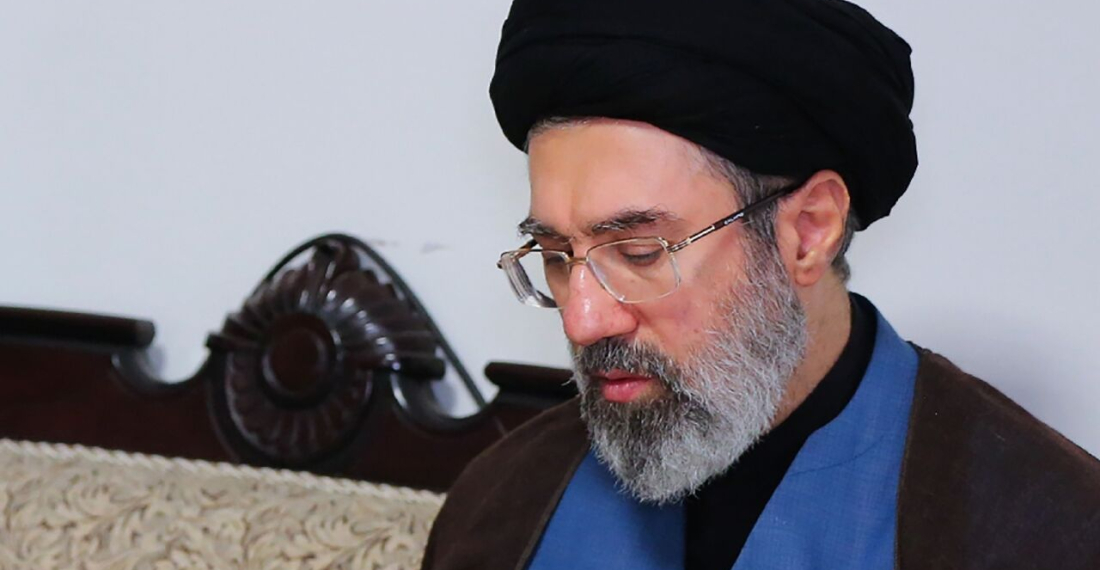
Khamenei’s son chosen as the supreme leader of Iran

Ayatollah Mojtaba Khamenei is Iran’s new supreme leader. He has replaced his father, Ayatollah Ali Khamenei who was killed in the opening phase of the United States and Israeli strikes against Iran.

The new Ayatollah is expected to maintain the hardline religious-political direction of his father, and is known as a conservative figure with close ties to Iran’s Islamic Revolutionary Guard Corps, the ideological arm of the country’s military. 

Khamenei's appointment was announced on Iranian state television, with the presenter reading a statement from the 88-member Assembly of Experts next to a picture of the new 56-year-old leader.

Khamenei "is appointed and introduced as the third leader of the sacred system of the Islamic Republic of Iran, based on the decisive vote of the respected representatives of the Assembly of Experts", the statement said.

It said the clerical body "did not hesitate for a minute" in choosing a new leader despite "the brutal aggression of the criminal America and the evil Zionist regime.”

The Guards (Iran’s Islamic Revolutionary Guard Corps) have pledged their support for the new leader, saying they were "ready for complete obedience and self-sacrifice in carrying out the divine commands.” Iran’s allies and proxies, like the Badr organisation in Iraq, have similarly shared positive sentiments of the new leader.

Source: commonspace.eu with Agence France-Presse

Related articles

Editor's choice
News
Zelensky of Arabia

Zelensky of Arabia

Ukrainian president, Volodomyr Zelensky, has just ended a tour to some of the Arab monarchies of the Gulf, during which he visited Saudi Arabia, the United Arab Emirates and Qatar. For the past four years the Gulf countries have been lukewarm in their support for Ukraine, as it fought off an unprovoked Russian invasion. In these four years a steadfast Ukraine has developed the skills, and the equipment, to resist the continuous attack by Russian drones, most of which provided by Iran. Now the Arab Gulf states unexpectedly find themselves fighting off a similar threat, as Iran fires drones and missiles at them as it widens the conflict started by the US and Israel four weeks ago. Ukraine's experience and equipment are now desperately needed by the Arab Gulf countries. During the trip Zelensky managed to convince his Arab hosts to turn the page. He offered them Ukraine's equipment and expertise in their present predicament. His offer was gladly accepted. Two hundred Ukrainian advisors are already in the region. The Gulf countries will buy Ukrainian equipment and expertise. This is not just a transactional step. It is an important shift that will have long term implications. Ukraine is set to become a long term  strategic partner of Ukraine, as the sides agree on joint long term co-operation in anti-drone technology. The visit of Zelensky to the Arab Gulf monarchies further isolates Russia, and especially the Russian approach to Ukraine. It also cements a relationship that is important for both Ukraine and the GCC.

Popular

Editor's choice
Interview
Thursday Interview: Murad Muradov

Thursday Interview: Murad Muradov

Today, commonspace.eu starts a new regular weekly series. THURSDAY INTERVIEW, conducted by Lauri Nikulainen, will host  persons who are thinkers, opinion shapers, and implementors in their countries and spheres. We start the series with an interview with Murad Muradov, a leading person in Azerbaijan's think tank community. He is also the first co-chair of the Action Committee for a new Armenian-Azerbaijani Dialogue. Last September he made history by being the first Azerbaijani civil society activist to visit Armenia after the 44 day war, and the start of the peace process. Speaking about this visit Murad Muradov said: "My experience was largely positive. My negative expectations luckily didn’t play out. The discussions were respectful, the panel format bringing together experts from Armenia, Azerbaijan, and Turkey was particularly valuable during the NATO Rose-Roth Seminar in Yerevan, and media coverage, while varied in tone, remained largely constructive. Some media outlets though attempted to represent me as more of a government mouthpiece than an independent expert, which was totally misleading.  Overall, I see these initiatives as important steps in rebuilding trust and normalising professional engagement. The fact that soon a larger Azerbaijani civil society visits to Armenia followed, reinforces the sense that this process is moving in the right direction." (click the image to read the interview in full)


