


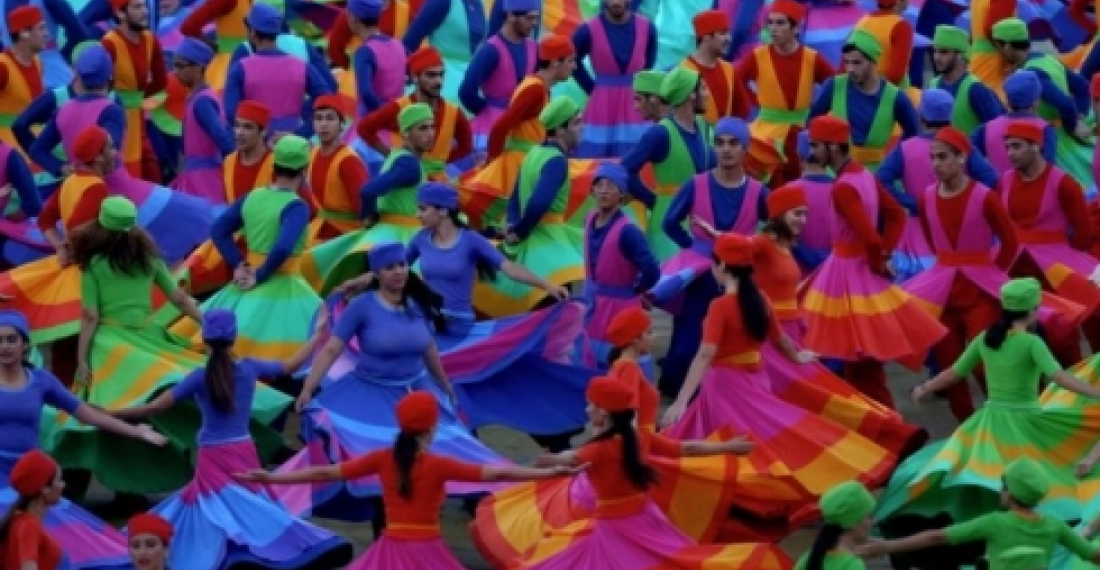
SPECTACULAR CLOSING CEREMONY BRINGS THE CURTAIN DOWN ON BAKU 2015 GAMES

The 1st European Games came to an end in a spectacular and glitzy ceremony in Baku on Sunday evening. The ceremony featured traditional Azerbaijani music and culture, laced in with modern music and artistic expression in a well balanced ceremony that drew the curtain on what has been Azerbaijan's biggest international event ever.

More than six thousand athletes participated in the games, and the Azerbaijani government is said to have spent billions of dollars to provide the infrastructure and the right conditions for the games to take place.

Speaking at the closing ceremony, the wife of the President of Azerbaijan, and Chairman of the Organising Committee of the Baku Games, Mehriban Aliyeva, thanked Europe for giving Azerbaijan an opportunity to host the games and said that she was proud of Azerbaijan and of the Azerbaijani nation for the effort that was made to make the Games a huge success. Speaking in English and Azerbaijanii, Mehraban Alieva hailed the contribution of the athletes, as well as the twelve thousand volunteers that worked to make the Games a success.

The colourful closing ceremony was full of symbolism from Azerbaijan's history. Earlier the athletes from fifty European nations were given a tumultuous welcome as they entered the stadium for the closing ceremony.

Commonspace.eu political editor said that "the Games have been a success for Azerbaijan despite some controversy that surrounded them. The Games had been overly politicised by both the Azerbaijan Government and its opponents. In the end however the Olympic spirit prevailed throughout the seveteen days of the games, and the spirit of friendship was also reflected in the closing ceremony. There will remain questions about whether Azerbaijan should have spent so much money on a prestige event when it has still a number of big challenges within its society that it needs to tackle. However a nation does not exist only on bread, and considering that Azerbaijan was only a couple of decades ago a nation broken by war, strife and economic collapse, the Games signify a new national confidence.

The Games were a European event and all European countries, large and small participated. It was wrong that some Azerbaijani officials kept claiming throughout the Games that there was some European boycott of the Games. If there had been a European boycott European teams would not have participated. Instead the Games had a full turnout. The European Union, at the Riga Eastern Partnership summit wished the Baku Games success. It is true that some European leaders stayed away. Since there has never been European Games before it is not clear whether they did so simply because the occasion did not demand it, or for political reasons. If the latter, the Azerbaijani government needs to reflect as to whether it could have been more sensitive to European sensibilities in the run-up to the games and whether its own actions had made high level European participation problematic. Regardless of this, the success of the 1st European Games in Baku is a welcome development, that affirms Azerbaijan's position among the family of European nations, and once more confirms the role of sport as a means for building peace and solidarity among nations".

source: commonspace.eu

photo: The closing ceremony of Baku 2015 - 1 st European Games, on Sundat 28 June 2015 (Picture courtesy of Getty Images/Baku 2015).

Related articles

Editor's choice
News
Borrell tells the European Parliament that the situation in Afghanistan was critical, but the EU will remain engaged

Borrell tells the European Parliament that the situation in Afghanistan was critical, but the EU will remain engaged

Borrell underlined that the European Union will make every effort to support the peace process and to remain a committed partner to the Afghan people. "Of course, we will have to take into account the evolving situation, but disengagement is not an option.  We are clear on that: there is no alternative to a negotiated political settlement, through inclusive peace talks.
Editor's choice
News
NATO Chief says war is on Europe's doorstep, and warns against complacency

NATO Chief says war is on Europe's doorstep, and warns against complacency

Russia could attack a Nato country within the next five years, the Secretary General of NATO, Mark Rutte, said in a stark new warning. "Nato's own defences can hold for now," Rutte warned in Berlin, but conflict was "next door" to Europe and he feared "too many are quietly complacent, and too many don't feel the urgency, too many believe that time is on our side. "Russia is already escalating its covert campaign against our societies," Rutte said in a speech in Germany. "We must be prepared for the scale of war our grandparents or great-grandparents endured." Earlier this month, Russia's President Vladimir Putin said his country was not planning to go to war with Europe, but it was ready "right now" if Europe wanted to - or started a war. But similar reassurances were given by Moscow in 2022, just before 200,000 Russian troops crossed the border and invaded Ukraine. Putin has accused European countries of hindering US efforts to bring peace in Ukraine - a reference to the role Ukraine's European allies have recently played in trying to change a US peace plan to end the war, whose initial draft was seen as favouring Russia. But Putin was not sincere, Nato's secretary-general said in the German capital, Berlin. Supporting Ukraine, he added, was a guarantee for European security. "Just imagine if Putin got his way; Ukraine under the boot of Russian occupation, his forces pressing against a longer border with Nato, and the significantly increased risk of an armed attack against us." Russia's economy has been on a war footing for more than three years now - its factories churn out ever more supplies of drones, missiles and artillery shells. According to a recent report by the Kiel Institute for the World Economy, Russia has been producing each month around 150 tanks, 550 infantry fighting vehicles, 120 Lancet drones and more than 50 artillery pieces. The UK, and most of its Western allies, are simply not anywhere near this point. Analysts say it would take years for Western Europe's factories to come close to matching Russia's mass-production of weapons. "Allied defence spending and production must rise rapidly, our armed forces must have what they need to keep us safe," the Nato chief said.

Popular

Editor's choice
News
NATO Chief says war is on Europe's doorstep, and warns against complacency

NATO Chief says war is on Europe's doorstep, and warns against complacency

Russia could attack a Nato country within the next five years, the Secretary General of NATO, Mark Rutte, said in a stark new warning. "Nato's own defences can hold for now," Rutte warned in Berlin, but conflict was "next door" to Europe and he feared "too many are quietly complacent, and too many don't feel the urgency, too many believe that time is on our side. "Russia is already escalating its covert campaign against our societies," Rutte said in a speech in Germany. "We must be prepared for the scale of war our grandparents or great-grandparents endured." Earlier this month, Russia's President Vladimir Putin said his country was not planning to go to war with Europe, but it was ready "right now" if Europe wanted to - or started a war. But similar reassurances were given by Moscow in 2022, just before 200,000 Russian troops crossed the border and invaded Ukraine. Putin has accused European countries of hindering US efforts to bring peace in Ukraine - a reference to the role Ukraine's European allies have recently played in trying to change a US peace plan to end the war, whose initial draft was seen as favouring Russia. But Putin was not sincere, Nato's secretary-general said in the German capital, Berlin. Supporting Ukraine, he added, was a guarantee for European security. "Just imagine if Putin got his way; Ukraine under the boot of Russian occupation, his forces pressing against a longer border with Nato, and the significantly increased risk of an armed attack against us." Russia's economy has been on a war footing for more than three years now - its factories churn out ever more supplies of drones, missiles and artillery shells. According to a recent report by the Kiel Institute for the World Economy, Russia has been producing each month around 150 tanks, 550 infantry fighting vehicles, 120 Lancet drones and more than 50 artillery pieces. The UK, and most of its Western allies, are simply not anywhere near this point. Analysts say it would take years for Western Europe's factories to come close to matching Russia's mass-production of weapons. "Allied defence spending and production must rise rapidly, our armed forces must have what they need to keep us safe," the Nato chief said.

