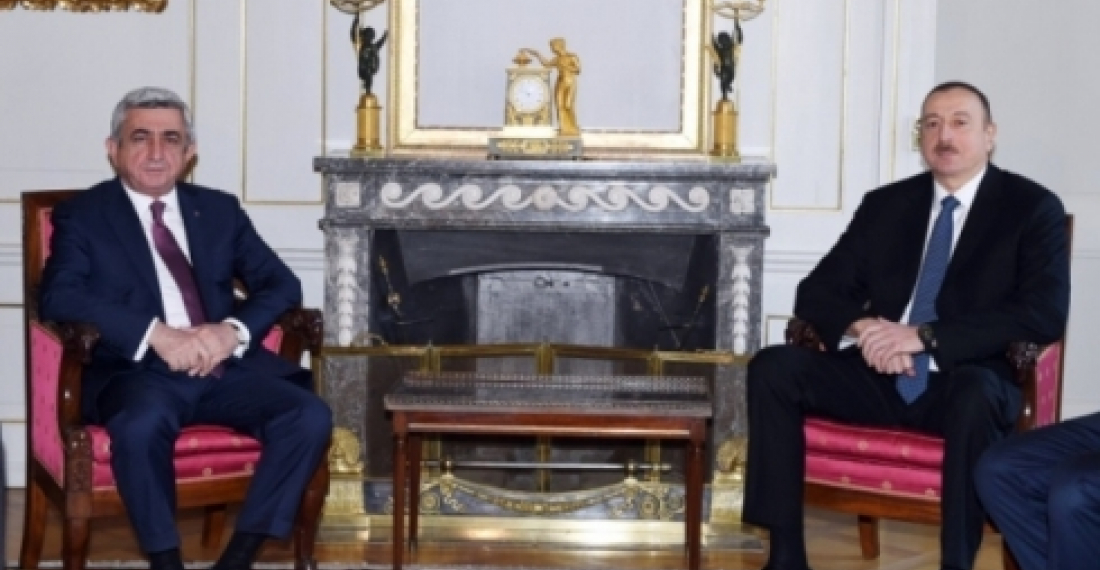
Armenian President Serzh Sargsyan and Azerbaijani President Ilham Aliev met in private for more than one hour today in the Swiss capital, Bern, as part of efforts of the OSCE Minsk Process co-Chair to resolve the conflict between the two countries over Nagorno-Karabakh. But even as the two Presidents were meeting reports say that shooting continued on the line of contact between the forces of the two countries.
President Sargsyan and President Aliev were welcomed to the talks by Swiss Foreign Minister Didier Burkhalter and posed for a picture with him with the diplomats of the co-Chair countries. A meeting in expanded format involving the two presidents and their foreign ministers, and the three co-Chair of the OSCE Minsk Process representing, France, Russia and the United States followed. The Presidents were then left alone for a private conversation.
The last meeting between the Azerbaijani and Armenian presidents took place in Paris on 27 October 2014.
The meeting Bern is being seen as an important breakthrough in the stalled negotiations between the two countries to try to resolve the Karabakh conflict that has been ongoing between them since before the collapse of the USSR in 1991.
However the talks have been marred by ongoing incidents on the line of contact separating the forces of the two sides. Throughout the week there were reports of casualties on both sides in serious violations of the cease fire in which both sides accuse each other of using heavy military equipment. Unconfirmed reports say that the incidents continued even as the two Presidents were meeting.
OSCE Minsk Group co-Chair issue statement
The co-Chair of the OSCE Minsk Process later issued a statement, which was published on the OSCE website. The statement says that in their meeting in Bern
"The presidents discussed recent violence and expressed particular concern about casualties, including civilians, caused by the use of heavy weapons. The presidents supported the Co-Chairs' ongoing work on proposals regarding measures to reduce the risk of violence along the Line of Contact and Armenia-Azerbaijan border, including an investigation mechanism. The presidents confirmed their readiness to continue engagement on proposals regarding a settlement currently under negotiation. They also reaffirmed their commitment to the Minsk Group format. The Co-Chairs remain ready to work with the sides on mediating a peaceful, negotiated settlement to the Nagorno-Karabakh conflict."
Updated at 14.00 GMT with OSCE Minsk Group co-chair statement
source: commonspace.eu with agencies
photo: The opresidents of Armenia and Azerbaijan meeting in Bern on 19 December 2015.