Region

Russia

Stories under this heading cover Russia, as well as countries in the eastern part of the European continent, such as Belarus, Ukraine, and Moldova.

Editor's choice
News
UN General Assembly demands that Russia returns Ukrainian children

UN General Assembly demands that Russia returns Ukrainian children

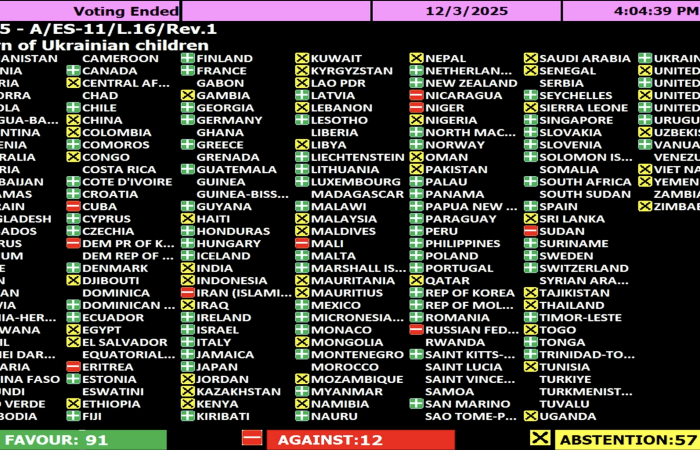
The UN General Assembly, in a vote on Wednesday (3 December) overwhelmingly voted in favour of a resolution demanding that Russia returns Ukrainian children kidnapped since the start of the Russian invasion in February 2022. 91 countries voted in favour of the resolution, 12 voted against, and 57 countries abstained or were not present. Russia and Belarus were joined by ten countries in voting against the resolution, namely, Iran, Cuba, Nicaragua, Burundi, Burkina Faso, Niger, Mali, Democratic Republic of Congo, Sudan, and Eritrea. From the South Caucasus, Georgia voted in favour of the resolution, but Armenia and Azerbaijan abstained, as did Turkiye and the five Central Asian republics. Also abstaining were the six Gulf monarchies and most Arab countries. The resolution calls for the immediate return of Ukrainian children who were deported to Russia. The Ukrainian government says more than 19,000 children have been taken away from Russian-occupied areas and elsewhere since Moscow's invasion began in February of 2022. The draft resolution submitted on Wednesday demands that Russia "ensure the immediate, safe and unconditional return" of the children. (Read more by clicking the image)
Editor's choice
News
EU imposes more sanctions on Russia but fails to reach agreement on using Russian assets

EU imposes more sanctions on Russia but fails to reach agreement on using Russian assets

The European Union on Thursday 23 October applied more economic sanctions on Russia, adding to U.S. President Donald Trump’s new punitive measures the previous day against the Russian oil industry. However, EU leaders meeting in Brussels have so far failed to reach a deal on using Russian frozen assets. European capitals were hoping to convince Belgium, which houses the international deposit organisation Euroclear and is worried about legal repercussions, that a reparation loan from the funds is workable. Most of the €200 billion in Russian central bank assets frozen by the EU are held in Euroclear. However, Belgian Prime Minister Bart De Wever has so far been skeptical, reiterating during the European Council meeting on Thursday that certain conditions must first be met before a €140 billion loan can be given to Ukraine using Russia’s frozen assets. Russian officials and state media dismissed the new Western measures, saying they are largely ineffective.

Filter archive

Publication date
Editor's choice
Opinion
Opinion: The Russian invasion of Ukraine is a life-changing moment for many of us

Opinion: The Russian invasion of Ukraine is a life-changing moment for many of us

"Looking at the current situation in Ukraine, there is no room for myself and other young people from the Middle East to think positively anymore about the Russian state and regime", writes Noman Ahmad in this op-ed. "As a young man from the Middle East,  and much as I dislike foreign interventionism, I do not want the Ukrainians to suffer from what many people in the Middle East faced for the past twenty some years, and I also hope that people in the region stop admiring Russia unjustifiably."
Editor's choice
News
"Drive this evil out"

"Drive this evil out"

Ukraine's President Volodymyr Zelensky has made an impassioned plea to his countrymen to drive the invading Russian army out of their land. Speaking in televised broadcast on Saturday night he told Ukrainians they have "withstood the blow" of Russia's invasion as he urged citizens to continue fighting. Mr Zelensky told the country that the time has come for them to launch a fightback. "You need to go out and drive this evil out of our cities," he said.
Editor's choice
Analysis
Isolated

Isolated

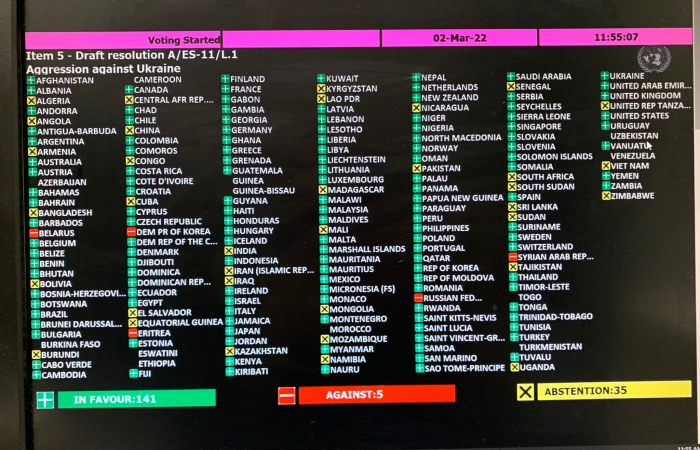
In a historic vote in the United Nations General Assembly condemning Russian aggression against Ukraine on Wednesday (2 March), Putin's Russia found itself isolated from the rest of the international community, with only North Korea, Belarus, Eritrea and Syria supporting its position in the 193 member world body. 141 countries voted for the resolution, 5 voted against and 35 abstained. 12 countries were absent. The vote was a stark revelation of Russia's isolation in the international community as it pursues its aggression against Ukraine. In a similar situation in 2014, when Russia annexed Crimea, a UN General Assembly resolution condemning the move received the support of 100 countries. This time the number was up by 41 countries, sending a resounding diplomatic message. The number of abstentions in 2014 was 58, compared to 35 this time. 24 countries were absent in 2014, this time only 12. Those supporting the Russian position in 2014 were 11, this time the number is down to 5.