


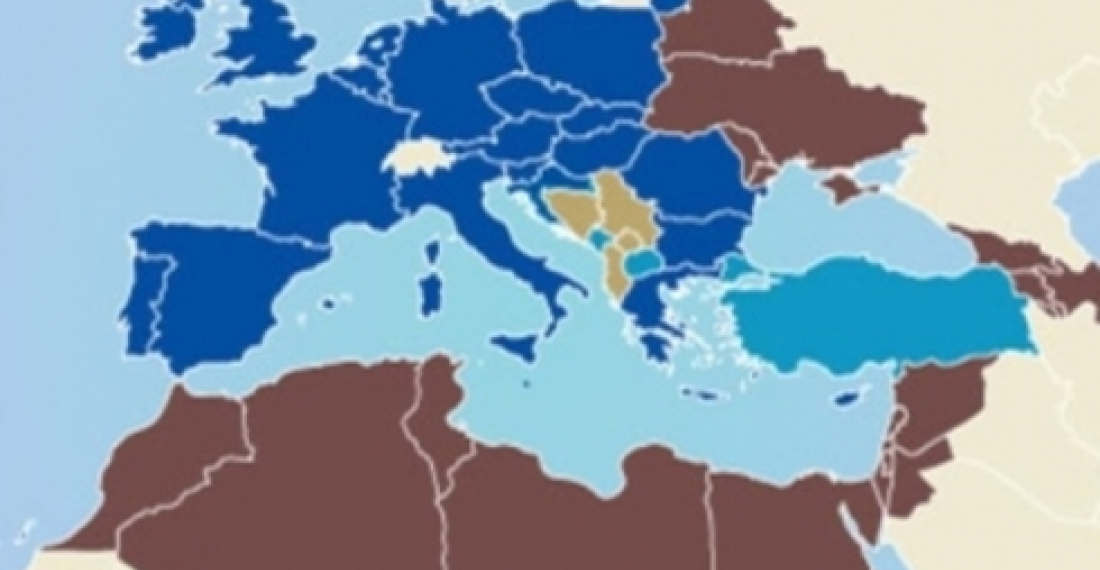
On Wednesday, 18 November, the European Union unveiled its new strategy towards its neighbourhood in a joint communication from the European Commission and the High Representative for foreign and Security policy (read it here). In this op-ed for commonspace.eu, Dennis Sammut, Director of LINKS (Dialogue, Analysis and research) cautiously welcomes the realism of the new strategy, but questions how some of the ideas contained in it will work in practise.
The European Union has just made public its new strategy towards its neighbourhood to the east and to the south. The joint communication by the European Commission and the High Representative for Foreign and Security Policy was prompted by an increasing concern that the previous strategy was not working, and that rather than being surrounded by an arc of friendly countries working in partnership with it, the EU now found itself surrounded by an arc of crises that threaten its very foundations.
The new document is deeply rooted in realism, not surprisingly since the EU finds itself surrounded by conflicts, radicalism, and millions of people on the move trying to escape war and abject poverty. It identifies stability as the most important objective for the immediate future. It says little or nothing about conditionality. It accepts that one does not choose one's neighbours, and one has to accept them and engage with them, however unpleasant one may think that they are. The document recognises that the "more for more" policy has not worked in most cases. "More for more" was always a flawed concept given that the EU membership perspective was ominously absent from previous strategies, as indeed from the present one. The last Eastern Partnership summit in Riga in May exposed the limitations of that approach. Instead the new strategy accepts the principle of differentiation. There are countries who have opted for stronger links with the EU - particularly the three that have signed Association Agreements: Georgia, Moldova and Ukraine - but for most a different set of engagement is required. This means co-operation a la carte, with each country choosing the areas in which it wants to co-operate with the EU.
Having thus somewhat briefly addressed this key issue in its first five pages, the strategy then quickly moves to listing tangible areas, such as economic co-operation, energy and security, where co-operation will be offered. Listed are a lot of practical measures, some already in hand, others newly offered.
This more realistic strategy is welcomed. The previous EU neighbourhood strategy had started looking distinctly delusional - a source of problems with the neighbours rather than a framework for co-operation. The last few years, and particularly the crisis in Ukraine and in Syria have taught the EU lessons about the limits of soft power. The EU is grappling with multiple internal and external problems, and is still searching for the best fit with which to deal with them. In dealing with its neighbours the European Union now needs time to regroup, and the new strategy seeks to gain it that time.
Many will ask where does this leave the EU's agenda on issues such as democratisation and human rights. Certainly the new strategy declares that "the EU is committed to promoting good governance, democracy, rule of law and human rights", but this will be done mainly through support for local civil society. It is implied that problems in these spheres will not constitute obstacles for co-operation in other spheres. Georgia, Moldova, Ukraine - to the East, and Morocco and Tunisia - to the South, are singled out as countries with which the EU will pursue deeper relations "based on shared values".
This approach will upset many in the EU, as well as in the partner countries. However the idea that democracy can be imposed from outside is inherently flawed, and it is right that an EU strategy to the neighbourhood recognises this. How differentiation will work in practice, and what privileged positions will the countries that "share values" with the EU get, is yet to be seen.
Much will depend on how the new policy is managed by the Brussels bureaucracy, and on the ground, and crucially how the EU member states engage with it. Here one can see that wishful thinking continues to cast a shadow. The limitations of the extent to which the EU can work with civil society in the partner countries without jeopardising relations with the authorities has already been experienced. If anything the EU's past helplessness, in the face of a local backlash, will only increase as a result of the new approach. The new strategy does not tell us how it proposes to square that circle.
The new strategy also speaks about "greater involvement of the member states in the ENP". Often the member states are the EU's worst enemies, insisting on policies that suit their individual needs but do little good, and sometimes a lot of harm, to the needs of the whole. Building a consensual position in dealing with the different neighbouring states is likely to prove even more difficult than developing a common strategy for all. Giving member states a leading role in certain countries and on certain issues, as the strategy proposes, may seem like a good idea on paper, but one that is likely to be full of risks and problems in practise.
Finally, the strategy fudges the answer to the question as to where Europe's neighbourhood ends. There is an acceptance that the neat set of countries that had been identified as part of ENP in the past is not the whole story. Adjacent countries and regions are too often so closely interconnected with the immediate neighbourhood that involving them is absolutely necessary - Russia, Central Asia, the GCC countries, the Sahel countries and those in the Horn of Africa are mentioned. Whilst it is realistic to accept this, the strategy does not quite explain how it proposes to do that
Overall therefore, one should cautiously welcome the new European neighbourhood strategy. It recognises some hard truths and offers some way forward in addressing immediate challenges. It remains however full of wishful thinking in terms of how things are likely to play out, or targets achieved. That could have been excused if this was a visionary document, which it is not. This is a pragmatic document that needs to deliver tangible results. As it is the risk that it is left in the hands of bureaucrats who will evaluate its success by the number of boxes that they are able to tick is very high. For this strategy to deliver the objectives it sets out to achieve it needs a steady and continuous political direction, as well as close oversight by the European parliament and European civil society.
Dennis Sammut is the Director of LINKS (Dialogue, Analysis and Research). He contributed this op-ed to commonspace.eu. Dennis Sammut may be contacted at dennis@links-dar.org.



