


Participants hail the NATO PA event in Baku as an important contribution to public diplomacy and welcome the spirit of openness during the event.

Participants hail the NATO PA event in Baku as an important contribution to public diplomacy and welcome the spirit of openness during the event despite some tense moments.

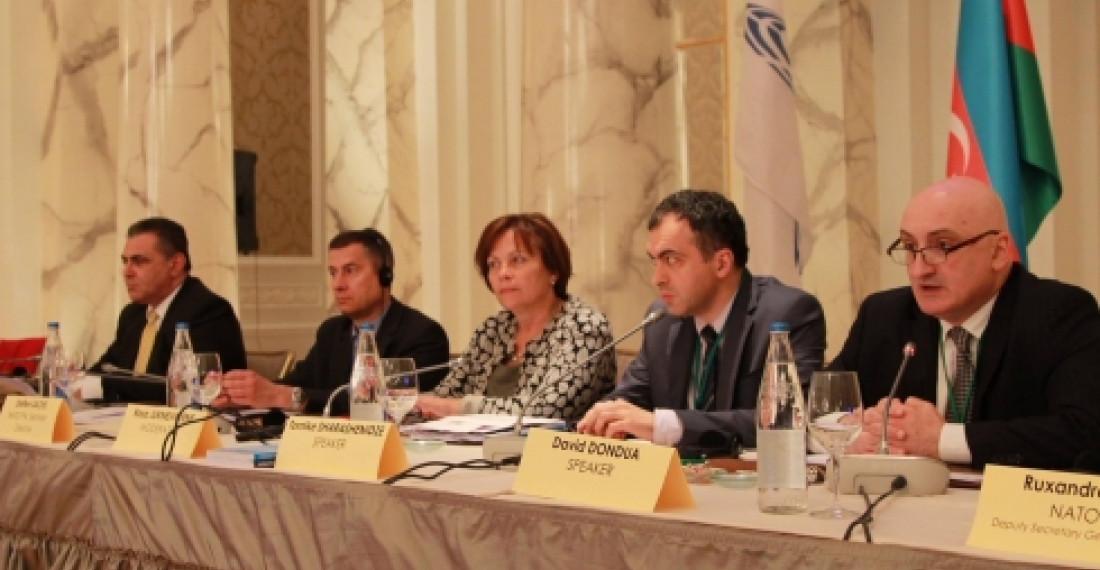
Parliamentarians from NATO member states and partner countries continued with their meeting in Baku yesterday. Focus on Tuesday turned to Georgia and the country's quest for European and Euro-Atlantic Integration. The discussion was led by a panel consisting of David Dondua, Deputy Minister for Euro-Atlantic Integration in the government of Georgia, Tornike Shrashenidze from Georgia's Public Administration Academy and Dennis Sammut from Oxford University. The session was chaired by Lithuanian MP Raza Jukneviene.

The Georgian speakers outlined the progress that Georgia had made in its quest for European and Euro-Atlantic integration but expressed disappointment that the possibility of Georgia getting a membership perspective at the forthcoming summit in Wales had already been ruled out. Deputy Minister Dondua said that all Georgian governments regardless of the party in power, had been committed to the process of European and Euro-Atlantic integration and that this was the overwhelming desire of the Georgian people, but there were small elements in society who were agitating against this. So far these were isolated elements but frustration with progress in the process could increase their numbers. All three speakers hailed the progress made towards the signing of an Association Agereement with the EU which will take place on 27 June.

Senior Georgian politician Giorgi Baramidze, who is also attending the seminar, warned against complacency by the European and Euro-Atlantic institutions which could contribute to cynicism amongst the Georgian people.

Dennis Sammut said that Georgia on Sunday held good local elections and this was yet another important step in strenghtening Georgia's credentials towards achieving its European asspirations. He said that what was now at stake was not Georgia's credibility, but that of its European and North American partners. The conditions that had been made to Georgia were on the way to being fulfilled and the process of embedding Georgia in NATO and the EU must now start in earnest. Sammut said that for Georgia Russia remains the elephant in the room, and Georgia needs to take passion out of its relations with Russia and engage with the country in a professional and calculating way. Strong diplomacy has to be Georgia's first line of defence, Sammut said.

A number of MPs from NATO member states took the floor to express support for Georgia and for Georgia's NATO membership after the presentations by the members of the panel.

The 86th NATO Parliamentary Assembly Rose-Roth seminar will conclude on Wednesday in Baku. The seminar has been overshadowed by sharp exchanges between the Armenian and the Azerbaijani delegations at the meeting resulting in some tense moments, but participants told commonspace.eu that they were impressed by the openess of the discussions during the event, and hailed the meeting as an important contribution to public diplomacy in the region.

source: commonspace.eu

photo: The panel on Georgia at the NATO Parliamentary Assembly panel in Baku on 17 June 2014. (Picture courtesy of the Nato PA)
Related articles

Editor's choice
News
Borrell tells the European Parliament that the situation in Afghanistan was critical, but the EU will remain engaged

Borrell tells the European Parliament that the situation in Afghanistan was critical, but the EU will remain engaged

Borrell underlined that the European Union will make every effort to support the peace process and to remain a committed partner to the Afghan people. "Of course, we will have to take into account the evolving situation, but disengagement is not an option.  We are clear on that: there is no alternative to a negotiated political settlement, through inclusive peace talks.
Editor's choice
News
Mystery surrounds the crash of a Turkish airline in Georgia which resulted in the death of 20 Turkish Airforce personnel

Mystery surrounds the crash of a Turkish airline in Georgia which resulted in the death of 20 Turkish Airforce personnel

​ Twenty Turkish Airforce personnel died when a military plane crushed on the Georgian side of the Azerbaijan - Georgia border on Tuesday (11 November). The C130 took off from Ganja and was heading to Merzifon, transporting service members that had participated in Azerbaijan's Victory Day celebrations. Half an hour after takeoff, the aircraft lost altitude and broke apart in mid-air over a mountainous area on the Georgian border. Lockheed C130 Hercules have been in service with Turkey since the 1960s and are considered among the most reliable in their class. However, some of these aircraft are 50–60 years old. In October, the Turkish Ministry of Defense announced plans to replace them with new C130J Super Hercules models, with deliveries expected to begin in the coming years. All aircraft fragments have already been collected for technical examination. The cause of the crash has not yet been officially determined. A Turkish expert and retired military officer Coşkun Başbuğ noted on CNN Türk, a technical malfunction "should be ruled out" as the cause of the crash. "Various possibilities should be considered, but the first thing to consider is that the C-130 is a time-tested military transport aircraft, the last known incident involving which occurred in 1982." "A technical malfunction should be ruled out as the cause of the crash. The same applies to weather conditions, as the relevant authorities would have reported bad weather. The remaining theories include a mid-air collision, sabotage, or an attack," he emphasized. Former Turkish Armed Forces Logistics Commander and retired Army General Erdoğan Karakuş stated in an interview with Turkish television that although the C-130 aircraft are old, they have undergone a complete modernization in Turkey, and their technical condition is thoroughly inspected before each flight. The Turkish Air Force is expected to operate the C-130 aircraft until 2040. ​

Popular

Editor's choice
News
Mystery surrounds the crash of a Turkish airline in Georgia which resulted in the death of 20 Turkish Airforce personnel

Mystery surrounds the crash of a Turkish airline in Georgia which resulted in the death of 20 Turkish Airforce personnel

​ Twenty Turkish Airforce personnel died when a military plane crushed on the Georgian side of the Azerbaijan - Georgia border on Tuesday (11 November). The C130 took off from Ganja and was heading to Merzifon, transporting service members that had participated in Azerbaijan's Victory Day celebrations. Half an hour after takeoff, the aircraft lost altitude and broke apart in mid-air over a mountainous area on the Georgian border. Lockheed C130 Hercules have been in service with Turkey since the 1960s and are considered among the most reliable in their class. However, some of these aircraft are 50–60 years old. In October, the Turkish Ministry of Defense announced plans to replace them with new C130J Super Hercules models, with deliveries expected to begin in the coming years. All aircraft fragments have already been collected for technical examination. The cause of the crash has not yet been officially determined. A Turkish expert and retired military officer Coşkun Başbuğ noted on CNN Türk, a technical malfunction "should be ruled out" as the cause of the crash. "Various possibilities should be considered, but the first thing to consider is that the C-130 is a time-tested military transport aircraft, the last known incident involving which occurred in 1982." "A technical malfunction should be ruled out as the cause of the crash. The same applies to weather conditions, as the relevant authorities would have reported bad weather. The remaining theories include a mid-air collision, sabotage, or an attack," he emphasized. Former Turkish Armed Forces Logistics Commander and retired Army General Erdoğan Karakuş stated in an interview with Turkish television that although the C-130 aircraft are old, they have undergone a complete modernization in Turkey, and their technical condition is thoroughly inspected before each flight. The Turkish Air Force is expected to operate the C-130 aircraft until 2040. ​

