Opinion: Macron's 'European Political Community' offers an opportunity for a continent-wide approach to critical security issues

French President Emmanuel Macron's proposal to create a "European Political Community" can, if handled correctly, provide a permanent framework where EU countries and other European states can interact on critical political and security issues. However, for the community to succeed it must not simply become an extension of the EU. It must be designed to ensure that all countries involved have a voice in fostering political dialogue and cooperation in order to address issues of common interest, writes Maximiliaan van Lange in this op-ed for commonspace.eu.

On Europe Day last 9 May, French President Emmanuel Macron launched discussions on the creation of a "European Political Community" (EPC). This proposal would allow like-minded democratic European countries to find a new space for political cooperation and to address political and security-related challenges facing the continent. 

The idea echoes François Mitterrand's 1989 proposal for a European Confederation. On 14 September, during the 2022 State of the Union Address, European Commission President Ursula von der Leyen reflected on Macron's idea and indicated that the time has come for the EU to reflect on the strength of its democracy, gather its member states alongside like-minded regional partners, and jointly address complex issues that result from a new security reality in Europe.

The matter is, however, sensitive among both the 27 member states and among the other European countries who are not in the EU, some of who aspire to join the EU and see the idea as a second best option. On 6-7 October, the first informal meeting of the EPC will take place in Prague, as the Czech Republic currently holds the rotating EU presidency. Participating countries include Türkiye - an EU candidate country with very little prospect of ever achieving membership, and the UK, a country that has actually left the EU. Others include Norway and Switzerland, who never joined the EU and do not aspire to join, and others.

The war in Ukraine is bound to overshadow the event, but there are other issues the Community can engage with in the future.

Macron's initiative champions compliments the notion of a "Europe as a geopolitical power". So far that has been presented as an EU project - for Europe read EU. The presence in the community of the UK - a member of the UN Security Council with strong armed forces and nuclear capability, and Türkiye, a strong power in the Eastern Mediterranean with a large standing army, give the proposed community an important sharp edge. But both Türkiye and the UK are already NATO members, together with most EU member states, with Finland and Sweden poised to join soon.

Although the UK Prime Minister Liz Truss is sceptical about the proposed grouping, she said that democracies must co-operate to counter the threat posed by autocracies. This should be the aim and purpose of the forum. Other countries will then follow along and actively participate in the initiative.

Against the backdrop of Putin's hybrid war with the West, the imperialist war in Ukraine, and his exploitation of energy and food as weapons to destabilise the whole world, Macron's idea can help strengthen the democratic rules-based order in Europe.

Overall, the idea of a European Political Community is a positive one. Ensuring that countries like Türkiye and the UK can be equal partners in the discussion on the future of Europe's security, is an important and positive step. Making sure that smaller countries in the Balkans and the Caucasus can also be part of the conversation is equally relevant. But for the Community to succeed it must quickly carve a niche for itself in the crowded field of European institutions, which apart from NATO and the EU, also includes the Council of Europe, the OSCE, and the Western European Union, not to mention multiple sub-regional entities. The best option for the new community is to focus on security, and the security threats posed by the new Russian and Chinese assertiveness.

The European leaders meeting in Prague need to remember Jean Monnet's words that “Europe will be forged in crises, and will be the sum of the solutions adopted for those crises.” The EPC is perhaps the answer to a much larger discussions related to EU enlargement, the setting up of a European defence capability, and the aspiration for Europe to be a global geo-political player in its own right. Macron has limited the scope somewhat, saying that this initiative would “consolidate European stability through multiple cooperation”. In the end, it will be circumstances and developments that will define the new community, and its success or otherwise.
source: Maximiliaan van Lange is a Research Associate and Project Officer at LINKS Europe and part of the research team of commonspace.eu
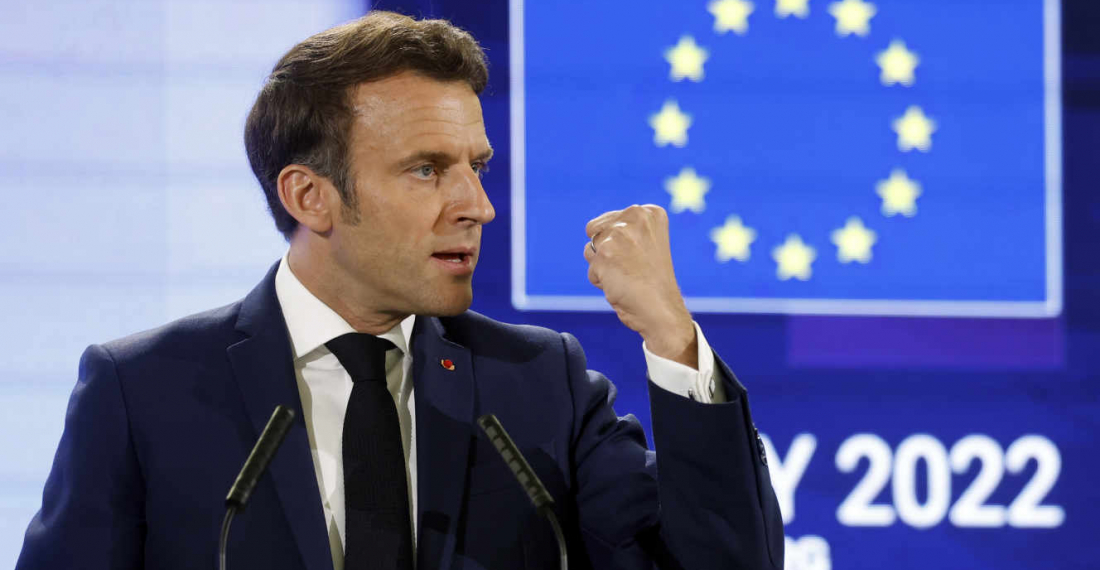
photo: French President Emmanuel Macron during his speech at the Conference on the Future of Europe in Strasbourg, 9 May 2022. Associated Press
 
The views expressed in opinion pieces and commentaries do not necessarily reflect the position of commonspace.eu or its partners

Related articles

Editor's choice
News
Borrell tells the European Parliament that the situation in Afghanistan was critical, but the EU will remain engaged

Borrell tells the European Parliament that the situation in Afghanistan was critical, but the EU will remain engaged

Borrell underlined that the European Union will make every effort to support the peace process and to remain a committed partner to the Afghan people. "Of course, we will have to take into account the evolving situation, but disengagement is not an option.  We are clear on that: there is no alternative to a negotiated political settlement, through inclusive peace talks.
Editor's choice
News
NATO Chief says war is on Europe's doorstep, and warns against complacency

NATO Chief says war is on Europe's doorstep, and warns against complacency

Russia could attack a Nato country within the next five years, the Secretary General of NATO, Mark Rutte, said in a stark new warning. "Nato's own defences can hold for now," Rutte warned in Berlin, but conflict was "next door" to Europe and he feared "too many are quietly complacent, and too many don't feel the urgency, too many believe that time is on our side. "Russia is already escalating its covert campaign against our societies," Rutte said in a speech in Germany. "We must be prepared for the scale of war our grandparents or great-grandparents endured." Earlier this month, Russia's President Vladimir Putin said his country was not planning to go to war with Europe, but it was ready "right now" if Europe wanted to - or started a war. But similar reassurances were given by Moscow in 2022, just before 200,000 Russian troops crossed the border and invaded Ukraine. Putin has accused European countries of hindering US efforts to bring peace in Ukraine - a reference to the role Ukraine's European allies have recently played in trying to change a US peace plan to end the war, whose initial draft was seen as favouring Russia. But Putin was not sincere, Nato's secretary-general said in the German capital, Berlin. Supporting Ukraine, he added, was a guarantee for European security. "Just imagine if Putin got his way; Ukraine under the boot of Russian occupation, his forces pressing against a longer border with Nato, and the significantly increased risk of an armed attack against us." Russia's economy has been on a war footing for more than three years now - its factories churn out ever more supplies of drones, missiles and artillery shells. According to a recent report by the Kiel Institute for the World Economy, Russia has been producing each month around 150 tanks, 550 infantry fighting vehicles, 120 Lancet drones and more than 50 artillery pieces. The UK, and most of its Western allies, are simply not anywhere near this point. Analysts say it would take years for Western Europe's factories to come close to matching Russia's mass-production of weapons. "Allied defence spending and production must rise rapidly, our armed forces must have what they need to keep us safe," the Nato chief said.

Popular

Editor's choice
News
NATO Chief says war is on Europe's doorstep, and warns against complacency

NATO Chief says war is on Europe's doorstep, and warns against complacency

Russia could attack a Nato country within the next five years, the Secretary General of NATO, Mark Rutte, said in a stark new warning. "Nato's own defences can hold for now," Rutte warned in Berlin, but conflict was "next door" to Europe and he feared "too many are quietly complacent, and too many don't feel the urgency, too many believe that time is on our side. "Russia is already escalating its covert campaign against our societies," Rutte said in a speech in Germany. "We must be prepared for the scale of war our grandparents or great-grandparents endured." Earlier this month, Russia's President Vladimir Putin said his country was not planning to go to war with Europe, but it was ready "right now" if Europe wanted to - or started a war. But similar reassurances were given by Moscow in 2022, just before 200,000 Russian troops crossed the border and invaded Ukraine. Putin has accused European countries of hindering US efforts to bring peace in Ukraine - a reference to the role Ukraine's European allies have recently played in trying to change a US peace plan to end the war, whose initial draft was seen as favouring Russia. But Putin was not sincere, Nato's secretary-general said in the German capital, Berlin. Supporting Ukraine, he added, was a guarantee for European security. "Just imagine if Putin got his way; Ukraine under the boot of Russian occupation, his forces pressing against a longer border with Nato, and the significantly increased risk of an armed attack against us." Russia's economy has been on a war footing for more than three years now - its factories churn out ever more supplies of drones, missiles and artillery shells. According to a recent report by the Kiel Institute for the World Economy, Russia has been producing each month around 150 tanks, 550 infantry fighting vehicles, 120 Lancet drones and more than 50 artillery pieces. The UK, and most of its Western allies, are simply not anywhere near this point. Analysts say it would take years for Western Europe's factories to come close to matching Russia's mass-production of weapons. "Allied defence spending and production must rise rapidly, our armed forces must have what they need to keep us safe," the Nato chief said.