


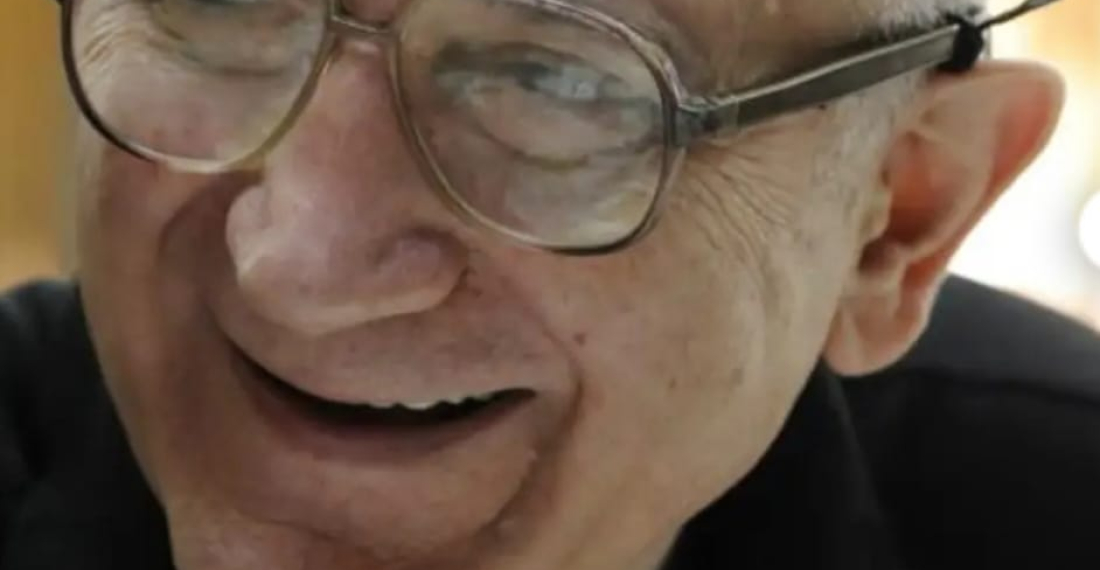
Obituary: Eldar Shengelaia – a most reluctant politician

Obituary: Eldar Shengelaia – a most reluctant politician

This obituary was written on 5 August 2025 by Dr Dennis Sammut, Director of LINKS Europe and Managing Editor of commonspace.eu


I was saddened to hear the news of the death of Georgian public figure, Eldar Shengelaia, at the venerable age of 92.

Shenngelaia connected the Georgian past with the present, and his death marks the end of an era. Shengelaia is known most for his career in cinema as a film director, and for the last thirty years of the Soviet Union his films mesmerized audiences across the USSR. From his debut film “The White Caravan” (1963), which described the difficult life of shepherds, to later more light hearted films like “An extraordinary exhibition” (1968) to “The ringers” 1973, Eldar Shengelaia walked the difficult tightrope of balancing the demands of the Soviet system, which tightly controlled all artistic expression, with his Georgian free spirit.

In 1995 Eldar Shengelaia made an unexpected appearance on the Georgian political scene. This was a defining year for Georgia. Shevardnadze had got rid of the warlords after they tried to kill him; a new constitution was adopted, and in November, the first free elections were held. The Citizens Union of Georgia (CUG) was created, with Shevardnadze as the nominal head, but with Zurab Zhvania as the effective leader. CUG won a landslide victory, and Zhvania was elected Chairman of the new parliament. There was a joke in Georgia at the time that CUG was like a watermelon, green on the outside because it was led by many people from the Greens, red on the inside, because it included many former communists and ex nomenklatura persons, with black spots on the inside, because it also included many corrupt people.

Zhvania certainly wanted CUG to be a “broad church”. Eldar Shengalaia understood the significance on the moment and became an MP, and soon Deputy Chairman of the new parliament.

Zhvania soon understood that a “broad church” brought it own problems, including discipline. At the time I used to spend a lot of time in Georgia. He asked me if  I could speak to the CUG MPs about party discipline, and about the “whip” system in the British parliament. The meeting was held in the main parliament room – there were more than 120 CUG MPs and no other room could accommodate all of them. It was chaired by Mikheil  Saakashvili, because he was the head of the CUG Parliamentary faction.  I gave my lecture on party discipline, including the grisly details of the whip system in the British parliament. I could see many MPs were not happy.

After the meeting, Eldar Shengelaia approached me. He had been to some of our meetings so we knew each other. “Its incredible”, he told me. “I could never believe such a system could exist in a democratic country like Britain”. It was one of the hard truths that Eldar Shengelaia had to deal with during his short time in politics. He was a most reluctant politician. However, in 1995, given the circumstances of the time, he did the right thing by getting involved in politics. But his heart was always in cinema, and that is how he will be best remembered.

This obituary was written on 5 August 2025 by Dr Dennis Sammut, Director of LINKS Europe and Managing Editor of commonspace.eu

Related articles

Editor's choice
News
UAE says it will withdraw from Yemen, but division emerges in Yemeni presidential council

UAE says it will withdraw from Yemen, but division emerges in Yemeni presidential council

In a move seen as an attempt to de-escalate a crises with Saudi Arabia, the United Arab Emirates, on Tuesday (30th December) announced that it was heeding a call to withdraw its troops from Southern Yemen. UAE says that its presence included counter-terrorism teams that were crucial in fighting against Islamist groups. UAE sources said that parts of Yemen not controlled by the Houthis have had Al Qaeda in the Arab Peninsula (AQAP) operatives using the territory to launch attacks on Europe, the US and Middle East. UAE teams have co-ordinated with American and British special forces and intelligence. The sources added that Emirati forces and their Yemeni allies also helped reverse Houthi gains in the south. including the liberation of Aden port. The small UAE contingent has remained in place since the UAE withdrew most of its military personnel in 2019. The leading English-language newspaper in Abu Dhabi, The National, said that the main UAE force was based at Riyan Mukalla International Airport, with access to fixed-wing aircraft and helicopters, but also operated smaller contingents in the port town Balhaf and Shabwa. "It is understood it also flew a number of drones from the airbase that were able to track terrorist movements, pass information back to its allies and assisted special forces' missions." Meanwhile a division has emerged in Yemen's presidential council after four members denounced what they called the 'unilateral decisions' by the chairman. Four of Yemen’s eight Presidential Leadership Council members on Tuesday denounced an announcement by the council’s chairman accusing him of breaching the governing agreement. Tension between Yemeni leaders has been rising for weeks, underscoring the fragility of the country's already fractured political landscape and further complicating efforts to confront the Iran-backed Houthi rebels. The latest rift took an unprecedented turn on Tuesday morning, marked by a Saudi-led coalition “limited operation” striking combat vehicles Riyadh linked to the Southern Transitional Council, which has three members in the PLC. The PLC Chairman, Rashad al Alimi, on Tuesday said that he was seeking to cancel the joint defence agreement with the UAE. “What has been issued … constitutes a clear violation of the Declaration of the Transfer of Power [agreement], which explicitly stipulates that the Presidential Leadership Council is a collective body whose decisions are taken by consensus, or by majority when consensus is not possible,” the statement by the four members said. “It does not, under any circumstances, allow for unilateral decision-making on sovereign, military, or major political matters." The statement was signed by STC chief Aidarous Al Zubaidi, Faraj Al Bahsani, Tariq Saleh and Abu Zaraa al Muharrami. (click the picture to read the full article).

Popular

Editor's choice
News
UAE says it will withdraw from Yemen, but division emerges in Yemeni presidential council

UAE says it will withdraw from Yemen, but division emerges in Yemeni presidential council

In a move seen as an attempt to de-escalate a crises with Saudi Arabia, the United Arab Emirates, on Tuesday (30th December) announced that it was heeding a call to withdraw its troops from Southern Yemen. UAE says that its presence included counter-terrorism teams that were crucial in fighting against Islamist groups. UAE sources said that parts of Yemen not controlled by the Houthis have had Al Qaeda in the Arab Peninsula (AQAP) operatives using the territory to launch attacks on Europe, the US and Middle East. UAE teams have co-ordinated with American and British special forces and intelligence. The sources added that Emirati forces and their Yemeni allies also helped reverse Houthi gains in the south. including the liberation of Aden port. The small UAE contingent has remained in place since the UAE withdrew most of its military personnel in 2019. The leading English-language newspaper in Abu Dhabi, The National, said that the main UAE force was based at Riyan Mukalla International Airport, with access to fixed-wing aircraft and helicopters, but also operated smaller contingents in the port town Balhaf and Shabwa. "It is understood it also flew a number of drones from the airbase that were able to track terrorist movements, pass information back to its allies and assisted special forces' missions." Meanwhile a division has emerged in Yemen's presidential council after four members denounced what they called the 'unilateral decisions' by the chairman. Four of Yemen’s eight Presidential Leadership Council members on Tuesday denounced an announcement by the council’s chairman accusing him of breaching the governing agreement. Tension between Yemeni leaders has been rising for weeks, underscoring the fragility of the country's already fractured political landscape and further complicating efforts to confront the Iran-backed Houthi rebels. The latest rift took an unprecedented turn on Tuesday morning, marked by a Saudi-led coalition “limited operation” striking combat vehicles Riyadh linked to the Southern Transitional Council, which has three members in the PLC. The PLC Chairman, Rashad al Alimi, on Tuesday said that he was seeking to cancel the joint defence agreement with the UAE. “What has been issued … constitutes a clear violation of the Declaration of the Transfer of Power [agreement], which explicitly stipulates that the Presidential Leadership Council is a collective body whose decisions are taken by consensus, or by majority when consensus is not possible,” the statement by the four members said. “It does not, under any circumstances, allow for unilateral decision-making on sovereign, military, or major political matters." The statement was signed by STC chief Aidarous Al Zubaidi, Faraj Al Bahsani, Tariq Saleh and Abu Zaraa al Muharrami. (click the picture to read the full article).
