


Opinion: Ahead of November, Armenia and Azerbaijan juggle for their geopolitical position

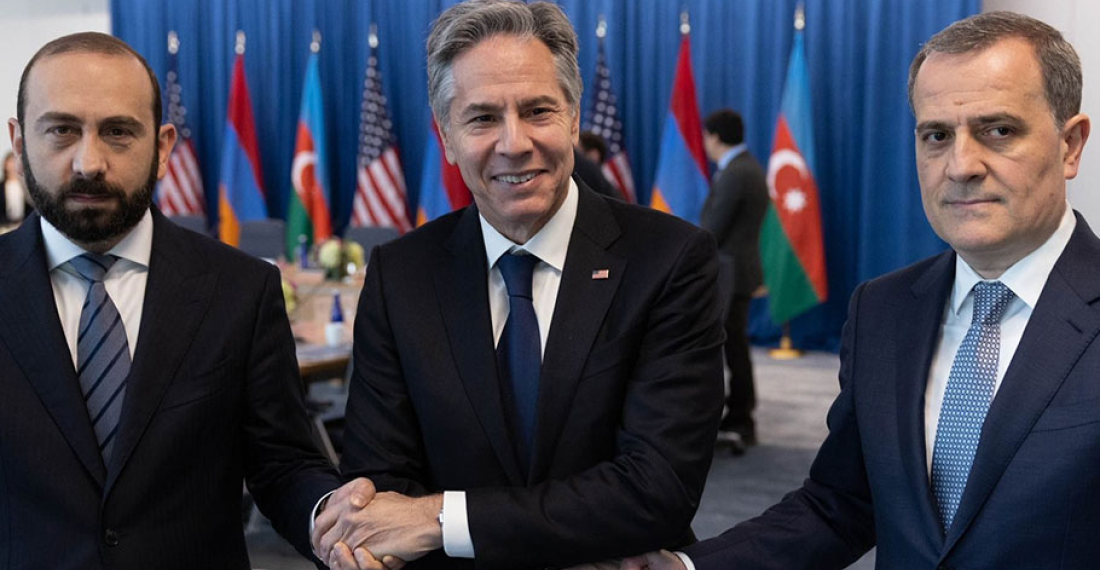
In the lead-up to this year's NATO Summit in Washington D.C., it was uncertain whether Armenian Foreign Minister Ararat Mirzoyan and Azerbaijani Foreign Minister Jeyhun Bayramov would meet. However, a last-minute announcement confirmed that they would, albeit not in a bilateral format, but with U.S. Secretary of State Antony Blinken. Expectations were low, given disagreements over Azerbaijani demands for Armenia to change its constitution and the United States now apparently pushing its own vision for unblocking trade and communication in the region. Nonetheless, Blinken again emphasised that the two were close to reaching a deal. The foreign ministers issued identical scant three-paragraph statements which at least referred to a “historic agreement.”

Meanwhile, Moscow expressed its displeasure at both foreign ministers being invited to the event, which also marked the 75th anniversary of the military alliance in existence to counter the former Soviet Union at first and now the Russian Federation.     

For Armenia, as it seeks to diversify its economic, energy, and security needs away from its former sponsor, such a posture is now welcomed as it seeks external support to balance itself against Azerbaijan. Prime Minister Nikol Pashinyan is now also reliant on Western support as he seeks to reverse his declining ratings. He has also found it useful to make Russia a scapegoat for his own security failings that saw the collapse of previous negotiations prior to September 2020 when war broke out instead. The same is true for the exodus of just over 100,000 ethnic Armenians from Karabakh last year. For Azerbaijan, however, the situation is more complex. Baku is cautious about being drawn into geopolitical confrontations, especially given its shared border with the Russian Federation.

As a result, Baku has to be more flexible in its geopolitical manoeuvring while Yerevan has significantly less options in comparison.

Nonetheless, for the United States and European Union, any successful diversification by Armenia means normalisation with Azerbaijan and Türkiye. The country is landlocked and needs access to both Europe and later Central Asia. This therefore concerns Iran, one of its two trade routes operating given closed borders with its other neighbours. Only last week the Iranian State Media reported that if normalisation occurs then efforts must be made to increase the amount of gas supplied to Armenia when a barter agreement for electricity in return expires in 2030. Otherwise, Azerbaijan and Türkiye will take the initiative if the United States has its way.

However, achieving that would require not only normalising relations with Azerbaijan but prematurely ending Gazprom's monopoly on the Armenian market and its pipelines, something set to continue until 2043. Some analysts supportive of Pashinyan have suggested the nationalisation of these pipelines, but that would be a significant gamble. Despite U.S. ambitions to bypass and exclude China and Russia from new regional trade routes neither Armenia nor Azerbaijan likely share this view. Even in 2001, a month after talks between then-presidents Robert Kocharyan and Heydar Aliyev at Key West, Pashinyan expressed such a perspective in his Haykakan Zhamanak newspaper. Even over two decades ago, the country's long-term future rested on financially benefiting from everyone if a trade route from Azerbaijan to Nakhchivan via Armenia was restored, he wrote.

At any rate, following the talks between Bayramov, Mirzoyan, and Blinken at the recent NATO summit, many analysts are skeptical that anything will emerge from it. First, the Biden administration might have less than six months left in office, though this is of course unknown, and secondly, neither side seems able to trust each other. The main difference between them is that while Baku can afford to wait for a deal, Yerevan cannot since Pashinyan needs to demonstrate how his “peace agenda” paid off and brought with it human, political, and security benefits by the time of elections set for mid-2026 at the latest. The stakes will be even higher if nothing comes by next year.

On July 18th, both Aliyev and Pashinyan could attend the next European Political Community (EPC) summit at Blenheim Palace in the United Kingdom. It is worth noting, however, that Azerbaijan withdrew from the last EPC in Granada. Whether that happens again next week will be particularly revealing given that Hungary, a country considered the closest to Azerbaijan and Russia in the European Union, will host the following EPC on 7 November. This means that the EPC in Budapest will occur not only two days after the U.S. presidential elections on 5 November but also four days before the UN Climate Change Conference in Baku on 11 November. All three events could therefore prove pivotal. Hopes, though diminishing, were for some kind of agreement to be signed by COP-29.

Assuming one is to come, though there is so far no indication that it will, few are expecting a comprehensive peace treaty. A framework agreement, however, would be better than none. Consider it at least akin to the Basic or Madrid Principles drawn up during the heyday of the OSCE Minsk Group but which were never officially endorsed, thus leading to the 44-day-war in 2020. Even though a comprehensive agreement is the ideal, it is imperative that past mistakes are not repeated again.

source: Onnik James Krikorian is a journalist, photojournalist, and consultant from the U.K. who has covered the Armenia-Azerbaijan conflict since 1994. 
photo: US Secretary of State Anthony Blinken, hosted Armenian Foreign Minister Ararat Mirzoyan and Azerbaijani foreign minister Jeyhun Bayramov, for talks in Washington DC in July on the margins of the NATO summit
Correction: This opinion piece initially listed the start of COP29 in Baku as 9 November.

The views expressed in opinion pieces and commentaries do not necessarily reflect the position of commonspace.eu or its partners

Related articles

Editor's choice
News
Borrell tells the European Parliament that the situation in Afghanistan was critical, but the EU will remain engaged

Borrell tells the European Parliament that the situation in Afghanistan was critical, but the EU will remain engaged

Borrell underlined that the European Union will make every effort to support the peace process and to remain a committed partner to the Afghan people. "Of course, we will have to take into account the evolving situation, but disengagement is not an option.  We are clear on that: there is no alternative to a negotiated political settlement, through inclusive peace talks.
Editor's choice
News
NATO Chief says war is on Europe's doorstep, and warns against complacency

NATO Chief says war is on Europe's doorstep, and warns against complacency

Russia could attack a Nato country within the next five years, the Secretary General of NATO, Mark Rutte, said in a stark new warning. "Nato's own defences can hold for now," Rutte warned in Berlin, but conflict was "next door" to Europe and he feared "too many are quietly complacent, and too many don't feel the urgency, too many believe that time is on our side. "Russia is already escalating its covert campaign against our societies," Rutte said in a speech in Germany. "We must be prepared for the scale of war our grandparents or great-grandparents endured." Earlier this month, Russia's President Vladimir Putin said his country was not planning to go to war with Europe, but it was ready "right now" if Europe wanted to - or started a war. But similar reassurances were given by Moscow in 2022, just before 200,000 Russian troops crossed the border and invaded Ukraine. Putin has accused European countries of hindering US efforts to bring peace in Ukraine - a reference to the role Ukraine's European allies have recently played in trying to change a US peace plan to end the war, whose initial draft was seen as favouring Russia. But Putin was not sincere, Nato's secretary-general said in the German capital, Berlin. Supporting Ukraine, he added, was a guarantee for European security. "Just imagine if Putin got his way; Ukraine under the boot of Russian occupation, his forces pressing against a longer border with Nato, and the significantly increased risk of an armed attack against us." Russia's economy has been on a war footing for more than three years now - its factories churn out ever more supplies of drones, missiles and artillery shells. According to a recent report by the Kiel Institute for the World Economy, Russia has been producing each month around 150 tanks, 550 infantry fighting vehicles, 120 Lancet drones and more than 50 artillery pieces. The UK, and most of its Western allies, are simply not anywhere near this point. Analysts say it would take years for Western Europe's factories to come close to matching Russia's mass-production of weapons. "Allied defence spending and production must rise rapidly, our armed forces must have what they need to keep us safe," the Nato chief said.

Popular

Editor's choice
News
NATO Chief says war is on Europe's doorstep, and warns against complacency

NATO Chief says war is on Europe's doorstep, and warns against complacency

Russia could attack a Nato country within the next five years, the Secretary General of NATO, Mark Rutte, said in a stark new warning. "Nato's own defences can hold for now," Rutte warned in Berlin, but conflict was "next door" to Europe and he feared "too many are quietly complacent, and too many don't feel the urgency, too many believe that time is on our side. "Russia is already escalating its covert campaign against our societies," Rutte said in a speech in Germany. "We must be prepared for the scale of war our grandparents or great-grandparents endured." Earlier this month, Russia's President Vladimir Putin said his country was not planning to go to war with Europe, but it was ready "right now" if Europe wanted to - or started a war. But similar reassurances were given by Moscow in 2022, just before 200,000 Russian troops crossed the border and invaded Ukraine. Putin has accused European countries of hindering US efforts to bring peace in Ukraine - a reference to the role Ukraine's European allies have recently played in trying to change a US peace plan to end the war, whose initial draft was seen as favouring Russia. But Putin was not sincere, Nato's secretary-general said in the German capital, Berlin. Supporting Ukraine, he added, was a guarantee for European security. "Just imagine if Putin got his way; Ukraine under the boot of Russian occupation, his forces pressing against a longer border with Nato, and the significantly increased risk of an armed attack against us." Russia's economy has been on a war footing for more than three years now - its factories churn out ever more supplies of drones, missiles and artillery shells. According to a recent report by the Kiel Institute for the World Economy, Russia has been producing each month around 150 tanks, 550 infantry fighting vehicles, 120 Lancet drones and more than 50 artillery pieces. The UK, and most of its Western allies, are simply not anywhere near this point. Analysts say it would take years for Western Europe's factories to come close to matching Russia's mass-production of weapons. "Allied defence spending and production must rise rapidly, our armed forces must have what they need to keep us safe," the Nato chief said.

