


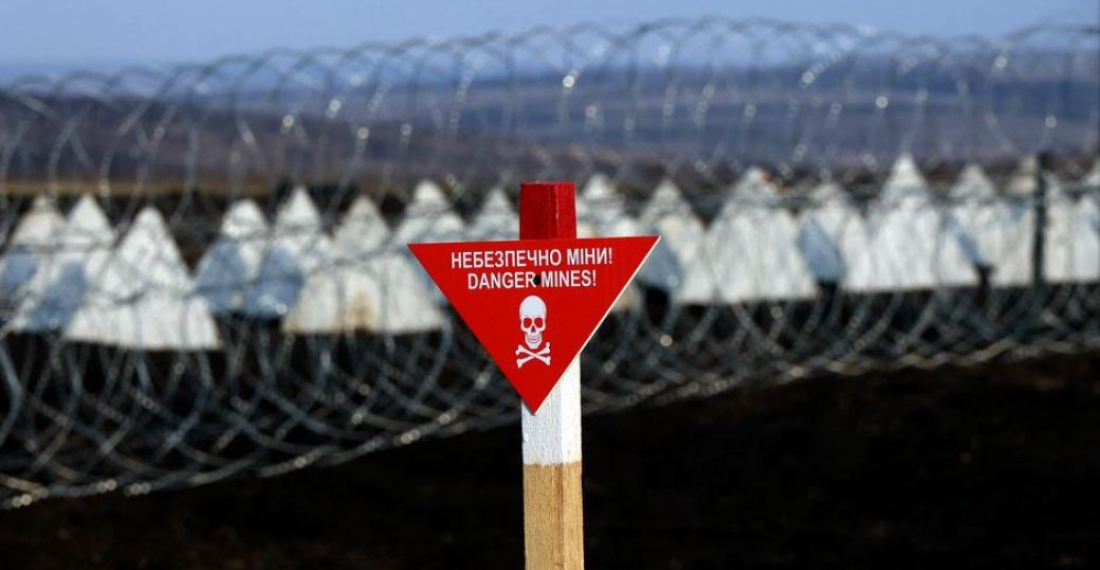
Landmines remain a global threat to civilians, but international resolve to eliminate them is wavering

This article, written by David Ehl, was first published by the German broadcaster, Deutsche Welle (DW) in English on 26 August 2026. It was originally published in German


Raheela Bibi was outside playing with her siblings when a landmine exploded. It was August 2020 and she was 12, living in Pakistan. Both her hands were amputated after the incident. Her sister suffered a serious leg injury, while her brother's eye was hurt. Bibi told DW in 2023 that though it was extremely difficult for her to do her homework, she was determined to continue with her education.

In 2025, more than 5,000 people, mainly civilians, were killed or injured by landmines or unexploded ordnance according to a preliminary analysis by the NGO Landmine and Cluster Munition Monitor. In South Sudan, 90% of the victims last year were children.

Landmines are actually designed to injure adults not kill them. This is because an injured soldier is more of a strain on an enemy country's resources than a dead soldier. But in peacetime, landmines continue to pose a deadly threat not only to soldiers but to civilians and particularly children, who often die.

Decades after the brutal conflicts from 1991 to 2001 that were Yugoslav wars, people continue to be killed and injured by landmines in former Yugoslavia, particularly Bosnia and Herzegovina.

What is the Ottawa Treaty?

In 1999, there were approximately 25,000 landmine casualties per year. This prompted pressure to ban the use of anti-personnel landmines. In 1997, representatives from more than 120 countries signed the Ottawa Treaty, which became legally binding in 1999. In total, 166 countries ratified the treaty, but not China, India, Russia or the US.

Since Russia's full-scale invasion of Ukraine in 2022, five European NATO countries, which share a border with Russia, have withdrawn from the treaty. Ukraine has also withdrawn though this will not take legal effect until the war ends.

"This is a dangerous precedent that European states, of all countries, have set," Simone Wisotzki from the Frankfurt-based Leibniz Peace Research Institute (PRIF) told DW. "Other parties to the Ottawa Treaty, which could also face equally extreme situations in times of conflict, could take the same step. We would then have to deal with more withdrawals, which would, of course, undermine the legitimacy of the entire treaty."

Last year, Ukraine withdrew from the treaty and justified the move citing the actions of Russia, which has never ratified the treaty and has been using mines in Ukrainian territory. "We cannot remain bound under conditions when the enemy has no restrictions," said Roman Kostenko, the secretary of the Ukrainian parliament's committee on national security, defense and intelligence.

If a country isn't at war, its withdrawal from the Ottawa Treaty is supposed to take effect six months after its announcement. If it is at war, however, withdrawal should take effect only after a peace treaty has been signed. Despite the legal uncertainty, Ukraine is reportedly already using mines, albeit on a much smaller scale than Russia.

A quarter of Ukraine affected by landmines

According the United Nations Mine Action Service (UNMAS), as of mid-2025 approximately 25% of Ukraine was affected by landmines and explosive ordnance. This applied not only to Ukrainian-controlled territories but also to Russian-occupied areas in the east and southeast of the country.

"Since February 2022, over 1,150 civilians have been killed or injured by landmines and explosive remnants of war (ERW)," UNMAS writes on its website, pointing out that the cost of full demining is estimated at just under $35 billion (approx. €30 billion) over 10 years.

Poland, Finland (which joined NATO after Russia's full-scale invasion of Ukraine), Latvia, Lithuania and Estonia, which have all suffered from Russian aggression and occupation in the past, also decided to withdraw from the Ottawa Treaty last year.

Polish Prime Minister Donald Tusk has stated on several occasions that his country wants to be able to mine its eastern borders with Russia very quickly if need be. The state-owned Polish defense company Belma has been contracted to produce anti-personnel mines in large quantities. Lithuania has also announced that it will resume the manufacture and purchase of landmines.

The Finnish military has said that if mines are necessary, they should be laid responsibly, accurate maps of their position must be created and there should be precise plans for demining.

Wisotzki from PRIF said that this is progress compared to the past but that modern anti-personnel mines often have integrated sensors and smart technologies that make it difficult to remove and destroy the mines.

"That's why I'm very critical of this and say that even new technologies present problems that, in turn, make mine clearance more difficult. In practice, mines are always laid in areas that are also used by civilians. They then remain in those territories and then injure civilians disproportionately."

In its reports, the Landmine and Cluster Munition Monitor has pointed out that while mines that were laid during past conflicts continued to be cleared, mines continue to be laid in Ukraine or in other countries such as Myanmar.

Where does global arms control stand?

This comes at a time when there is increasingly less arms control. In the past few years, three major agreements between the United States and Russia have expired or been terminated: the Intermediate-Range Nuclear Forces Treaty that banned all nuclear and conventional ground-launched ballistic missiles, cruise missiles and missile launchers with intermediate range; the New Start Treaty which is a nuclear arms reduction treaty; and the Treaty on Open Skies, which set out the framework for a regime of observation flights over the territory of participating states.

In 2023, Russia's withdrawal also effectively put an end to the CFE treaty that aimed to create a secure and stable balance of conventional armed forces in Europe and to remove the capability to launch surprise attacks or large-scale offensives

"Humanitarian arms control — which includes the Anti-Personnel Mine Ban Convention — was in effect the only area that could still be said to be working," Wisotzki said. "And that is no longer the case."

source: This article, written by David Ehl, was first published by the German broadcaster, Deutsche Welle (DW) in English on 26 August 2026. It was originally published in German

 

Latest

Editor's choice
News
Lula wins fourth term in Brazil, Vucic loses in Serbia

Lula wins fourth term in Brazil, Vucic loses in Serbia

In elections on both sides of the Atlantic, that are likely to have deep implications for their respective regions, one incumbent won, another lost. In Brazil, Latin America's biggest country, left-wing President Lula won a fourth term in office, defeating his right-wing challenger Flávio Bolsonaro. The 80-year-old, took just under 52% of the vote in a run-off on Sunday. Lula thanked cheering supporters in São Paulo and said he had defended Brazil's democracy. His opponent, Flavio Bolsonaro - who won the first round - says the result is "inexplicable" and called for it to be annulled. His father, ex-president Jair Bolsonaro, is currently serving a jail sentence under house arrest for plotting a coup after losing the last election. This election was bitterly fought - and it bucks a wider regional trend towards right-wing leaders. On the other side of the Atlantic, in Serbia, long-standing leader Aleksandar Vučić has admitted defeat to the student-led protest movement in snap parliamentary elections. "We still do not have final results... it is clear that we have lost these elections," the right-wing populist leader said as he conceded late on Sunday. Preliminary figures from Serbia's election commission indicated a record high turnout, which commentators had suggested would favour the student movement. Celebrations erupted after Vučić conceded. Vučić called the snap elections after two years of protests triggered by the collapse of a train station canopy in the city of Novi Sad, which killed 16 and was seen as emblematic of corruption and negligence. Both election results are going to have a deep impact on their respective regions.

Popular

Editor's choice
Monday Commentary
Monday Commentary: European-Azerbaijan relations need an intensive and multifaceted dialogue that is frank and honest

Monday Commentary: European-Azerbaijan relations need an intensive and multifaceted dialogue that is frank and honest

Last week I visited Baku, Azerbaijan. My visit was relatively short, but very intensive, and had many meetings with stakeholders and colleagues. When I arrived in Baku first time in 1996,  Azerbaijan was a different country: weak, poor, and shaken by defeat in war. For thirty year the Karabakh issue dominated the agenda: the political agenda but also the popular mindset. Now, thirty years later, Azerbaijan has returned to Karabakh, and peace with Armenia is on the horizon. It is a new era for Armenia-Azerbaijan relations, for the South Caucasus, but also for Europe.  But we cannot be complacent: the Peace agreement has been initialed but not signed; borders remain closed; TRIPP is ambitious but remains an idea; and there are spoilers who want to turn the clock back. We must not allow them, and in this Europe and Azerbaijan must work together. Europe’ vanguard organization is the European Union – it is a free union of 27 member states; it is a strong global economic force, and increasingly a diplomatic and military force too. But it remains “work in progress” and can often appear dysfunctional. It often lacks collective and institutional memory. In its dealings with Azerbaijan the EU has made many mistakes – not least opening the delegation here late – in 2008. It sometimes appears condescending. Some utterances from the European Parliament and from some quarters in some member states are not understandable even for me. They irritate the Azerbaijanis, but serve no other purpose But Azerbaijan has also not handled relations with the EU well. It has failed to respond when the hand of friendship reached out; and it confused irritating actions, sometimes by well-meaning people; sometimes by outright spoilers, with strategic action. In short, EU-Azerbaijan relations have suffered from a lack of proper dialogue. This dialogue must be frank, honest and multi-faceted involving different segments of society on both sides.   Is Azerbaijan Europe? When Azerbaijan applied to join the Council of Europe in the 1990s, there were some who opposed, saying this was not Europe. I was one of the people who argued that Armenia and Azerbaijan may be on the periphery of the continent geographically, but were European in essence. Certainly their elites. During the discussion on 4 September in Baku, my friend Farhad Mammedov, mentioned that Azerbaijan is not interested in joining the EU, and was now close to the Central Asian countries in the 5 plus 1 format. Neither things mean that Azerbaijan is not Europe. There are several European countries that are not in the EU, and do not want to be, for example Norway and Switzerland. Iceland has recently voted to stay out of the EU. The UK was a member and left. Europe is bigger than the EU, and the holding of the European Political Community summit in Baku in 2027 proves that. Despite all the rhetoric, I never heard the president of Azerbaijan  saying that Azerbaijan is not Europe, nor have I heard any European president say it either. Not wanting to join the EU and forging close relations with neighbouring regions does not make Azerbaijan any less European. It is only logical that when Europeans talk to Azerbaijan they talk like family. The conversation is often frank. It must also be honest, and Europeans need always to remember this too. A frank, honest and multi-faceted dialogue A frank, honest and multifaceted dialogue will contribute to relations between Azerbaijan and the rest of Europe: it will avoid misperception, which unfortunately is very common on both sides; it will provide a forum where problems can be discussed and resolved, and it will increase mutual trust, so that together common problems can be addressed. (click image to read the full Monday Commentary)
Editor's choice
Monday Commentary
Monday Commentary: “The barren rocks of Aden” and “These lands of Yemen are so ruthless”

Monday Commentary: “The barren rocks of Aden” and “These lands of Yemen are so ruthless”

There are two early 20th-century tunes that mark foreign attempts to occupy and “pacify” Yemen. The Scottish tune “The barren rocks of Aden” marks the mobilisation of Highland soldiers, enlisted to be deployed to the Yemeni port of Aden, that in 1837 became the last colony to be incorporated into the British Empire. The tune talks of the harshness of the terrain, but is celebratory, It was even played as a farewell tune to Sir William Luce at the parade in Sharjah celebrating his end as “British Viceroy” in the Middle East in 1966. The second tune is an Anatolian lament. As Ilker Sezer reminded us this weekend, in his weekly feature on “Turkiye Today”, it “mourns the tragic fate of Ottoman soldiers dispatched to the harsh, remote deserts of Yemen during the fall of the empire, young men who marched away from their villages and never returned home. Most of their names, and numbers, were never recorded. Yet, their fate left a mark on the Turkish psyche.” Subsequent invaders have discovered that Yemen is a grave that cannot be overcome by the strength of modern technology, and that whilst Yemeni society is splintered and divided, building a reliable alliance with Yemeni factions is difficult. These are the harsh lessons facing Saudi Arabia, as the Kingdom faces its biggest challenge in its modern history. The leadership of the Kingdom now has to respond decisively. At stake is their very credibility. This is likely to be a long and messy conflict. Saudi military objectives need to be focused: to box in the Houthis rather than destroy them. This is likely to include: (a) regaining territory lost on the Red Sea coast; (b) control over Bab el Mandeb Strait; (c) some kind of cordon sanitaire on the Saudi-Yemeni border; and if things go well (d) the capture of Sanaa. All this would not eliminate the Houthi problem, but it will contain it. In the end the Saudis will have to continue managing Yemen with a mixture of carrot and stick. For the moment, the stick is likely, but the carrot cannot be forgotten either. (click the image to read the Monday Commentary in full)
