


Europe goes to the Caucasus, but that is just the beginning of the story
This is the Monday Commentary prepared by Dr Dennis Sammut, Director of LINKS Europe and Managing Editor of commonspace.eu
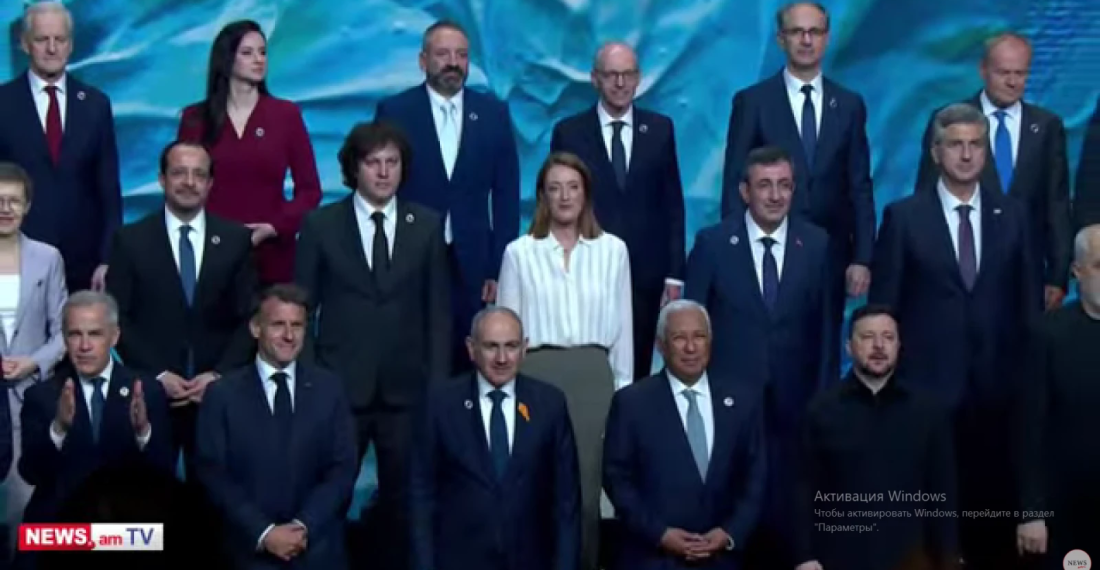
Dozens of European presidents, prime ministers, and other senior leaders descended on Yerevan last week to participate in the 8th Summit of the European Political Community (EPC). For a day or two, you could not go anywhere in the centre of the Armenian capital without bumping into a European leader and his entourage.
The summit itself was by and large uneventful, with seven-minute set-piece speeches, during which leaders heaped praise on Armenian Prime Minister Nikol Pashinyan. This followed the traditional welcome, whereby leaders were greeted individually by Pashinyan, which lasted for hours. There was an unusually long “red carpet’. NATO Secretary General, Mark Rutte sprinted the last part of his walk, remarking that this was the “longest red carpet ever”. But otherwise, the Summit was uneventful. There was speculation about the Azerbaijani participation in the Summit. In the end, President Ilham Aliyev addressed the summit online. It would have been nice if he were present in person, but clearly, not possible yet, and an online presence was the next best thing.
The following day, it was time for bilateral relations, and the first EU-Armenia summit took place with the participation of Ursula von der Leyen, president of the European Commission, and Antonio Costa, president of the European Council. This was a more substantial affair, during which the EU heaped praise, and some financial support for Armenia, and importantly highlighted how it proposed to engage with Armenia in the future. Armenia had made the journey from being a Russian outpost, which it was until 2018, to becoming the EU’s favorite in the South Caucasus – a “status” achieved not least because of Azerbaijani aloofness, and Georgia’s bizarre anti-EU trajectory.
On 4-5 May, Europe went to the Caucasus, but the consequences are far from clear.
The European show of strength in Yerevan, at least in numbers, did not go unnoticed in Moscow. In public, Russia has tried to show it is not unduly concerned, but there has been a lot of gnashing of teeth in Moscow behind the scenes, and sometimes in public too. The Armenian Ambassador to Russia was summoned to the Russian Foreign Ministry for a dressing down about the presence of Ukrainian president Zelenskiy at the EPC summit, and his speech there; Vladimir Putin himself casually remarked that Armenia was a member of the Eurasian Economic Union (EAEU), and this was incompatible with Armenia’s EU aspirations. We all remember the circumstances in which Armenia joined the EAEU, but that notwithstanding, the Pashinyan government has been carefully balancing EAEU membership with closer relations with the EU. Putin’s intervention was therefore misguided and misleading.
But there is a more important core issue here. Putin’s whole strategy, including the war against Ukraine, is aimed at consolidating the Russian position in the near abroad. Armenia looked in that regard like a Russian success story. Not anymore. And last week was a visible expression of a new Armenia, and a new resolve of Europe to stand with Armenia in the face of Russian bullying and pressure.
Europe’s embrace of Armenia was also watched carefully by another geopolitical regional player - Iran. Iran may have its hands full at the moment with the ongoing war with the US and Israel. But the Caucasus countries, and particularly Armenia and Azerbaijan, have a border with Iran, not to mention centuries of historical relations. What happens in the Caucasus is of primary interest to Iran. Managing this interest is a challenge for the region and whoever engages with it.
The third geopolitical player that was watching the Europeans gathered in Yerevan is the United States. For a moment, one could sense that the US was losing interest in the region. Then came 8th August, and the Trump-Aliyev-Pashinyan meeting in the White House. Trump discovered the Caucasus, and it appeared to give him the success story as a peacemaker that he longed for. From that came TRIPP, “an idea and a route” that will require a lot of money and political will to implement. That was already in question before 28th February. Now, as a minimum, all sides will have to go back to the drawing board. After 8 August, the EU was left looking rather silly, with all its efforts since 2021 at Armenia-Azerbaijan peace and reconciliation, overshadowed by Trump’s theatrics. But there is now a new reality, and the EU may have a role yet.
For Armenia, Azerbaijan remains the elephant in the room. Pashinyan has gone a long way to redefine Armenia-Azerbaijan relations. This is still “work in progress”. But the EU needs to engage carefully and sensitively, but not meekly, on this issue too. Kaja Kallas, the EU High Representative, went to Baku immediately after Yerevan to emphasise this inclusivity.
On the same day (6 May), EU Special Representative for the South Caucasus Magdalena Grono spoke about the Armenia-Azerbaijan peace process and the role of external players during a panel discussion held within the framework of the Yerevan Dialogue international forum 2026.
EUSR Grono noted that the Armenia-Azerbaijan peace process has been a “wonderful and powerful” one, adding that it has received important support from external partners.
“I think that the two capitals themselves were the owners of this project and gave it crucial importance,” she said.
Grono underscored the role of the leadership shown by both sides, noting that they want to be partners in the sense that the agenda is set by the regional actors themselves, while external partners support where their approach is useful.
She added that all possibilities for cooperation had been discussed, expressing hope for new opportunities for regional cooperation when the time is right. She also stressed the importance of addressing humanitarian issues.
In Yerevan last week, the European Union and wider Europe assembled in the EPC, showing its commitment to Armenia and the South Caucasus region. It was necessary. It was timely, but it was also just a start.
In its approach to the South Caucasus over the last thirty years, Europe has been largely reflexive: responding to events. It has lacked a strategic approach and a regional vision. Both require patience, perseverance, and flexibility, but in the end, they make policy towards the region more sustainable.
In the South Caucasus, people have long memories, and the EU has no institutional memory. It fails to build on its own success, and it fails to learn from its mistakes. The region is too important and is too close to Europe either to be ignored or to be approached lightly.
The Armenian parliamentary elections on 7 June will define Armenia’s future, as well as that of the region. In many ways, the EPC Summit and Armenia-EU summit were a loud statement of support for the current Armenian trajectory. However, in the end, it is up to the Armenian people to make a decision. Europe must support the democratic process that makes this possible, and after 7 June, must be ready to stand with Armenia in case Moscow and Tehran do not like the result.
Source: This is the Monday Commentary prepared by Dr Dennis Sammut, Director of LINKS Europe and Managing Editor of commonspace.eu



