Editor's choice
This is a members’ functionality. Please
Sign upGULF CRISIS
Trending
European countries close ranks with Gulf allies: British planes to defend Saudi Arabia; the Sultan of Oman in London; Macron in Qatar.
21 October 2026
Amid increased tension in the Gulf, European countries are closing ranks with allies in the region. The United Kingdom announced it will deploy RAF Typhoon jets to defend Saudi Arabia in response to escalating Houthi missile and drone attacks, the government has said.
The defensive mission will help defend Saudi cities and infrastructure - a move authorised by Prime Minister Andy Burnham - against aerial attacks by the Iran-backed group.
It follows Houthi attacks on the Saudi capital Riyadh, as well as on energy sites on the country's coast."These aircraft will operate in a defensive role and will not conduct offensive strikes against the Houthis," Defence Secretary Wes Streeting said in a written statement on Tuesday.
The news came the same day that the Sultan of Oman started a three day State visit to London. Oman is a long time friend and ally of the UK in the region.
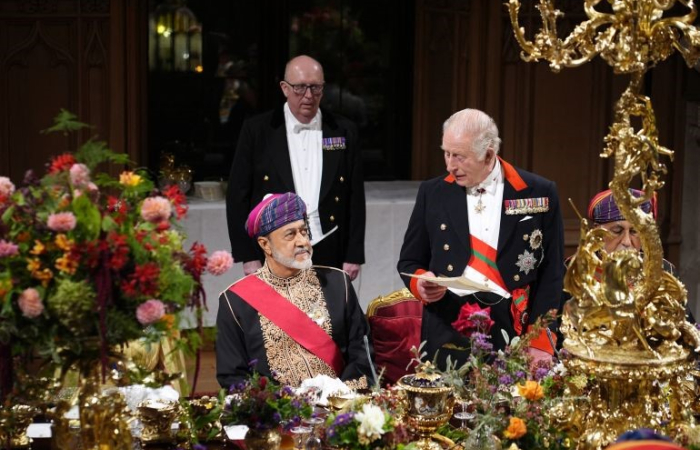
Britain’s King Charles III has welcomed Oman’s Sultan, Haitham bin Tariq, for a state visit, praising the Gulf Arab monarch’s efforts to broker peace in the region.
Haitham bin Tariq said his country has chosen the path of diplomacy in a region rife with conflict.
“In a region that has known too much conflict, Oman has chosen a different path, an independent path,” the Omani ruler said during a state banquet on Tuesday.
“Britain has been a friend on this path and has stood beside us in this duty,” he added.
King Charles III praised Oman’s peacemaking attempts in the Middle East, paying tribute to Muscat’s “noble efforts” to help reopen the choked Strait of Hormuz.
“I would especially like to recognise, at a time when conflict has returned so painfully to the region, Oman’s enduring commitment as a trusted interlocutor to all parties,” Charles told about 160 guests at the lavish dinner.
“Oman’s role across the Gulf and her ‘constructive neutrality’, as you put it, matters far beyond Hormuz, and is worthy of our utmost respect,” Britain’s king added in a toast to the Omani sultan.
In the meantime French President Emanuel Macron is on a tour in the region, visiting, Kuwait, Bahrain, UAE and Qatar.
The French leader is hoping to strengthen defence ties and energy supplies amid major disruption to global fuel shipments arising from the US-Israel war on Iran. He has already visited Kuwait and the United Arab Emirates (UAE) as part of his three-day trip. His next stop is Qatar
On the first day of Macron’s trip, France and Kuwait signed eight agreements and cooperation documents covering defence, artificial intelligence, investment and more.
Macron then met UAE President Sheikh Mohamed bin Zayed Al Nahyan in Abu Dhabi on Monday. The two leaders reaffirmed their commitment to advancing cooperation in energy, advanced technology and artificial intelligence (AI).
According to the French Foreign Ministry, the UAE is France’s biggest importer in the Gulf, with bilateral trade standing at 10.8 billion euros ($12.1bn) in 2025. According to the Stockholm International Peace Research Institute (SIPRI), France supplied 18 percent of the UAE’s arms and defence imports in 2025 – the second highest after the United States, at 42 percent.
But this isn’t all about simple trade.
Andreas Krieg, a senior lecturer at King’s College London’s School of Security Studies, explained that Macron’s visit to the region is “symptomatic of a much larger geopolitical transformation”.
“We are witnessing the gradual emergence of a post-American Middle East in which Washington remains militarily powerful but increasingly struggles to exercise the political leadership it once enjoyed,” Krieg told Al Jazeera.
source: commonspace.eu with agencies