

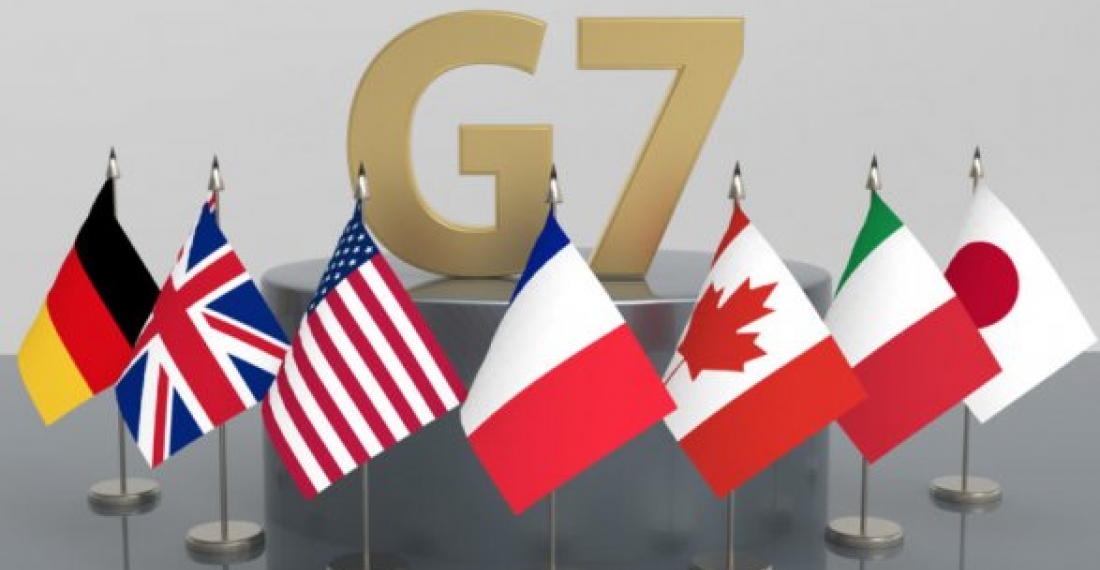
In a strongly worded statement issued on Saturday (14 May), the foreign ministers of the G7 countries have declared steadfast solidarity and support for Ukraine as it defends itself against Russia’s unjustifiable, unprovoked and illegal war of aggression, a war in which Belarus is complicit.
The foreign ministers of Canada, France, Germany, Italy, Japan, UK and US, and the High Representative of the EU stated that "they are committed to helping Ukraine, a democracy and a UN member, uphold its sovereignty and territorial integrity, to defend itself and resist future attacks or coercion, choose its own future and prosper."
In their final statement after their meeting the Ministers declared:
"In the presence of the Foreign Ministers of Ukraine and Moldova, we underscore Ukraine’s sovereignty, territorial integrity, independence and right for self-defence under the UN Charter. This war of aggression has reaffirmed our determination to reject outright attempts to redraw borders by force in violation of sovereignty and territorial integrity."
The statement added:
We are providing significant humanitarian assistance to Ukraine and its neighbours to meet urgent protection and other lifesaving needs. We continue to make substantial financial and economic support available to Ukraine to strengthen the resilience of its economy. We reaffirm our commitment to support Ukraine, including in the reconstruction of the country, and call on all partners to join our efforts to ensure support for Ukraine in meeting its immediate humanitarian and financial needs and for Ukraine to rebuild its future. We will pursue our ongoing military and defense assistance to Ukraine as long as necessary.
We reiterate our demand that Russia put an end to the war it started unprovoked and to end the tragic suffering and loss of life it continues to cause. We also continue to call on Belarus to stop enabling Russia’s aggression and to abide by its international obligations. We urge full compliance with international humanitarian law, allowing and facilitating rapid, safe and unimpeded humanitarian access as well as the humanitarian evacuation of civilians safeguarding evacuees’ freedom to choose their destination. We call on Russia to immediately comply with the legally binding order of the International Court of Justice of 16 March 2022 and to abide by the relevant resolutions of the UN General Assembly and stop its military aggression – to cease fire, and immediately and unconditionally withdraw its troops from the entire territory of Ukraine within its internationally recognised borders.
Russia has violated the UN Charter, undermined the fundamental principles of the European security architecture as enshrined in the Helsinki Final Act and the Charter of Paris and will have to face consequences for its actions. We reject any notion of spheres of influence and any use of force that is not in compliance with international law. We will never recognize borders Russia has attempted to change by military aggression, and will uphold our engagement in the support of the sovereignty and territorial integrity of Ukraine, including Crimea, and all states. We condemn as irresponsible threats of use of chemical, biological or nuclear weapons or related materials by Russia and reiterate that any use of such weapons would be met with severe consequences.
Russia’s war of aggression against Ukraine as well as its unilateral actions restraining Ukrainian agricultural exports, are leading to steep price rises in commodity markets and the threats we are now seeing to global food security. As global markets suffer from Russia’s war of choice by rising food and commodity prices, thus affecting the lives of people around the world and exacerbating existing humanitarian and protection needs, we are determined to contribute additional resources to and support all relevant efforts that aim to ensure availability and accessibility of food, energy and financial resources as well as basic commodities for all. We call on Russia to cease immediately its attacks on key transport infrastructure in Ukraine, including ports, so that they can be used for exporting Ukrainian agricultural products. We will address the causes and consequences of the global food crisis through a Global Alliance for Food Security, that is to be launched officially at the G7 Development Ministers meeting, and other efforts in close cooperation with international partners and organisations beyond the G7. We will closely cooperate with international parters and organisations beyond the G7, and, with the aim of transforming political commitments into concrete actions as planned by various international initiatives such as the Food and Agricultural Resilience Mission (FARM) and key regional outreach initiatives, including towards African and Mediterranean countries.
We underscore that our sanctions and export controls against Russia do not and will not target essential exports of food and agricultural inputs to developing countries and to this end include measures to avoid any negative consequences for the production and distribution of food. We reaffirm our commitment to protect the most vulnerable countries and people suffering from Russia’s war against Ukraine and its global repercussions.
We condemn and will systematically expose Russia's policy of information manipulation and interference, including disinformation which it employs to justify and support its war of aggression against Ukraine and which deliberately aims at manipulating public opinions domestically and worldwide with a view to covering its responsibilities in the ongoing war. We will continue to work together to address this manipulative behavior, in particular within the G7 Rapid Response Mechanism, and promote the exercise of freedom of opinion and expression and access to reliable information from free, pluralistic and independent media, notably on the war and its consequences for the world.
We stand united against Russia’s violation of the UN Charter and other fundamental principles of international law. We condemn in the strongest terms the ongoing attacks killing and wounding civilians and non-combatants, the systematic targeting of critical infrastructure and the extensive harm to healthcare personnel and facilities, as well as conflict-related sexual and gender-based violence in Ukraine. We will continue to support the ongoing investigations into violations of international law, including violations of international humanitarian law, and human rights violations and potential war crimes and crimes against humanity committed in Ukraine. We support investigations by the Prosecutor of the International Criminal Court, the Prosecutor-General of Ukraine, and other national prosecutors who are able to establish jurisdiction under national law. Further, we fully support the Commission of Inquiry mandated by the UN Human Rights Council, the UN Human Rights Monitoring Mission in Ukraine and efforts of civil society organizations to investigate violations and document potential war crimes. We commit to providing investigative support, technical expertise, funding and other assistance to work towards ensuring the accountability of those who are responsible for the atrocities and crimes committed.
A number of countries have shown solidarity and provided safe haven for those who have fled from Russia’s war of aggression. We particularly commend Moldova’s remarkable efforts in hosting so many refugees, both in relative and absolute terms. Through the Moldova Support Platform launched in Berlin on 5 April and other formats, we will support Moldova to meet short-term needs and its longer-term development and reform programme. We express our concern regarding the recent attempts to destabilise the Transnistrian region and emphasize our support to Moldova’s stability, sovereignty and territorial integrity.
We reaffirm our determination to further increase economic and political pressure on Russia, continuing to act in unity. We will do so, as underlined by G7 Leaders on 8 May, by imposing coordinated further restrictive measures on Russia‘s economy and financial system; by further targeting Russian elites including economic actors, the central government institutions and the military, that enable President Putin to lead his war of choice; and by isolating Russia from our economies, the international financial system, and within global institutions. We will broaden our sanctions measures to include sectors on which Russia has a particular dependence.
We commend partners that have aligned with us, and encourage others to adopt measures to increase the cost of the war for Russia by isolating it, and Belarus for its support, from the global economy, and to prevent sanctions evasion, circumvention and backfilling. We will listen to and work with partners around the world through increased outreach to mitigate any impacts to their own economies caused by Putin’s war, and pledge our support in mitigating the costs.
We will expedite our efforts to reduce and end reliance on Russian energy supplies as quickly as possible, building on G7 commitments to phase out or ban imports of Russian coal and oil. We will accelerate the energy transition and enhance energy efficiency in the context of the accelerated phasing out of our dependency on Russian energy, in accordance with our climate objectives and energy security imperatives, thereby steadily reducing foreign currency flows into Russia and restricting the financial means available to fund Russia’s war machinery. We will ensure that we do so in a timely and orderly fashion, and in ways that provide time for the world to secure alternative supplies.
We deplore the domestic repressions in Russia and Belarus against independent media, civil society, the opposition and citizens who peacefully express their disapproval of Russia’s war against Ukraine. The Russians and Belarusians deserve better: They should be able to make full use of fundamental human rights, most basically the right to decide their own fate and the fate of their countries. We, the G7, are not at war with Russia or the Russian people. The Russian decision to attack Ukraine was taken by leaders who reject democratic responsibility. We lend our support to those who have fallen victim to repression. We reaffirm the right of Russians and Belarusians to seek, receive and impart fact-based information from free, pluralistic and independent media and condemn the Russian government’s and Belarusian regime’s recourse to censorship and other methods of hampering Russians’ and Belarusians’ access to independent media, including through restrictions on access to the internet and social media platforms.
We condemn actions perpetrated by Russia, which compromise the safety and security of nuclear material and facilities in Ukraine and consequently pose serious risks to human life and the environment. We underline our full support for the efforts of the IAEA and its Director-General to ensure the nuclear safety and security of, and the application of safeguards to, nuclear material and facilities in Ukraine. We call on Russia to immediately withdraw its forces from Ukraine’s nuclear facilities and to return full control to legitimate Ukrainian authorities. We reiterate that the IAEA must be able to access all nuclear facilities in Ukraine safely and without any impediments.