


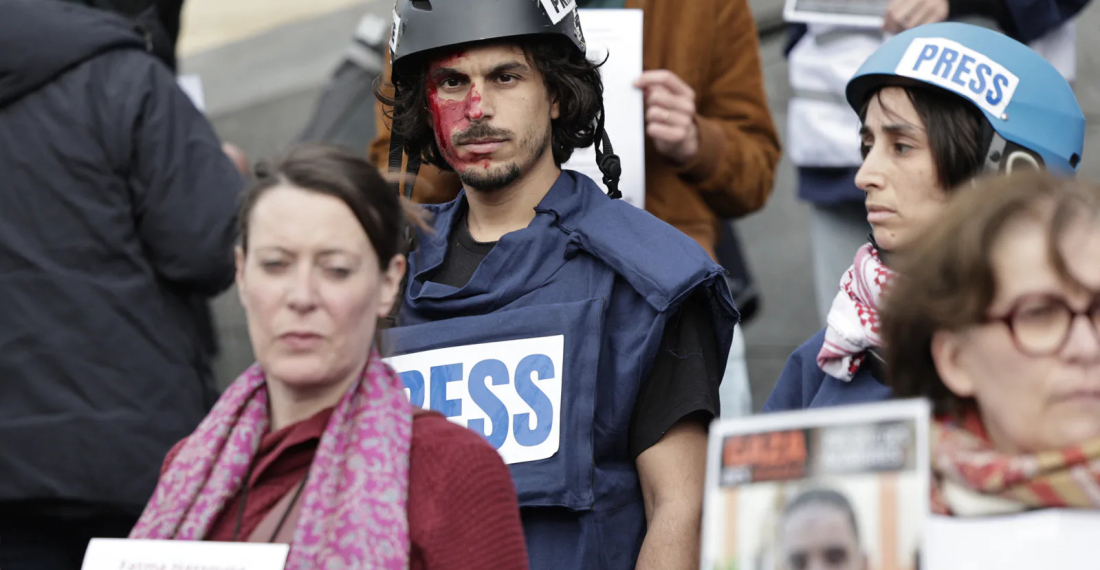
Worldwide press freedom at a 25-year low

Freedom of the press around the world has dropped to its lowest level in a quarter century, reports the Paris-based freedom NGO Reporters Sans Frontières (RSF), or Reporters Without Borders.

Each year, the RSF releases a World Press Freedom Index covering 180 countries, allowing media outlets and journalists to be compared across countries. Each country is ranked on a five-point scale that indicates its relative press freedom, ranging from “very serious” to “good”.

The 2026 index, released on Thursday (30 April), has set a new record low for press freedom since the RSF started covering it in 2002, placing over half of the world’s countries' freedom of press into the “difficult” and “very serious” categories.

In the report, the RSF claimed that these trends represent a global trend in the “criminalisation of journalism, which is rooted in circumventing press law and misusing emergency legislation and common law”.

Additionally, RSF reported that sixty percent of countries, 110 out of 180, have criminalised media workers in crackdowns inflicted by states, noting India (157th), Egypt (169th), Georgia (135th), Türkiye (163rd) and Hong Kong (140th) as clear examples.

Anna Bocande, RSF’s Editorial Director, is quoted in the report, where she cited “authoritarian states, complicit or incompetent political powers, predatory economic actors and under-regulated online platforms” as the primary drivers “for the global decline in press freedom”.

“Current protection mechanisms are not strong enough; international law is being undermined and impunity is rife,” she stated.

​“The ball is in the court of democracies and their citizens. It is up to them to stand in the way of those who seek to silence the press. The spread of authoritarianism isn’t inevitable.”

Source: commonspace.eu with Al Jazeera and RSF
Related articles

Editor's choice
News
Van der Leyen to Pashinyan "You can count on us"

Van der Leyen to Pashinyan "You can count on us"

The president of the European Commission, Ursual von der Leyen, on Thursday (2 July) made a short visit to the Armenian Capital, Yerevan, during which she met the Armenian leader, Nicol Pashinyan. This was Van der Leyen's second visit to Armenia in as many months. During the visit the President of the European Commission reiterated Europe's support for Pashinyan and his government, following the recent elections: On 7 June, the people of Armenia spoke clearly. They chose democracy. The rule of law. They chose reform and peace. They chose an open, welcoming, and inclusive society. And they chose to partner with the European Union. And together, we must now turn their aspirations into results. You can count on us.  Speaking ata joint press conference after her meeting, Van der Leyen said: "First of all, I want to congratulate you on your electoral victory. These elections have shown, once again, the strength of Armenia's democracy. The spirit of the Velvet Revolution which you led in 2018 is alive and well. Armenia is carrying on the path of democracy, reform, peace, and of a closer partnership with Europe. And I am here to tell you: you can count on us. While Armenia is coming closer to the EU, the South Caucasus is coming closer together. The initialling of the peace agreement last year was a history-making moment. The most consequential step this region has taken in decades. The same goes for the continued normalisation of relations with Türkiye. These decisions required political courage and leadership. And I know their rewards will be immense. Opening borders will transform Armenia's economic future. And it will anchor Armenia at the heart of one of the world's most strategic crossroads. We will stand by you to turn this vision into reality." (click image to read more)

Popular

Editor's choice
Interview
Thursday Interview: Murad Muradov

Thursday Interview: Murad Muradov

Today, commonspace.eu starts a new regular weekly series. THURSDAY INTERVIEW, conducted by Lauri Nikulainen, will host  persons who are thinkers, opinion shapers, and implementors in their countries and spheres. We start the series with an interview with Murad Muradov, a leading person in Azerbaijan's think tank community. He is also the first co-chair of the Action Committee for a new Armenian-Azerbaijani Dialogue. Last September he made history by being the first Azerbaijani civil society activist to visit Armenia after the 44 day war, and the start of the peace process. Speaking about this visit Murad Muradov said: "My experience was largely positive. My negative expectations luckily didn’t play out. The discussions were respectful, the panel format bringing together experts from Armenia, Azerbaijan, and Turkey was particularly valuable during the NATO Rose-Roth Seminar in Yerevan, and media coverage, while varied in tone, remained largely constructive. Some media outlets though attempted to represent me as more of a government mouthpiece than an independent expert, which was totally misleading.  Overall, I see these initiatives as important steps in rebuilding trust and normalising professional engagement. The fact that soon a larger Azerbaijani civil society visits to Armenia followed, reinforces the sense that this process is moving in the right direction." (click the image to read the interview in full)


