


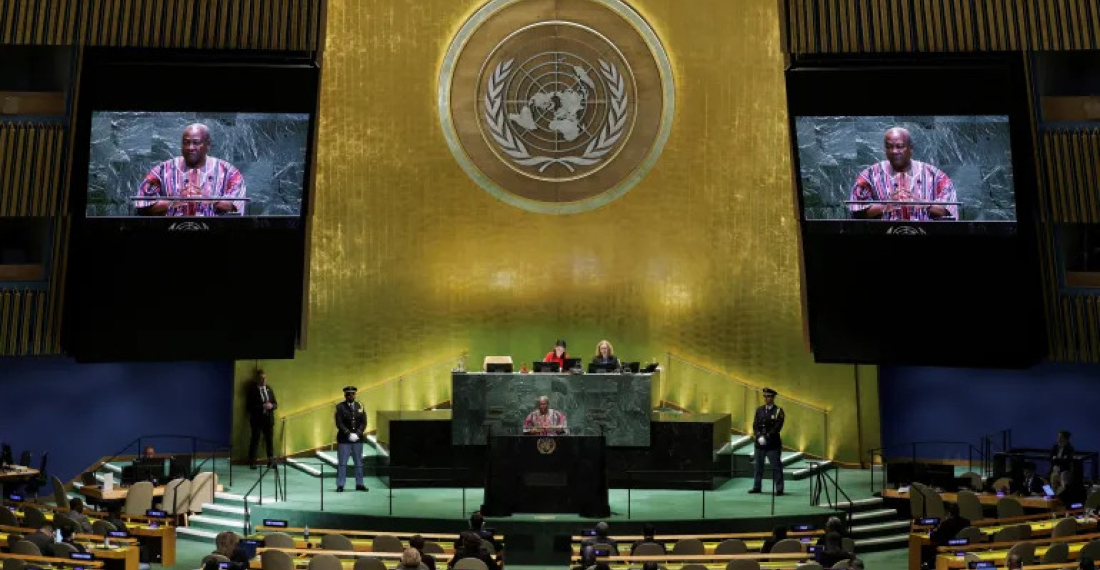
UN adopts resolution recognising transatlantic slavery as the “gravest crime against humanity”

The United Nations General Assembly voted on Wednesday (25 March) to recognise transatlantic slavery as the “gravest crime against humanity” and calling on UN member states to contribute to a reparations fund.

The resolution was proposed by Ghana, which advocated for this designation, and called for apologies and financial reparations from member states for their role in the slave trade. No specific amount was outlined.

The resolution passed with 123 member states in favour and three opposed, including the United States, Israel, and Argentina. Fifty-two countries abstained from voting, including the United Kingdom and European Union member states.

UN General Assembly resolutions are not legally binding, but decisions nevertheless carry substantial political weight. Ghana’s President John Dramani Mahama addressed the UN General Assembly on Wednesday (26 March): "This resolution is a pathway to healing and reparatory justice. This resolution is a safeguard against forgetting. This is a resolution of destiny."

“Let it be recorded that when history beckoned, we did what was right for the memory of the millions who suffered the indignity of slavery.”

Before the vote, Samuel Ablakwa, Ghana's Foreign Minister, told the BBC’s Newsday programme that they are demanding compensation: "We want justice for the victims and causes to be supported, educational and endowment funds, skills training funds."

Between 1500 and 1800, the transatlantic slave trade abducted and sold approximately 12-15 million Africans, transporting them to the Americas and systematically forcing them into slave labour.

The resolution, supported by the African Union and the Caribbean Community, states that the impacts of transatlantic slavery reverberate in racial inequalities and underdevelopment, “affecting Africans and people of African descent in all parts of the world”.

Ablakwa told the BBC: "Many generations continue to suffer the exclusion, the racism because of the transatlantic slave trade, which has left millions separated from the continent and impoverished.”

Source: commonspace.eu with BBC and Al Jazeera
Related articles

Editor's choice
News
NATO LEADERS GATHER IN ANKARA FOR  DEFINING SUMMIT

NATO LEADERS GATHER IN ANKARA FOR DEFINING SUMMIT

NATO leaders gathered in Ankara on Wednesday, for the main day of their annual summit. Ukraine is one of the main topics at the summit. Ukrainian President Volodymyr Zelensky used a speech at the summit on Tuesday to urge Ukraine's allies to deliver the air defence systems it urgently needs to protect it from escalating Russian attacks. Ukraine has been stepping up its own long-range drone and missile attacks against Russia, hitting oil refineries and military targets there and causing significant fuel shortages and power cuts. "Ukraine's Armed Forces have proved that the effective use of long-range systems can have game-changing impacts on the battlefield, giving the Armed Forces the ability to degrade enemy forces far behind the frontline," Number 10 said. "Ukrainian long-range strikes, such as those on key logistics hubs, have significantly impacted Russia's ability to sustain their offensives." Kremlin spokesman Dmitry Peskov said on Tuesday that Russia, which invaded Ukraine in 2022, would closely monitor the summit in Ankara..

Popular

Editor's choice
Interview
Thursday Interview: Murad Muradov

Thursday Interview: Murad Muradov

Today, commonspace.eu starts a new regular weekly series. THURSDAY INTERVIEW, conducted by Lauri Nikulainen, will host  persons who are thinkers, opinion shapers, and implementors in their countries and spheres. We start the series with an interview with Murad Muradov, a leading person in Azerbaijan's think tank community. He is also the first co-chair of the Action Committee for a new Armenian-Azerbaijani Dialogue. Last September he made history by being the first Azerbaijani civil society activist to visit Armenia after the 44 day war, and the start of the peace process. Speaking about this visit Murad Muradov said: "My experience was largely positive. My negative expectations luckily didn’t play out. The discussions were respectful, the panel format bringing together experts from Armenia, Azerbaijan, and Turkey was particularly valuable during the NATO Rose-Roth Seminar in Yerevan, and media coverage, while varied in tone, remained largely constructive. Some media outlets though attempted to represent me as more of a government mouthpiece than an independent expert, which was totally misleading.  Overall, I see these initiatives as important steps in rebuilding trust and normalising professional engagement. The fact that soon a larger Azerbaijani civil society visits to Armenia followed, reinforces the sense that this process is moving in the right direction." (click the image to read the interview in full)


