UK and Ukraine Forge AI Partnership Based on Battlefield Data

The United Kingdom and Ukraine signed an Artificial Intelligence (AI) defence partnership in Kyiv on Monday (August 24), granting British researchers access to Ukraine’s Avengers AI Labs and launching joint efforts to develop new military and national security technologies.

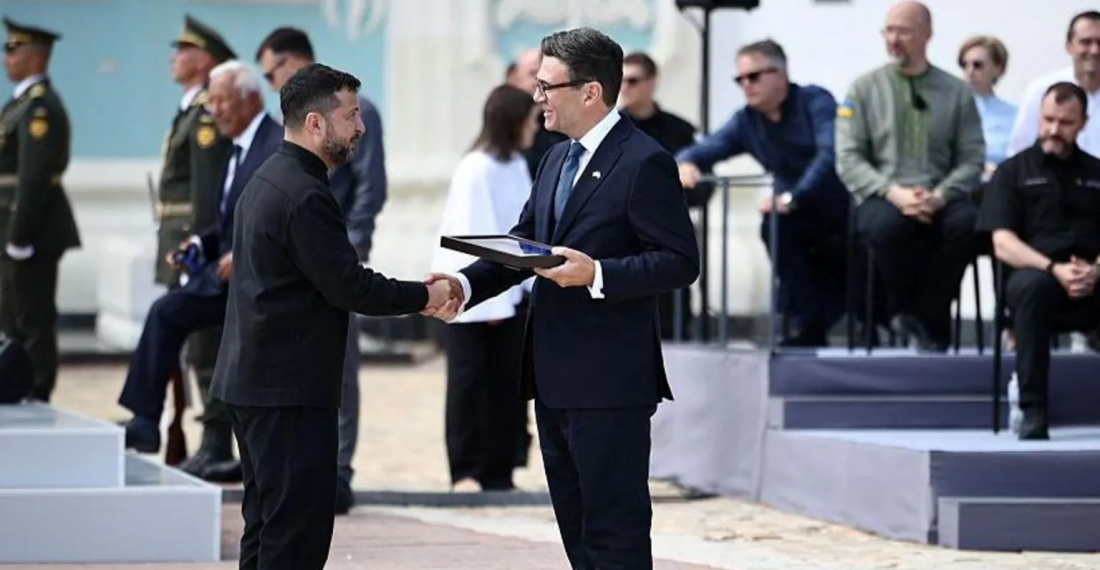
British Prime Minister Andy Burnham and Ukrainian President Volodymyr Zelenskyy signed the agreement during Burnham’s first visit to Kyiv as prime minister, coinciding with Ukraine’s 35th Independence Day. The UK became the first international partner to gain access to Avengers AI Labs, a platform built on operational data gathered during Russia’s war against Ukraine.

The platform draws on information collected by thousands of daylight cameras and infrared sensors deployed across the battlefield. These systems record tanks, artillery, air-defence equipment, infantry and aerial targets, including Shahed drones and reconnaissance UAVs. Ukraine’s Defence Ministry said earlier in August that the database contained an annotated dataset of five million battlefield images, much of it derived from the DELTA combat management and situational-awareness system.

AI models trained using this data are already supporting Ukraine’s military operations. According to the Ukrainian Defence Ministry, an automated target-detection system processes more than 100,000 drone video feeds each month and can identify approximately 70% of enemy targets in real time.

The partnership will initially focus on defence and national security, bringing together researchers, universities, engineers, technology companies and military specialists from both countries. Several pilot projects involving British companies Sintela, Mind Foundry and Skyral have already been launched. One project will test the use of buried fibre-optic cables as AI-enabled sensors to detect activity around defence facilities, with the first trial planned at a UK military site. The technology could later be adapted for airports, prisons, railways and energy infrastructure.

A second project will explore low-power AI chips designed for drones, robotics and autonomous systems, with the aim of developing machines capable of operating for longer periods and responding more rapidly in demanding environments.

In a press release, Burnham said the partnership would combine Ukraine’s operational experience with Britain’s AI capabilities to develop technologies that could strengthen security and protect critical infrastructure. In return for access to Ukrainian battlefield data, the UK will provide Ukraine with support from its universities, researchers and technology sector.

The agreement forms part of the UK-Ukraine 100 Year Partnership. It was announced shortly after Britain said it would allow defence company MBDA to release classified information on British components used in SCALP long-range missiles, supporting efforts to establish local missile assembly lines in Ukraine.

Source: commonspace.eu with GOV.UK (London), Kyiv Independent (Kyiv), and Reuters (London).

 

Related articles

Editor's choice
News
The European Parliament approved the temporary elimination of customs duties on goods exported from Armenia to the EU in a plenary session.

The European Parliament approved the temporary elimination of customs duties on goods exported from Armenia to the EU in a plenary session.

The European Parliament, during its plenary session in Strasbourg, approved the European Commission's proposal to apply a system of trade measures for "Made in Armenia" products, which means there will be a temporary elimination of customs duties on a wide range of products imported from Armenia to the European Union.   The proposal presented by the European Commission was adopted at the plenary session of the Council of Europe with 583 votes in favor, 49 against and 39 abstentions. According to the proposal, the European Union plans to eliminate customs duties on a number of Armenian goods for a period of two years. At the same time, it is planned to establish duty-free import quotas for eight types of Armenian agricultural products. These include grapes, apricots, cherries, peaches, and cucumbers. The draft also provides for safeguard mechanisms that will allow the European Union to intervene, if necessary, if increased imports from Armenia have a negative impact on European producers. This step is due to the restrictions imposed by Russia on a number of important Armenian export products since May 2026. They relate, in particular, to alcoholic beverages, mineral waters, fruits and vegetables, as well as their transit through Russian territory. According to the European Commission, these restrictions have disrupted Armenia's traditional supply chains and significantly limited the country's access to traditional export markets. The situation has had a particularly severe impact on small and medium-sized enterprises, as well as agricultural producers, while creating challenges for Armenia's economic resilience. The EU sees the initiative as a temporary measure to support the Armenian economy and create additional opportunities for exporters to access the EU market. The next step for the proposal is formal approval by the EU Council. The regulation will enter into force the day after its publication in the Official Journal of the European Union. Let us recall that on September 2, the Council of the European Union approved the proposal to establish temporary trade liberalization measures for Armenian products and sent the draft to the European Parliament for approval. 

Popular

Editor's choice
Interview
Thursday Interview: Murad Muradov

Thursday Interview: Murad Muradov

Today, commonspace.eu starts a new regular weekly series. THURSDAY INTERVIEW, conducted by Lauri Nikulainen, will host  persons who are thinkers, opinion shapers, and implementors in their countries and spheres. We start the series with an interview with Murad Muradov, a leading person in Azerbaijan's think tank community. He is also the first co-chair of the Action Committee for a new Armenian-Azerbaijani Dialogue. Last September he made history by being the first Azerbaijani civil society activist to visit Armenia after the 44 day war, and the start of the peace process. Speaking about this visit Murad Muradov said: "My experience was largely positive. My negative expectations luckily didn’t play out. The discussions were respectful, the panel format bringing together experts from Armenia, Azerbaijan, and Turkey was particularly valuable during the NATO Rose-Roth Seminar in Yerevan, and media coverage, while varied in tone, remained largely constructive. Some media outlets though attempted to represent me as more of a government mouthpiece than an independent expert, which was totally misleading.  Overall, I see these initiatives as important steps in rebuilding trust and normalising professional engagement. The fact that soon a larger Azerbaijani civil society visits to Armenia followed, reinforces the sense that this process is moving in the right direction." (click the image to read the interview in full)