


Two police officers killed in clashes with protestors in Ganca

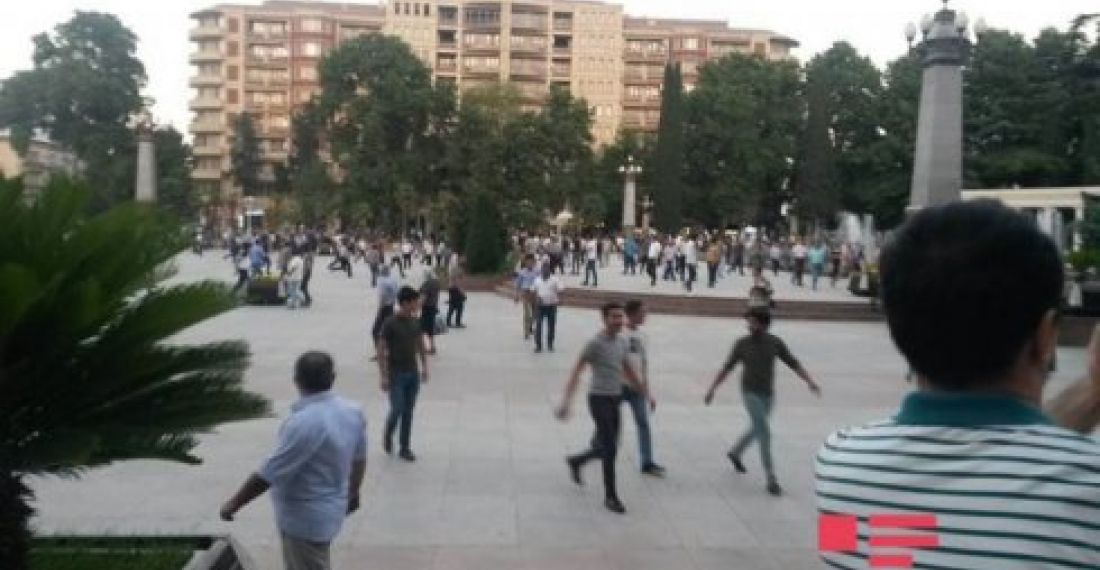
Tension remains high in Azerbaijan's second city, Ganca, after incidents last evening (10 July) during which hundreds of protestors clashed with police in front of the government building in the city centre. In the clashes two police officers were klilled and forty protestors arrested. The protests followed an incident last week when a local resident tried to kill the main government representative in the city, Elmar Valiyev.

Yesterday's incidents started when a group of around 200 protestors gathered in the city centre, allegedly armed with knives and sharp objects, and calling for the release of a man who is in detention accused of the attempted murder of the Elmar Valiyev. Police and Ministry of Interior troops reacted quickly, breaking up the protests. Scenes of the protest were broadcast live on social media by some local residents. It later transpired that during the clashes two police colonels were killed. The authorities are saying that two persons suspected of the murders managed to escape. They have issued pictures and details of the two men and have asked the public for information on their whereabouts. The main opposition parties in Azerbaijan - Musavat and Popular Front Party, have distanced themselves from the protests, according to the BBC Azerbaijani service who interviewed some of their leaders.

Commonspace.eu political editor said in a comment that "the incidents in Ganca constitute a serious challenge to the government of president Ilham Aliyev. The protestors seem to be religiously inspired, with some support in the wider community. Ganca is traditionally a stronghold of Shia Islam, the main religious tradition in Azerbaijan, however signs of religious radicalism in Ganca have so far been under the surface. The government has to move cautiously in order not to create a backlash within the wider community. But the audacious murder of two senior police officers in the centre of the second largest city is a serious challenege to the government. The incidents in Ganca also need to be seen in the wider political context in the country. The government has curtailed the space for criticism or political activism, but Azerbaijan remains an open country with citizens able to access most social media. At the moment the government is fighting on three fronts - internally it is trying to clean some of the most acute cases of corruption within its own ranks that it belatedly has recognised as being a serious impediment to it its work; it is in direct confrontation with the secular opposition who accuse it of totalitarianism and abuse of power; and it is in confrontation with radical religious groups who abhor the secular nature of the Azerbaijani leadership, and all it represents. As the events in Ganca in the last days have shown, the latter challenge may prove the most difficult".

source: commonspace.eu

photo: scenes from the portests in Ganca on 10 July 2018 (picture courtesy of APA news agency, Baku).



Related articles

Editor's choice
News
Borrell tells the European Parliament that the situation in Afghanistan was critical, but the EU will remain engaged

Borrell tells the European Parliament that the situation in Afghanistan was critical, but the EU will remain engaged

Borrell underlined that the European Union will make every effort to support the peace process and to remain a committed partner to the Afghan people. "Of course, we will have to take into account the evolving situation, but disengagement is not an option.  We are clear on that: there is no alternative to a negotiated political settlement, through inclusive peace talks.
Editor's choice
News
Germany accuses Russia of cyberattacks and disinformation campaign

Germany accuses Russia of cyberattacks and disinformation campaign

The German government holds Russia responsible for a cyberattack on German air traffic control, and for targeted disinformation campaigns before the last federal election. According to the German Foreign Office in Berlin, the incidents could be clearly attributed to the Russian military intelligence service, the GRU. In response, the Russian ambassador to Berlin was summoned to the Foreign Ministry. "We have been observing a massive increase in threatening hybrid activities by Russia for some time now," a spokesperson for the Foreign Ministry stated. These range from disinformation campaigns and espionage to cyberattacks and sabotage attempts. The aim is to divide society, sow distrust, and undermine confidence in democratic institutions. The spokesperson added that with these actions, Russia is "very concretely threatening our security, not only through its war of aggression against Ukraine, but also here in Germany."  The Foreign Ministry spokesperson explained that the cyberattack on air traffic control in August 2024 was clearly attributed to the hacker collective "APT28," known as "Fancy Bear," and to the responsibility of the Russian military intelligence service, the GRU. Furthermore, it could now be "conclusively stated" that Russia had attempted "to influence and destabilize both the last Federal election and the ongoing internal affairs of the Federal Republic of Germany." There was "absolutely irrefutable evidence" for this". The so-called "Storm 1516" campaign, which has been running since 2024, is allegedly backed by "reliable information" that the Moscow-based think tank "Center for Geopolitical Expertise" is behind it. The Center is also said to be supported by Russian military intelligence. Its primary aim is to influence democratic elections in the West. (Click the image to read more).

Popular

Editor's choice
News
Germany accuses Russia of cyberattacks and disinformation campaign

Germany accuses Russia of cyberattacks and disinformation campaign

The German government holds Russia responsible for a cyberattack on German air traffic control, and for targeted disinformation campaigns before the last federal election. According to the German Foreign Office in Berlin, the incidents could be clearly attributed to the Russian military intelligence service, the GRU. In response, the Russian ambassador to Berlin was summoned to the Foreign Ministry. "We have been observing a massive increase in threatening hybrid activities by Russia for some time now," a spokesperson for the Foreign Ministry stated. These range from disinformation campaigns and espionage to cyberattacks and sabotage attempts. The aim is to divide society, sow distrust, and undermine confidence in democratic institutions. The spokesperson added that with these actions, Russia is "very concretely threatening our security, not only through its war of aggression against Ukraine, but also here in Germany."  The Foreign Ministry spokesperson explained that the cyberattack on air traffic control in August 2024 was clearly attributed to the hacker collective "APT28," known as "Fancy Bear," and to the responsibility of the Russian military intelligence service, the GRU. Furthermore, it could now be "conclusively stated" that Russia had attempted "to influence and destabilize both the last Federal election and the ongoing internal affairs of the Federal Republic of Germany." There was "absolutely irrefutable evidence" for this". The so-called "Storm 1516" campaign, which has been running since 2024, is allegedly backed by "reliable information" that the Moscow-based think tank "Center for Geopolitical Expertise" is behind it. The Center is also said to be supported by Russian military intelligence. Its primary aim is to influence democratic elections in the West. (Click the image to read more).

