


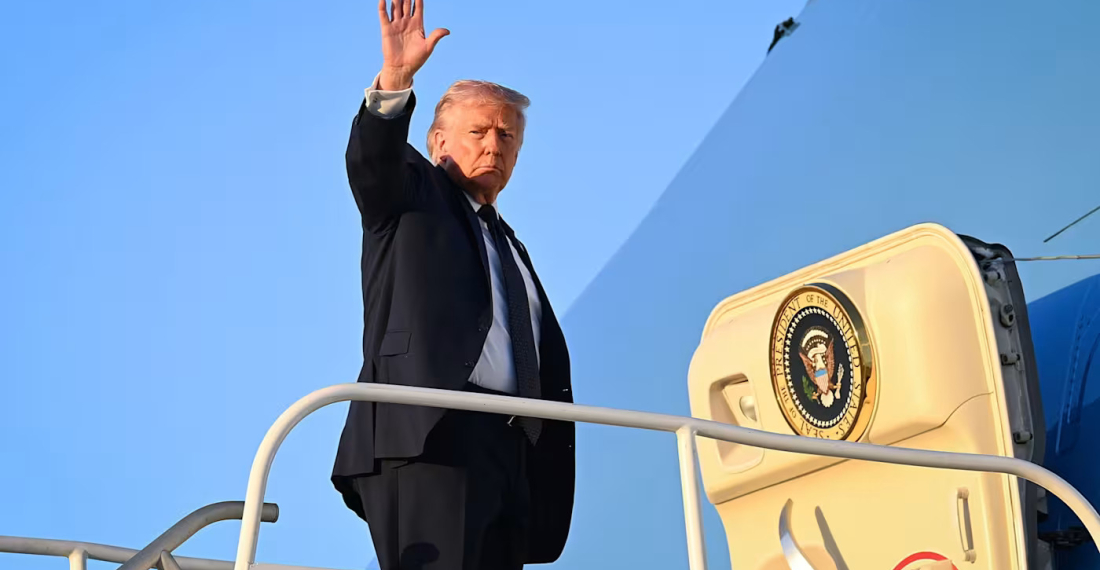
Trump on Iran: “We could call it a tremendous success now and leave here . . . or we could go further”

President Trump said that the US-Israeli war against Iran could end “very soon”, and that “we’ve already won in many ways, but we haven’t won enough”.

Donald Trump sought to calm oil markets on Monday, 9 March, but The Iran Revolutionary Guard Corps has responded to Trump's comments that the war in Iran would end soon, saying that they will "determine the end of the war".

Tehran will not allow "one litre of oil" to be exported from the region if the US and Israeli attacks continue, the IRGC says, according to Reuters.

On rising tensions over the Strait of Hormuz, which is crucial to the global energy market as around a fifth of the world's oil passes through the narrow waterway, President Trump issued another warning to Iran:

"If Iran does anything that stops the flow of Oil within the Strait of Hormuz, they will be hit by the United States of America TWENTY TIMES HARDER than they have been hit thus far," Trump says in an online statement.

"Additionally, we will take out easily destroyable targets that will make it virtually impossible for Iran to ever be built back, as a Nation, again — Death, Fire, and Fury will reign upon them — But I hope, and pray, that it does not happen!" he says.

Source: commonspace.eu with the Financial Times, BBC, and Reuters

Related articles

Editor's choice
News
Zelensky of Arabia

Zelensky of Arabia

Ukrainian president, Volodomyr Zelensky, has just ended a tour to some of the Arab monarchies of the Gulf, during which he visited Saudi Arabia, the United Arab Emirates and Qatar. For the past four years the Gulf countries have been lukewarm in their support for Ukraine, as it fought off an unprovoked Russian invasion. In these four years a steadfast Ukraine has developed the skills, and the equipment, to resist the continuous attack by Russian drones, most of which provided by Iran. Now the Arab Gulf states unexpectedly find themselves fighting off a similar threat, as Iran fires drones and missiles at them as it widens the conflict started by the US and Israel four weeks ago. Ukraine's experience and equipment are now desperately needed by the Arab Gulf countries. During the trip Zelensky managed to convince his Arab hosts to turn the page. He offered them Ukraine's equipment and expertise in their present predicament. His offer was gladly accepted. Two hundred Ukrainian advisors are already in the region. The Gulf countries will buy Ukrainian equipment and expertise. This is not just a transactional step. It is an important shift that will have long term implications. Ukraine is set to become a long term  strategic partner of Ukraine, as the sides agree on joint long term co-operation in anti-drone technology. The visit of Zelensky to the Arab Gulf monarchies further isolates Russia, and especially the Russian approach to Ukraine. It also cements a relationship that is important for both Ukraine and the GCC.

Popular

Editor's choice
Interview
Thursday Interview: Murad Muradov

Thursday Interview: Murad Muradov

Today, commonspace.eu starts a new regular weekly series. THURSDAY INTERVIEW, conducted by Lauri Nikulainen, will host  persons who are thinkers, opinion shapers, and implementors in their countries and spheres. We start the series with an interview with Murad Muradov, a leading person in Azerbaijan's think tank community. He is also the first co-chair of the Action Committee for a new Armenian-Azerbaijani Dialogue. Last September he made history by being the first Azerbaijani civil society activist to visit Armenia after the 44 day war, and the start of the peace process. Speaking about this visit Murad Muradov said: "My experience was largely positive. My negative expectations luckily didn’t play out. The discussions were respectful, the panel format bringing together experts from Armenia, Azerbaijan, and Turkey was particularly valuable during the NATO Rose-Roth Seminar in Yerevan, and media coverage, while varied in tone, remained largely constructive. Some media outlets though attempted to represent me as more of a government mouthpiece than an independent expert, which was totally misleading.  Overall, I see these initiatives as important steps in rebuilding trust and normalising professional engagement. The fact that soon a larger Azerbaijani civil society visits to Armenia followed, reinforces the sense that this process is moving in the right direction." (click the image to read the interview in full)


