Tuareg shoot down a Russian helicopter in Mali

Fightng has been reported in different part of Mali over the weekend, as Tuareg fighters and jihdist groups keep pressure on the military government.

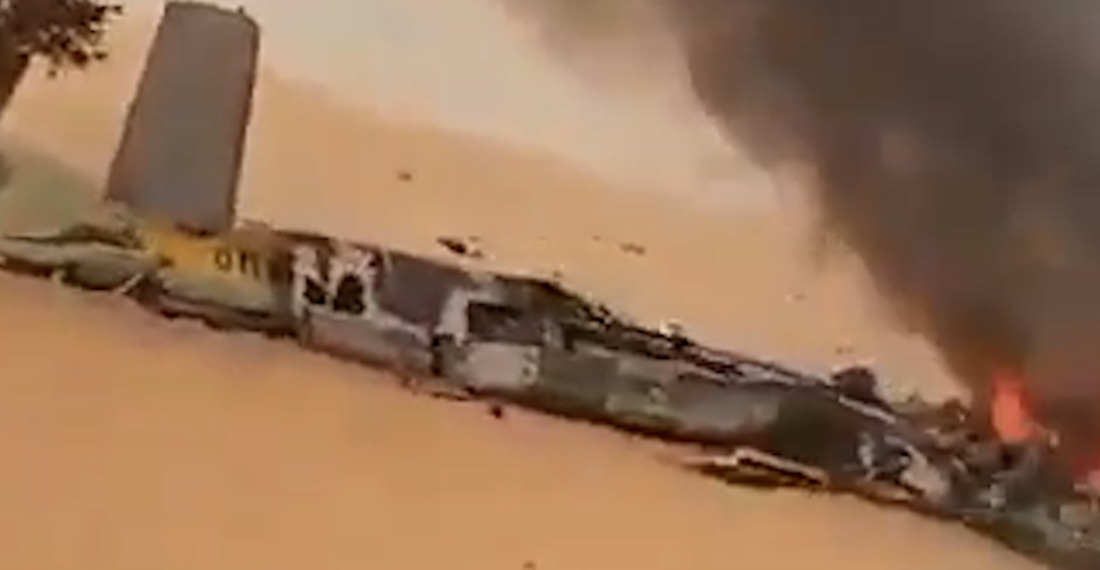
Tuareg fighters operating in the north of Mali where they seeke to establish an independent state, claimed to have shot down a Russian Africa Corps Mi-24 helicopter. This event marks a notable escalation in the ongoing conflict in the region and highlights the complex dynamics of foreign involvement in Mali.

The footage released by the Tuareg fighters appears to show the moment the Mi-24 helicopter was targeted and hit. The Mi-24, a heavily armed Russian attack helicopter, is known for its combat capabilities and has been deployed in Mali as part of Russia’s broader military support in Africa.

Mali has been a hotspot for militant activity and foreign military interventions in recent years. Various groups, including Tuareg rebels, jihadist factions, and government forces backed by international allies, have been engaged in frequent conflicts.

The Tuareg fighters, an ethnic group with a long history in the Saharan region, have often been involved in insurgencies and rebellions aiming for autonomy or greater political rights. Their claim to have successfully taken down a high-value military target like the Russian Mi-24 could have significant implications for the conflict dynamics in Mali.

Russia’s military presence in Mali is part of its increasing involvement in Africa, often through private military contractors and direct military aid. The downing of the helicopter could prompt a reassessment of the operational risks faced by Russian forces in the region.

While the fottage remains to be independently verfied, it has already drawn attention from international observers and analysts monitoring the Sahel crisis. The incident underscores the volatility in Mali and the ongoing struggle for control over its vast and often lawless territories.

The impact of this incident extends beyond Mali’s borders, potentially affecting the strategic calculations of regional powers and international stakeholders concerned with stability in the Sahel. As foreign involvement intensifies, the risk of escalated confrontations among competing factions grows.

source: commonspace.eu with agencies

 

Related articles

Editor's choice
News
Nearly half a million Russians killed in Ukraine but Moscow far from reaching its objectives

Nearly half a million Russians killed in Ukraine but Moscow far from reaching its objectives

Nearly half a million Russians have died in fighting in Ukraine, as Vladimir Putin continues to push his country to the brink. His aim of completely controlling the Donbass region, which he annexed after invading Ukraine in 2022, seems more distant than ever. After a bleak winter which saw months of fierce Russian bombing of Ukrainian energy infrastructure, the future is beginning to look more positive for Kyiv Russia’s frontline advances have slowed almost to a halt, as Ukrainian counter-attacks and defensive tactics become more effective. Successes in local counterattacks have become more frequent, as Ukrainian forces scale up their use of ground robots and sshort-range drone warfare. The Centre for Strategic and International Studies (CSIS) paints a bleak picture of Russian casualties. Between February 2022 and June 2026, there have been as many as 450,000 Russian battlefield deaths and 1.4 million casualties, it says. The UK’s biggest spy agency, GCHQ, has produced a similar figure. In May, GCHQ director Anne Keast-Butler said in her inaugural public speech that nearly 500,000 Russian soldiers had been killed. The massive death toll is a product of several factors, including an attritional warfare strategy in which Moscow sends thousands of troops towards fortified Ukrainian defences, attempting to grind Kyiv’s forces down with sheer manpower. (click image to read more)

Popular

Editor's choice
Interview
Thursday Interview: Murad Muradov

Thursday Interview: Murad Muradov

Today, commonspace.eu starts a new regular weekly series. THURSDAY INTERVIEW, conducted by Lauri Nikulainen, will host  persons who are thinkers, opinion shapers, and implementors in their countries and spheres. We start the series with an interview with Murad Muradov, a leading person in Azerbaijan's think tank community. He is also the first co-chair of the Action Committee for a new Armenian-Azerbaijani Dialogue. Last September he made history by being the first Azerbaijani civil society activist to visit Armenia after the 44 day war, and the start of the peace process. Speaking about this visit Murad Muradov said: "My experience was largely positive. My negative expectations luckily didn’t play out. The discussions were respectful, the panel format bringing together experts from Armenia, Azerbaijan, and Turkey was particularly valuable during the NATO Rose-Roth Seminar in Yerevan, and media coverage, while varied in tone, remained largely constructive. Some media outlets though attempted to represent me as more of a government mouthpiece than an independent expert, which was totally misleading.  Overall, I see these initiatives as important steps in rebuilding trust and normalising professional engagement. The fact that soon a larger Azerbaijani civil society visits to Armenia followed, reinforces the sense that this process is moving in the right direction." (click the image to read the interview in full)