


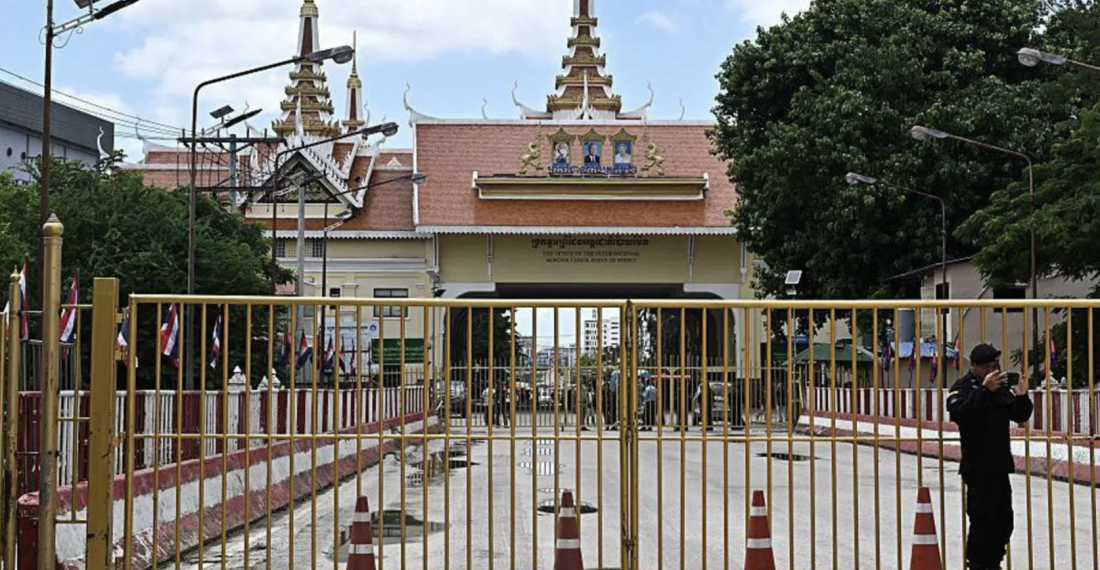
Thailand’s army has closed border crossings with Cambodia amid escalating territorial tensions

Tensions between the two countries continue to rise. Cambodia has accused Thailand of exacerbating the conflict by closing almost all border crossings. This has made it virtually impossible for tourists to enter or leave the country by land.

Only people with urgent reasons, such as students and medical patients, are permitted to enter or leave the country. Thousands of tourists have been affected. Cambodians have also had to wait a long time for a border crossing to be temporarily opened for them.

Tensions between the two Southeast Asian neighbours escalated after a Cambodian soldier was killed in a shooting incident involving Thai and Cambodian soldiers at the end of May. This occurred in a disputed area of the border.

In response to the Thai border closures, Cambodia has blocked Thai internet services, imposed an import ban on Thai fruit and vegetables, and stopped supplying Thai electricity and fuel. Previously, around 30% of Cambodia's fuel came from Thailand. However, Cambodia says it wants to resolve the conflict peacefully and will not close its borders as Thailand has done.
Source: commonspace.eu with agencies

Related articles

Popular

Editor's choice
Interview
Thursday Interview: Murad Muradov

Thursday Interview: Murad Muradov

Today, commonspace.eu starts a new regular weekly series. THURSDAY INTERVIEW, conducted by Lauri Nikulainen, will host  persons who are thinkers, opinion shapers, and implementors in their countries and spheres. We start the series with an interview with Murad Muradov, a leading person in Azerbaijan's think tank community. He is also the first co-chair of the Action Committee for a new Armenian-Azerbaijani Dialogue. Last September he made history by being the first Azerbaijani civil society activist to visit Armenia after the 44 day war, and the start of the peace process. Speaking about this visit Murad Muradov said: "My experience was largely positive. My negative expectations luckily didn’t play out. The discussions were respectful, the panel format bringing together experts from Armenia, Azerbaijan, and Turkey was particularly valuable during the NATO Rose-Roth Seminar in Yerevan, and media coverage, while varied in tone, remained largely constructive. Some media outlets though attempted to represent me as more of a government mouthpiece than an independent expert, which was totally misleading.  Overall, I see these initiatives as important steps in rebuilding trust and normalising professional engagement. The fact that soon a larger Azerbaijani civil society visits to Armenia followed, reinforces the sense that this process is moving in the right direction." (click the image to read the interview in full)

