


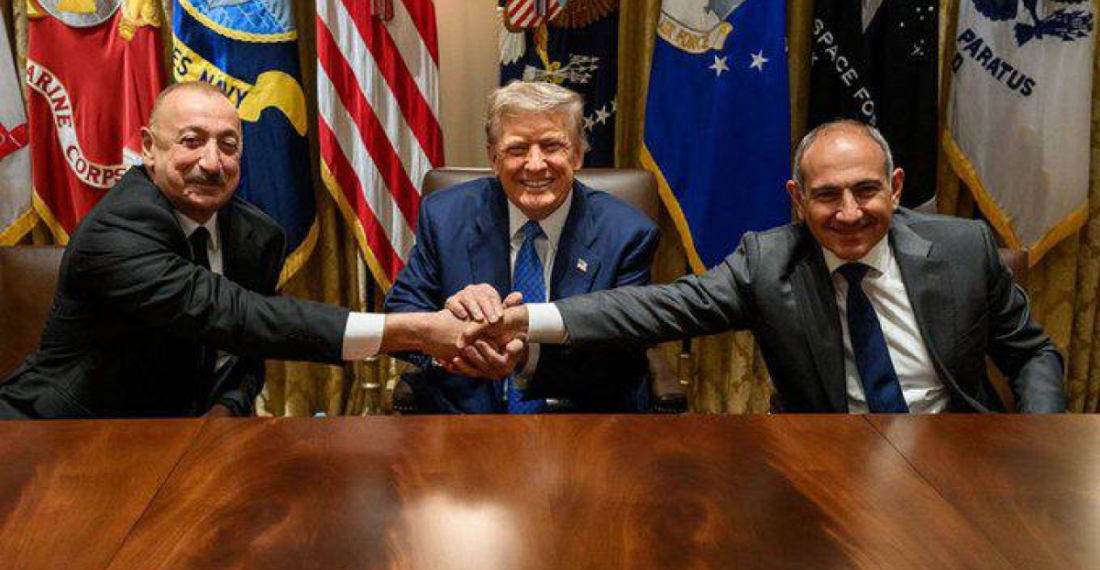
Armenia and Azerbaijan have ended decades of conflict between them, and opened the door for a new era for them, and for the entire South Caucasus.
In a historic meeting in Washington DC, facilitated by US President, Donald Trump, the two sides initialed the Peace Agreement between them that has been under discussion for a long time. The agreement still has to be signed and ratified.
The two side also issued a joint declaration which was signed by the two leaders, and countersigned by the US president, as witness.
The document emphasised the importance of sustainable peace between the two countries.
The parties also agreed to terminate the Minsk process and dissolve the structures associated with it. In this regard, the Foreign Ministers of Azerbaijan and Armenia signed a joint appeal to the OSCE. All OSCE participants are called upon to support this decision.
The parties confirmed the importance of opening transport communications, including unimpeded communication between the Nakhchivan Autonomous Republic and the main part of Azerbaijan, as well as ensuring mutual benefits for Armenia in international and domestic transportation.
Armenia expressed its readiness to cooperate with the United States and agreed third parties will create the "Trump Route for International Peace and Prosperity" (TRIPP) transport corridor project on its territory.
The desire of both sides to build good-neighborly relations based on the inviolability of internationally recognized borders and the inadmissibility of the use of force is separately emphasized. The leaders rejected any attempts at revenge in the present and future.
In conclusion, the parties expressed confidence that the summit in Washington will become a solid foundation for peace in the region, and expressed gratitude to Donald Trump for his hospitality and assistance in normalizing relations between Baku and Yerevan.
commonspace.eu political editor said in a comment that the Washington meeting took a long time in coming, and many had started wondering if the leaders of Armenia and Azerbaijan had the political will and stamina to bring peace to the region, but in the end, with a bit of nudging by president Trump they did it. Congratulations to all concerned. In many ways, the work starts now, and Armenian and Azerbaijani societies must be involved and must make their contribution so that the Washington agreements can be successfully implemented .
source: commonspace.eu
photo: President Ilham Aliyev of Azerbaijan, president Donald Trump of the US, and prime minister Nikol Pashinyan at the White House on 8 August 2025.



