


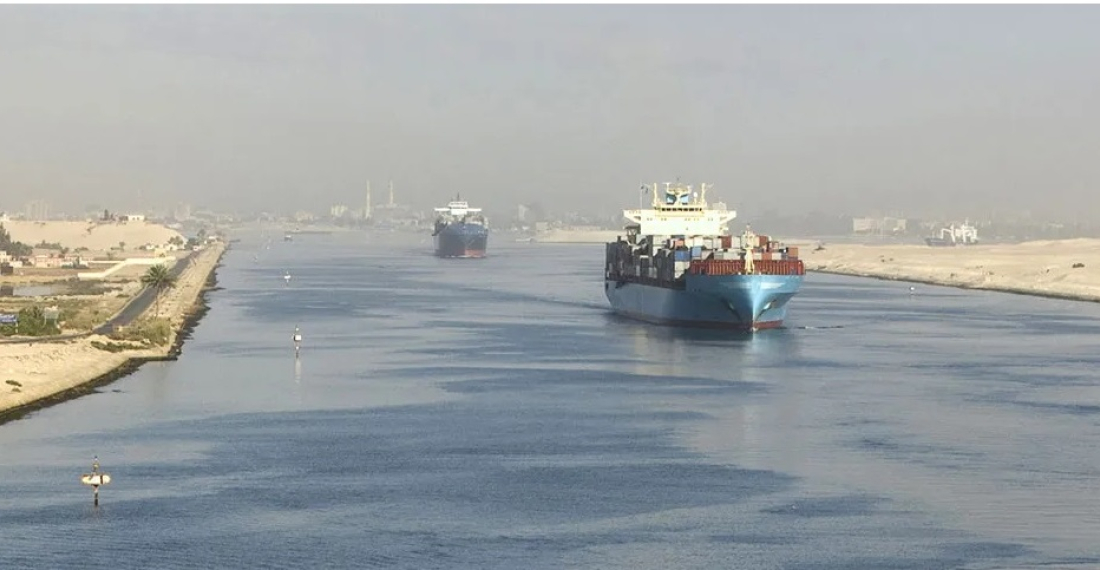
Egypt's already considerable economic problems took a turn for the worse last month as revenues from transit of shipping through the Suez Canal dropped by half as a result of security problems in the Red Sea and the Gulf of Aden. Attacks by Houthi rebels on commercial vessels forced major shipping companies to divert away from the key global trade artery.
Income from the international strategic waterway last month dropped to $428 million, compared to $804 million in January 2023, Osama Rabie, chairman of the Suez Canal Authority, said in an interview with Egyptian television channel ON TV.
The total number of ships through the Suez Canal last month fell to 1,362 vessels, down 36 per cent from the 2,155 vessels navigating the canal during January 2023, he said.
Houthi militants in Yemen began attacking commercial vessels in October in solidarity with the Palestinians in the Israel-Gaza war, and show no signs of retreating despite the US and Western allies attempting to deter the Iran-backed group with air strikes, which began on January 12.
Many shipping companies have rerouted their vessels away from the Red Sea to avoid the attacks, opting instead for the longer and more expensive route around the Cape of Good Hope at the southern tip of Africa.
The Suez Canal is the shortest sea route between Asia and Europe. With about 12 per cent of the world's shipping traffic passing through it, the waterway is a major facilitator of global trade.
The canal is also a crucial source of foreign currency for Egypt. The North African economy, already grappling with record inflation and a heavy debt burden was further impacted by the Israel-Gaza war, which has slowed tourism and decreased shipping through the Suez Canal.
Egypt is "particularly exposed" to the Red Sea shipping crisis as the country generates about 2.2 per cent of its gross domestic product in annual balance-of-payment receipts and 1.2 per cent of GDP in fiscal revenue from Suez Canal dues, the International Monetary Fund said in its regional economic outlook in January.
Egypt is also in talks with the IMF to revive and expand a $3 billion loan agreement, which was signed in December 2022, to help it through its economic crisis. However, this comes with strict conditions such as reducing public spending and a free float of the local currency.
"Working with Egypt is a very high priority. Both because it matters to the Egyptian economy and the Egyptian people, but also because it matters more broadly in regional context," IMF managing director Kristalina Georgieva in a press briefing on Friday.
"We are in this very last stretch when we are working on the details of implementation ... but we are close. We are very close. So we are not talking about long protracted period at all."
commonspace.eu with agencies



