


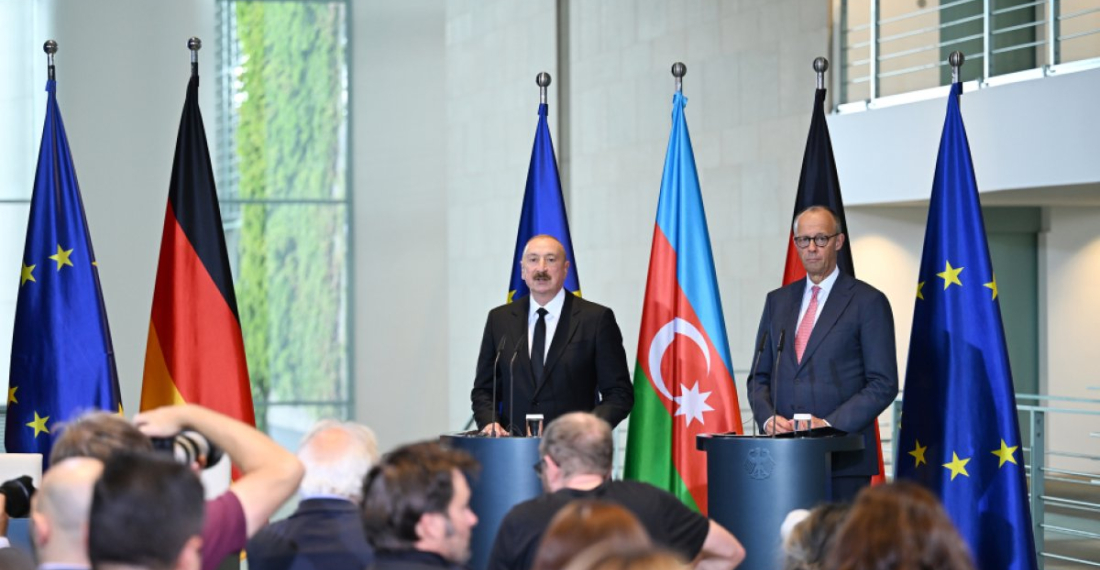
During their joint press conference in Berlin on 21 July, Azerbaijani president, Ilham Aliyev, and German Chancellor, Friedrich Merz, were asked about a secret meeting about Ukraine, that took place earlier this month between Russian and German personalities. The question was asked by Deutsche Welle's Roman Goncharenko. He asked
"Mr. Federal Chancellor, a few days ago, the German media reported that an unofficial German-Russian meeting took place in Baku. It is also noted that former high-ranking politicians from the parties in the government coalition participated in the meeting. No information was given about the outcome of that meeting. There are two opinions among experts here in Berlin on this. Some say that such meetings are useful behind the scenes and cannot do any harm. Others criticize them and argue that such meetings can backfire. Because they can send a signal of weakness to Russia. What do you think about this?"
Merz replied, I can answer that very simply. I have no knowledge of such a meeting. For months we have tried to persuade President Putin to start negotiations. We have repeatedly put forward proposals for joint discussions with Ukraine at the European level. President Putin refuses to participate in such negotiations. That is why I, unfortunately, repeat again and again what I have been saying for the last 14 months.
Ending this war depends only on the Russian government and the Russian President. It depends only on him to enter into negotiations and, if necessary, to start peace talks. He continues to refuse to do so. As long as it continues, there is no choice but to support Ukraine in its struggle for life in the face of Russian aggression. We will do this. We will do this by coordinating at the European level. I am very grateful to President Aliyev for sharing with us his similar position on this war, its causes, its course and its possible end. I have just said this
Ilham Aliyev added, "regarding the meetings you mentioned in Baku, I can say that we learned this information from “The Times” newspaper. We were not aware of this. Of course, we carefully investigated the article published in such a reputable press outlet, and yesterday, before I arrived in Berlin, I asked the Azerbaijan State Border Service for information about whether th.e people named in “The Times” newspaper were in Azerbaijan at the same time or not. I can tell you that this information has been confirmed. On July 12, two well-known people, Mr. Pofala and Mr. Platsik, arrived in Baku on a Berlin-Baku flight - one of whom is known to be the head of Mrs. Merkel’s administration - and returned from Baku to Berlin on July 14. At the same time, on July 12, former Russian Prime Minister Mr. Zubkov and head of the Civil Society Council under the Russian President Mr. Fadeyev arrived in Baku from Moscow, and one of them left Baku on the 13th and the other on the 14th. We did not receive any information about this from either Germany or Russia. That is, our territory was simply used without our knowledge. I cannot say anything specific about whether such a meeting took place. Because we did not see it. But the flight statistics I mentioned give reason to say that such a secret meeting was held in Baku. If this meeting will end the Ukrainian-Russian war, of course we welcome it."
source: commonspace.eu with Deutsche Welle (Cologne) and president.az (Baku) and agencies



