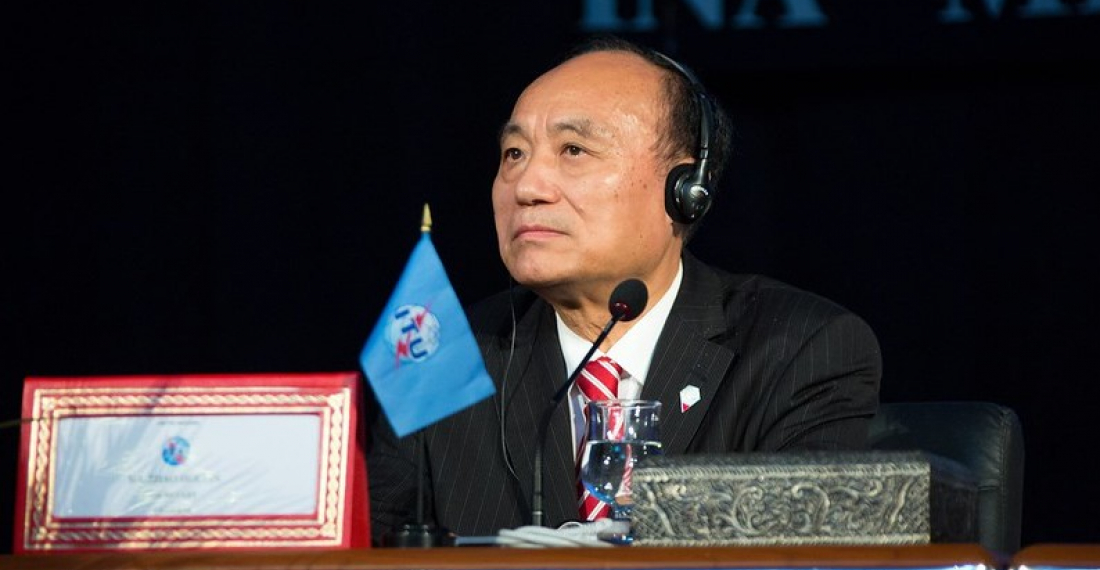
Saudi telecommunications market is largest in Middle East, says ITU secretary-general

Houlin Zhao, secretary-general of the International Telecommunication Union (ITU), hailed Saudi Arabia’s efforts and its remarkable initiatives in telecommunications fields, including the launch of a new platform to enhance international cooperation in the digital fields. He described the Kingdom’s telecommunications market as the largest in the Middle East region, reports the Saudi Gazette, 

Zhao made the remarks during a three-day webinar titled “Radio Spectrum for IMT-2020 and beyond: Fostering Commercial and Innovative Use”, co-organized by ITU and the Communication and Information Technology Commission (CITC) of Saudi Arabia. The webinar focuses on the latest spectrum of innovation and best practices for policymakers.

Zhao praised the regulatory maturity of the telecommunications and information technology (CIT) sector in the Kingdom. “As per the classification of ITU, CITC is one of the most regulated and developed CIT bodies in the world,” he added.

Inaugurating the event on Tuesday, Minister of Communications and Information Technology Eng. Abdullah Al-Swaha highlighted the role of digital infrastructure, calling it the lifeblood of the global economy after the coronavirus pandemic. He also stressed its importance in the success and resilience of the economy.

Al-Swaha underscored the Kingdom’s keenness to cooperate with ITU and its global partners in the field of the spectrum to enhance the benefits from it. He stressed the importance of the meeting of decision-makers in the field of spectrum in the seminar to discuss this important resource.

More than 70 high-ranking officials and specialists from various governmental, private, and academic agencies attended the virtual event. The webinar is being convened as part of unifying global efforts and visions in the field of the frequency spectrum, and to activate its role in promoting digital transformation in the Kingdom and the world.


Source: commonspace.eu with agencies 
Photo: Houlin Zhao, secretary-general of the ITU. 


Related articles

Editor's choice
News
Aden under curfew, as problem in Yemen's south deepens

Aden under curfew, as problem in Yemen's south deepens

The port city of Aden, in Yemen's south, has been put under curfew, as the rift in the country between  the Saudi led coalition which  backs Yemen's presidential governing council, and the southern forces led by the Southern Transitional Council (STC), deepens. Abdul Rahman al-Mahrami, a member of the Yemeni Presidential Governing Council and commander of the al-Amalik brigades, has ordered a curfew in the temporary capital, Aden, "to maintain security". "A curfew has been imposed throughout Aden Governorate from 9:00 p.m. to 6:00 a.m., in accordance with the instructions of Commander Abdul Rahman al-Mahrami, a member of the Presidential Management Council," the statement said. It states that only security and military personnel, as well as medical and technical teams with approved permits, will be allowed to move in the area during these hours. Yemen's presidential council, which is backed by Saudi Arabia and which already is in a struggle with the Houthi Movement in the north of the country who also occupy the capital Sanaa, two days ago issued an order for the arrest of the head of the Southern Transitional Council (STC),, Aidarous al Zubaidi. The STC have wide support among people in the South, and advocate that South Yemen restores its independence. The coalition warned of further escalation in Aden, long regarded as an STC stronghold, as the Presidential Leadership Council (PLC) chief accused STC leader Aidarous Al Zubaidi of “high treason” and announced the revocation of his membership in the governing body. The moves mark a sharp escalation in tensions within the anti-Houthi camp, despite National Shield Forces, rivals of the STC and former allies, having recently retaken control of Hadhramaut and Mahra from southern fighters. The STC’s takeover of the two regions last month angered Saudi Arabia and contributed to igniting the current internal conflict. (click the picture to read more)

Popular

Editor's choice
News
Aden under curfew, as problem in Yemen's south deepens

Aden under curfew, as problem in Yemen's south deepens

The port city of Aden, in Yemen's south, has been put under curfew, as the rift in the country between  the Saudi led coalition which  backs Yemen's presidential governing council, and the southern forces led by the Southern Transitional Council (STC), deepens. Abdul Rahman al-Mahrami, a member of the Yemeni Presidential Governing Council and commander of the al-Amalik brigades, has ordered a curfew in the temporary capital, Aden, "to maintain security". "A curfew has been imposed throughout Aden Governorate from 9:00 p.m. to 6:00 a.m., in accordance with the instructions of Commander Abdul Rahman al-Mahrami, a member of the Presidential Management Council," the statement said. It states that only security and military personnel, as well as medical and technical teams with approved permits, will be allowed to move in the area during these hours. Yemen's presidential council, which is backed by Saudi Arabia and which already is in a struggle with the Houthi Movement in the north of the country who also occupy the capital Sanaa, two days ago issued an order for the arrest of the head of the Southern Transitional Council (STC),, Aidarous al Zubaidi. The STC have wide support among people in the South, and advocate that South Yemen restores its independence. The coalition warned of further escalation in Aden, long regarded as an STC stronghold, as the Presidential Leadership Council (PLC) chief accused STC leader Aidarous Al Zubaidi of “high treason” and announced the revocation of his membership in the governing body. The moves mark a sharp escalation in tensions within the anti-Houthi camp, despite National Shield Forces, rivals of the STC and former allies, having recently retaken control of Hadhramaut and Mahra from southern fighters. The STC’s takeover of the two regions last month angered Saudi Arabia and contributed to igniting the current internal conflict. (click the picture to read more)