

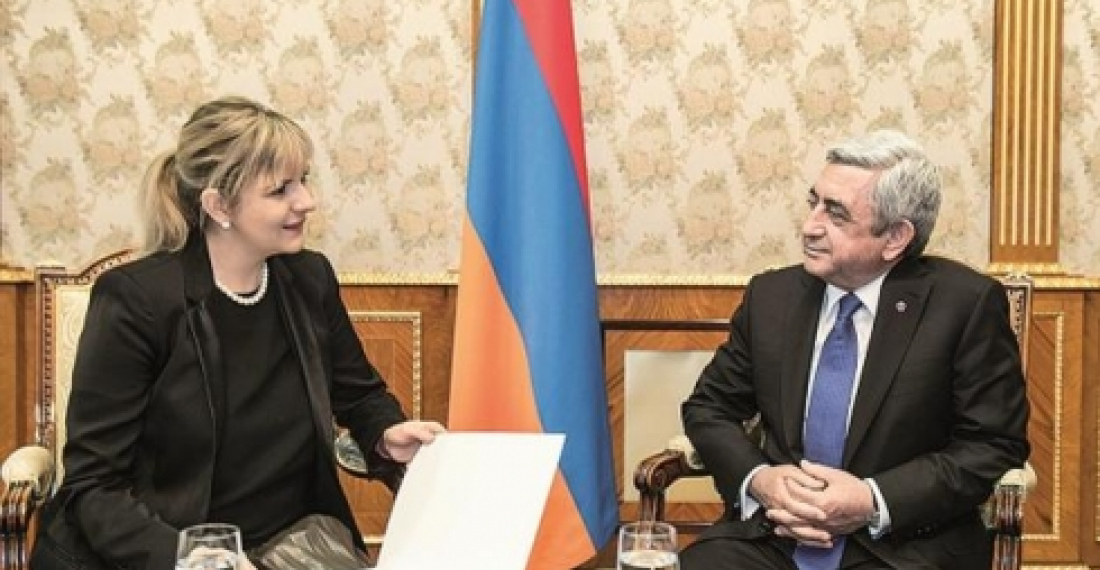
The President of Armenia Serzh Sargsyan, in an interview published today in the Turkish newspaper Hurriyet and its sister paper Hurriyet Daily News, has declared that his country is ready for normalisation of ties with Turkey. Sargsyan stated,
"I declare that we are ready for the normalization of relations with Turkey, for starting a process of rapprochement between the Armenian and Turkish nations without any preconditions".
Here is the full text of the interview that was published on Hurriyet Daily News on 24 April 2015.:
As a politician who has invested great efforts into the process of reconciliation between your country and Turkey, what scenario would you dream of having on April 24 Remembrance Day this year?
I believe one such option would be giving tribute to the innocent victims of the Armenian Genocide jointly with the Turkish president on the hill of Tsitsernakaberd, and proclaiming from the memorial to the whole world that we join our efforts in condemning the crimes of genocide of the past, thus preventing the possible recurrence of genocide and other crimes against humanity.
This was exactly our aim when we sent an invitation to the president of Turkey to participate in the commemoration events on April 24. Unfortunately, this became another missed opportunity for Turkey.
If the protocols were implemented, would Armenia still continue its aggressive campaign calling upon states and international organizations to recognize genocide claims?
First of all, the characterization of being "aggressive" is misplaced. The steps we have taken should not be misconstrued as an attack, and are not against the Turkish people. And, secondly, I would rather avoid any hypothetical questions.
It was a process, which had not reached its logical conclusion. Should it have been crowned with success, perhaps, we would have found ourselves in another reality: it is possible that eventually Turkey itself could have acknowledged the Armenian Genocide, and with that we would enter a new phase of a genuine reconciliation between our nations. Today we have what we have.
The present tendencies of recognition and condemnation of the Armenian Genocide by various states and organizations demonstrate in practice the international community's awareness that impunity for the crimes against humanity is inadmissible, and we shall join efforts to devise effective mechanisms for the prevention thereof.
The continuous process of the Armenian Genocide recognition by the international community should be a serious signal to the Turkish authorities that the denials stance of Turkey on this issue does not in any way or shape fit the values and realities of the 21st century.
What have you gained from the latest statement by Pope Francis? Did you anticipate it? What possible consequences do you think it may entail?
World leaders are vested with a unique mission to prevent crimes against humanity. In this context, the Mass at St. Peter's Basilica served by Pope Francis on April 12 to commemorate the Armenian Genocide Centennial, who followed the lead of Pope John Paul II in defining the well-known events as genocide, was a clear demonstration to that effect. The pope's statement was a message of humanism, tolerance, struggle against xenophobia, and crimes against humanity addressed to the entire humankind. I hope it will become a landmark to guide especially those countries that subordinate universal values to their political interests.
The emotional and non-diplomatic reaction of the Turkish leadership was yet another proof that Turkey continued its policy of evident denial pursued at a state level, thus taking upon it the burden of the responsibility for the crime perpetrated by the authorities of the Ottoman Empire. If Turkey does not share this view, if it disagrees with numerous countries and international organizations that have recognized the Armenian Genocide, that is Turkey's problem, and not the one of the international community.
What are your expectations from U.S. President Obama on April 24 this year? If the United States decides to take into account its strategic interests in the region, and not to initiate any steps that might infuriate Turkey, what would be your reaction?
Every country pursues its strategic interests, but there are universal interests and universal priorities. One of them is to build a secure and peaceful world, which is possible through straightening out disputes we presently that exist today. And that means that one needs to face its own past, learn lessons from it by taking the necessary steps.
The 28th president of the United States, Woodrow Wilson, 95 years ago actually formulated the need for the international recognition of the Armenian Genocide, since the prevention of the crimes of genocide and all other future sufferings starts with the acknowledgement.
As a mighty power and champion of democratic values, the United States has on numerous occasions stated its position regarding the Armenian Genocide. Out of 51 U.S. constituent states 44 recognized and condemned the Armenian Genocide. Throughout history various American presidents, such as Ronald Reagan, Gerald Ford, described the atrocities against the Armenian people as genocide. Even those U.S. presidents that had not used the word "genocide" during their tenure had used that term while campaigning. It means that they never questioned the veracity of what had happened, and only due to certain political considerations refrained from uttering the word "genocide." We strongly believe that universal values will eventually prevail over ephemeral political interests.
In spite of the European Parliament recognition of the Armenian claims in 1987, and a similar resolution adopted on April 15 this year, I have met numerous European liberals in past years that happened to support the Turkish views that history is better left to historians.
I do not know which representatives of the European Parliament you have met, but the resolution of April 15, 2015, was adopted by a sheer majority in the European Parliament that represents 28 European states, and around half a billion people. That in itself is already a very vocal fact that testifies the clear-cut position of the European family with regard to the Armenian Genocide.
By adopting that document, the European legislative body paid tribute to the memory of 1.5 million victims of the Armenian Genocide, and once again underscored its commitment to the protection of human rights and universal values.
There was also a reference to that effect in the Armenian-Turkish protocols too, aiming at the establishment of a special commission. Despite this we have noticed the position of the Armenian authorities that history is not a matter of discussion. This is a kind of controversial stance, isn't it?
On the notion of leaving history to historians: the veracity of the Armenian Genocide has been studied by various scholars, social and political figures, international law experts, the International Association of Genocide Scholars, lawmakers, and also a number of Turkish historians for about a century now. The unanimous view of all of them was that what happened to the Armenian people in the Ottoman Empire definitely constituted genocide. Under the light of this, it becomes obvious that the Turkish proposal of establishing the so-called commission of historians has only one goal, which is to delay the process of the Armenian Genocide recognition, and divert the attention of international community from that crime. That is not only our view but also the view of the international community that goes on recognizing and condemning the Armenian Genocide.
The protocols contain no clause of establishing any commission on historical studies. The respective paragraph in the protocol envisages a dialogue aimed at restoring mutual confidence between the two nations, which entailed the establishment of a sub-commission. Throughout the negotiations, the Armenian side has stressed on numerous occasions at various levels also to the Turkish side that the veracity of the genocide cannot be questioned under any circumstances.
On Feb. 16 you recalled the protocols from your parliament. On the other hand, the protocols are still in the Turkish Parliament waiting for a politically expedient time for ratification. Isn't this move by Armenia perceived as a step back from the reconciliation efforts on your side? Does this mean the 2009 process has failed totally?
I will ask a rhetorical question: when will the expedient time arrive according to Turkish standards? It is already the sixth year since the protocols have been signed: when is the expedient time? On the part of Turkey, this signifies a lack of any basic respect not only toward the side that the protocols have been concluded with but also toward its international obligations. The years past have demonstrated that Turkey is looking forward not to some convenient moment, but instead is trying to prevent the manifestation of the unambiguous position of the international community on the Armenian Genocide by imitating a process of the Armenian-Turkish rapprochement, claiming that recognitions were something that hindered the reconciliation.
The process of the Armenian-Turkish reconciliation was launched upon my initiative, and pursued a very simple goal - to establish diplomatic relations without any preconditions, and unseal the last closed border in Europe, safeguarding peaceful and neighborly coexistence of our nations.
Unfortunately, the lack of political will on the part of the Turkish authorities, distortion of the letter and spirit of the protocols, fresh manifestations of denial, and continuously brought up preconditions intended to feed groundless demands of Azerbaijan thwarted the implementation of the protocols. Everyone is well-aware that it was Armenia that could have brought up some preconditions in the first place, but we have not resorted to it yet since we are guided by our vision of establishing an environment of cooperation in the region.
After six years of unfulfilled expectations, I have decided to recall the protocols from the parliament. On one occasion I said the Armenians are not going to wait indefinitely for the Turkish authorities to be able to find a convenient moment to finally ratify those protocols.
It was not Armenia that closed the Armenian-Turkish border, and it is not Armenia that is shutting the doors to reconciliation. Unfortunately, the window of opportunity to arrive at historic reconciliation between our nations was missed because of the unconstructive Turkish policies.
We, however, are ready to embark upon a constructive dialogue with Turkey in case it faces its own history, heeds the calls of the international community, and guides itself by the vision of creating a peaceful future for the Armenian and Turkish peoples.
Does the Republic of Armenia have any territorial claims on Turkey?
The Republic of Armenia has never declared any territorial claims either on Turkey, or any other country since our independence. There has never been such an issue on the foreign policy agenda of our country, and there is none today. That is a clear-cut position. We are a fully-fledged and responsible member of the international community. As a member to the United Nations, we recognize our role in international affairs, we respect the principles of international law and, incidentally, we anticipate the same from our neighbor to the west. The one that illegally keeps the border with our country shut, turning it into the last closed border in Europe, and brings up unacceptable preconditions for the establishment of the diplomatic relations with Armenia is disrespect toward the international community that mediated the Zurich Protocols - the Zurich Protocols, I remind you, which bears Turkey's own signature underneath.
And, finally, I would like to register: you might have noticed that the talk of Armenia's territorial claims toward Turkey or any intentions of our to that effect is mainly carried in Turkey, not in Armenia. I will stop here to let each of us draw his own conclusions as to why it is so.
Why did Armenia consider the Turkish invitation to participate in the ceremonies dedicated to the Battle of Çanakkale on April 24 as offensive? Turkish officials say that for the past 20 years they have been marking that event, and the present year has been significant because of the 100th anniversary of the Çanakkale battle. It seems around 20 plus heads of states are going to participate in that ceremony. Is Armenia concerned about that?
The events scheduled for the commemoration of the Armenian Genocide Centennial are not a matter of competition for us. If the Turkish authorities are in pursuit of securing more state leaders in attendance at any cost in order to overshadow the Armenian Genocide Centennial events, we have got much more serious and forward-looking goals, that is, to establish a vigorous platform together with the international community in struggling against the past and future crimes against humanity.
In contrast to Turkey, we neither force, nor threaten, nor blackmail the international community to partake in our commemoration events. The representatives of states and international organizations are coming to Armenia guided not by political or economic gains, but principles, universal values and moral imperatives.
As you have indicated, it has been for only 20 years that Turkey has been holding those ceremonies. But let us also register that in the course of those 20 years, it has never been held on April 24. This is the first year that the celebration is planned on the very same day of April 24, when the Armenian people for a 100 years has been firmly getting together to commemorate the innocent victims of the Armenian Genocide.
Regardless of what name the Turkish authorities ascribe to the Armenian Genocide, such an indelicate move manifested a disrespectful attitude toward their own citizens - the memory of 1.5 million murdered Armenians. Meanwhile, had Turkey the slightest willingness to normalize our relations, figuratively speaking, "it should not have organized a feast and celebration on the day when the neighbor is mourning at home."
Do you think that opening the border will change the existing difficulties in the relations?
Opening the border will change many things. First of all, it will create a certain atmosphere of trust, lay the foundation of establishing beneficial business ties, and make a considerable contribution to the economic development of the eastern provinces of Turkey. Opening the border will also make contacts between our civil societies more active, making them more informed about each other's approaches and perceptions, which, I believe, will also have a positive impact on the two nations' rapprochement.
Now, as April 24 passes, what will be the strategy of the Armenian state in the upcoming years? Will there be a place for renewed efforts to start a new process of rapprochement? Do you personally have the political will to change this process of stalemate, which does not make it possible for the two states to live as neighbors?
We have stated many times that our struggle does not end in 2015 - it will just enter a more mature phase. Let us not forget that we have had an opportunity to raise the issue of the Armenian Genocide, and condemn it only after the declaration of independence of the third Republic of Armenia. And that means that our struggle has just started. And it will be more coordinated and purposeful in the upcoming years.
The bridges of rapprochement are not burned yet and we even initiated rapprochement ourselves. However, it is impossible to open the door whose key we don't have. And even now, when we commemorate the centennial of our innocent victims, I declare that we are ready for the normalization of relations with Turkey, for starting a process of rapprochement between the Armenian and Turkish nations without any preconditions.
Prime Minister Davutoğlu of the Republic of Turkey made a statement on April 19, which was unexpected for us. He said, "I express my condolences to the grandchildren of Ottoman Armenians who lost their lives during WWI." There were also expressions like sharing the pain, true memory, honestly confronting the past in the statement. Another surprise is that on April 24, a liturgy will be served in the Armenian Patriarchate. How do you assess the content of this message?
It is interesting that this message was published on April 19. If it had been made public on April 24, i.e., on the day of the centennial of the genocide or a day before that, I would have considered it as an ordinary statement whose denialist content we know from the previous statements. However, since it was made public so early, in our opinion, it is an attempt to resist or affect the larger process related to the recognition of the genocide that is under way around the world. It is understandable why it was made public on April 19. And I think it was inappropriate to distort, manipulate or respond to His Holiness Pope Francis' words.
I don't want to talk about the content of that spurious statement - I expect that on April 24, Mr. Erdoğan, the president of Turkey, will prove to be more robust and rational and will make a real statement, in which he will say what happened, which will make it possible for us to start a process of rapprochement between our two nations. To be more accurate, perhaps, one needs to say - not between the nations, but between ourselves and the Turkish government because I don't blame the Turkish people, the Turks for anything whatsoever.
If you are ready to share your feelings toward the Turkish people, I would like to ask the following question. What does the pain suffered by the Turkish and Muslim societies during the same war signify to you? Does Armenia admit the pain, sufferings, and deportations of Turks during the same period?
The Armenian people cannot but understand that suffering because the Armenian people have suffered many defeats and won many victories during their three-millennia-old history. There have been both sufferings and joys; therefore, the Armenian people can understand very well what any people, including the Turkish people, can undergo during war. However, it is one thing to suffer and another thing to undergo genocide. If the Turkish people also went through genocide during the Ottoman rule, let the current government of Turkey recognize the genocide of both Armenians and Turks, which was committed by the Ottoman government.
It is one thing when residents of one, two, or three villages move to another place, or individual citizens change their places of residence, which we pity, but when a whole people is eliminated, it is quite another thing. I suggest that you pay attention to two facts: first, the statements of the Young Turks' leaders about their intentions to eliminate Armenians. Secondly, there are interviews with Raphael Lemkin, during which he was asked, "What does genocide mean?" He answered, "Genocide is what happened to Armenians and Jews." What can one add to this?
I hope that some years on from now, there will be so many people in Turkey who realize what happened, that it will be impossible to make statements like the one the prime minister made [on April 19].
This interview is reproduced in full from Hurriyet Daily News.
source: commonspace.eu with Hurriyet Daily News.
photo: Armenian President Serzh Sargsyan speaks to Hürriyet correspondent Cansu Çamlıbel. (picture courtesy of Hurriyet Daily news).