


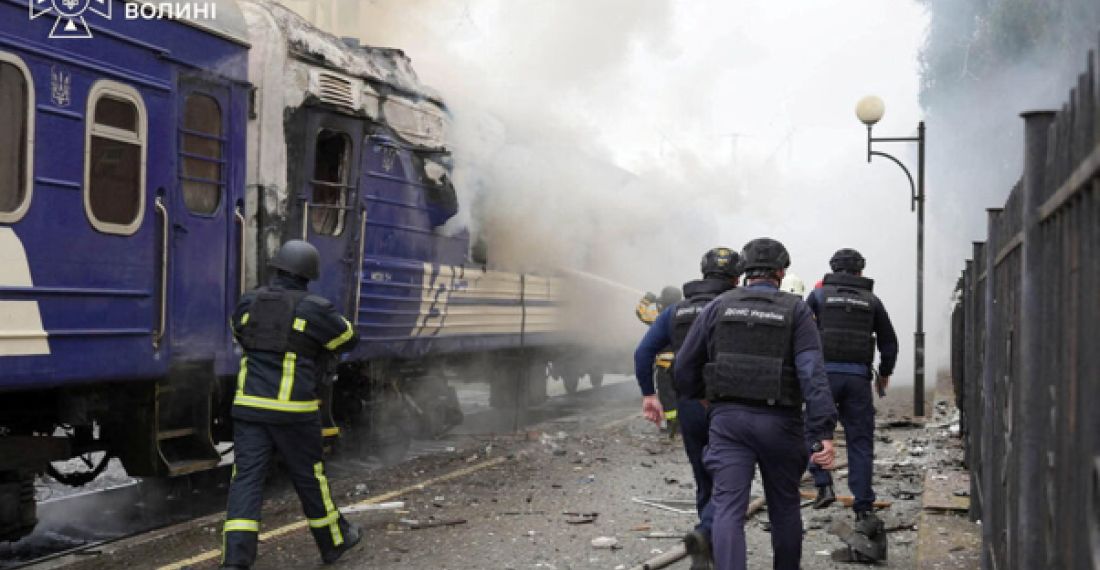
A Russian drone struck the locomotive of a passenger train near Ukraine’s border with Poland on Sunday (September 13), shortly after a separate train carrying former British Prime Minister Boris Johnson and several European officials had passed through the area. The strike occurred around two kilometres from the Polish border in Ukraine’s Volyn region. No casualties were reported.
Ukraine’s state railway operator Ukrzaliznytsia said in a Telegram post that the train carrying Johnson had departed earlier than planned because of real-time timetable changes prompted by the continuing threat of Russian attacks. The operator said it was “quite possible” that the drone had been targeting Johnson’s train. The former prime minister was travelling with European diplomats and officials, including former Swedish Prime Minister Carl Bildt and an adviser to German Chancellor Friedrich Merz. Former CIA director David Petraeus was travelling on another train at the time and said he heard drones overhead before an explosion forced the train’s passengers to be partially evacuated.
The same day, Johnson condemned the attack on X, describing it as “random and senseless” and saying that Ukrainian civilians and railway workers were facing such attacks regularly. Similarly, Bildt, also on X, reported that his train received an evacuation warning but was able to continue towards Poland.
The strike formed part of a wider Russian aerial offensive. Ukraine’s Air Force said that more than 450 drones were launched overnight, with at least three people killed and 36 injured. A truck was also destroyed near the Polish border crossing, temporarily disrupting traffic between the two countries.
The attacks also prompted a Polish military response: aircraft were deployed to monitor and secure the country’s airspace, although authorities confirmed that it had not been violated. Defence Minister Władysław Kosiniak-Kamysz said Polish systems detected drones striking western Ukraine as close as one kilometre from the border.
Ukrainian and Polish officials highlighted the proximity of the attacks to NATO territory. Writing on X, Ukrainian Foreign Minister Andrii Sybiha said Russian strikes were “knocking” on the doors of the EU and NATO, while Polish Foreign Minister Radosław Sikorski called for increased support for Ukraine and warned of an escalation in Russian activity.
Source: commonspace.eu with Euronews (Brussels), RTÉ (Dublin), and Sky News (London).



