


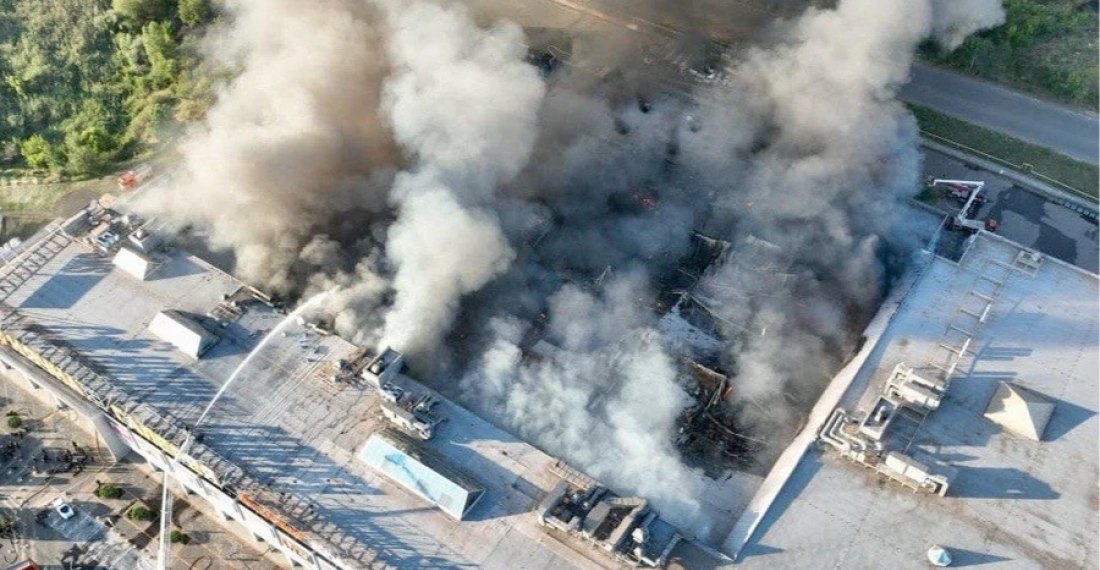
Rescuers in Ukraine are continuing their search for survivors in the wreckage of a big shopping centre hit by Russia on Friday.
Sixteen people were killed and 130 injured when two drones hit the busy centre in Kryvyi Rih in quick succession in what is known as a double-tap strike. Four people are still missing. The search and rescue operation could last for another two days.
President Volodymyr Zelensky condemned the "cynical and despicable" attack in which the second drone targeted emergency workers.
The sides exchanged more fire overnight, with Ukrainian attacks said to have killed at least four people in Russia, including two children, and three people reported dead by Kyiv as a result of Russian strikes.
The death toll from Friday's attack reached 16 after another body was retrieved from the rubble overnight, said Dnipropetrovsk regional head Oleksandr Hanzha.
"We're doing everything possible to speed up... the search and rescue operation," he told Ukrainian TV on Saturday morning.
He added that the work could continue for another two days because of the sheer scale of devastation and constant threats of more Russian attacks.
Rescue teams from seven other Ukrainian regions were urgently deployed on Friday evening to help search for survivors.
The huge fire covering an area of some 9,000 sq m has been extinguished.
In an update later on Saturday, Hanzha said that 52 injured people, including 14 children, were still in city hospitals.
Dozens of people had already undergone surgery, said Kryvyi Rih's miltiary chief Oleksandr Vilkul.
A day of mourning is being observed across the Dnipropetrovsk region.
Dramatic footage verified by the BBC showed the second drone hitting the already burning shopping centre in Zelensky's hometown. Russia's military has not commented.
Vilkul said the drones had been flying at "extremely low altitudes" and described the attackers as "animals".
Officials have not commented on why Ukraine's air defence units - which the military says are 90% successful at intercepting drones - failed to stop Friday's attacks on the shopping centre.
Ukraine's interception rate of ballistic missiles, however, is much lower - at about 40%, the defence ministry reported in June. Kyiv has repeatedly said it is running low on US-made Patriot missiles - the most effective weapon against the ballistics.
The attack in Kryvyi Rih came a day after 17 people were killed and many more injured in a major Russian missile and drone attack on Ukraine's capital Kyiv.
A number of people are reported to be trapped in the rubble of the shopping centre in the central Ukrainian city of Kryvyi Rih.
Specially trained psychologists were deployed to help some survivors after Friday's attack
Zelensky said there had been "missile and drone strikes throughout the evening and night" across Ukraine, with residential buildings and civilian infrastructure damaged.
He said one person was killed and another injured after ballistic missile strikes damaged railway infrastructure in the capital Kyiv, while three people were injured by a "brutal" drone strike on a city minibus in the southern city of Zaporizhzhia.
Two people were killed in a separate Russian attack in the Kyiv region, Ukraine's state emergencies service DSNS said.
Meanwhile, Russia's defence ministry said it downed a total of 457 Ukrainian drones overnight.
Two children were killed and two adults injured in a drone strike on a port town in Russia's southern Krasnodar region, according to Governor Veniamin Kondratyev.
source: commonspace.eu with BBC (London) and agencies



