


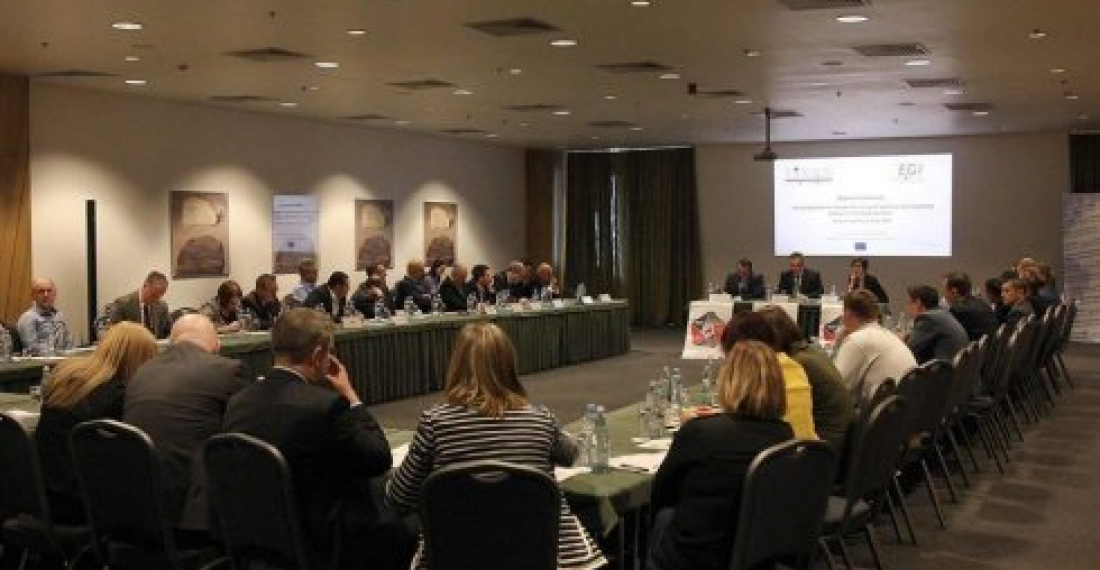
A conference to look at how the issue of landmines in the South Caucasus can be impacted by a regional approach to some of the more intractable challenges in the region concluded the campaign LANDMINE FREE SOUTH CAUCASUS, conducted from 4-10 April. During the conference, held in Tbilisi on 10 April, participants heard from representatives of organisations that helped implement the campaign in Armenia, Azerbaijan and Georgia on how the campaign messages were received at activities held in the respective countries. A panel of experts reviewed the current situation in the region and explored the question if a regional approach may help address some of the region's problems.
The conference was opened by the Deputy Foreign Minister of Georgia, Lasha Darsalia, who spoke about the importance that Georgia attached to relations with its neighbours in the South Caucasus and said that a regional approach to some issues opened interesting possibilities for development. He welcomed the campaign against landmines, and said that despite the fact that for geopolitical reasons it was not yet possible for Georgia to sign the Ottawa convention on the banning of landmines, the government was trying as much as possible to operate within the spirit of the convention.
The conference was also addressed by Monika Csaki on behalf of the European Union delegation in Tbilisi. Ms Csaki also welcomed the campaign and its message, and spoke about the efforts of the European Union to bring about an end to landmine use worldwide, and to clean those areas that were infected by landmines.

Participants from government structures from Armenia and Azerbaijan attended the meeting, as well as a number of Ambassadors, military attaches and representatives of international organisations based in Tbilisi.
Representatives of various Georgian government structures, including the Ministry of Defence, the Ministry of Interior, the DELTA demining agency and the State Border Guard Service of Georgia were also present.
During the meeting representatives of the HALO Trust, Mairi Cunningham, Levan Rapava, Mamuka Jumutia and Ashkanaz Hombhazanian made short presentations about their work programme in Georgia as well as in the conflict regions of Abkhazia and Nagorno-Karabakh.

Addressing the event, Vakhtang Kolbaia, Head of the Tbilisi based government of the Abkhaz Autonomous Republic, spoke about the danger that landmines create for civilians. He welcomed the work of the HALO Trust to clean Abkhazia from the problem of landmines and other unexploded ordinance. He also welcomed the fact that the campaign LANDMINE FREE SOUTH CAUACSUS had taken its mine awarness messages to schools were children of Georgian IDPs from the conflicts were educated.

In an intervention from the floor, the Romanian Ambassador to Georgia, HE Mr Radu Liviu Horumba, shared with participants some of his personal experiences working on the international landmine convention. He urged participants to give particular attention to the issue of victims of landmines and their families and communities. He also called on the Georgian government to consider voluntary reporting to the Ottawa Convention mechanism, even before it signs the convention.
related content: Landmine issues discussed at regional meeting in Tbilisi
The regional approach is far from easy
In the second part of the conference, experts working on the region discussed the potential of a regional approach in dealing with some of the more intractable problems of the region.

Dr Giorgi Khelashvili said that the regional distribution of power in the South Caucasus over the last two decades has remained largely unchanged. There has been progress in the state-building processes in the three countries, the foreign policy of the three countries remains largely unchanged and there has been a hardening of the conflict environement. The speaker said that on the other hand there are changes in the external engagement with the region. Western soft power has been declining, as has been western activism in trying to solve the conflicts in the region, and western conditionality on issues of human rights and democracy. Dr Khelashvili said that nationalism continues to be the basis of politics in the three countries, democratisation was stagnating and social inequality increasing. The speaker said that in this situation regional co-operation was very difficult. There was no outside hegemonic power that could push for it, and a complete lack of a regional security architecture. The only motivation for regional co-operation at this point was economic, but achieving regional co-operation through an economic prism would be long and painful. Dr Khrelashvili said that the only rare glimpse of hope was the new generation which appeared to view things from a different perspective, and may be ready to push the issue much further than their predecessors.
Olesya Vartanyan spoke about recent political changes in Armenia, which she said had created a new interesting situation. The Karabakh peace process had been in deep deadlock for years, and after the 2016 escalations, the two sides tried a number of tactical moves to try to strengthen their bargaining positions. Both sides had a war vision, although both sides well understood the high cost of war. Olesya Vartanyan said that the Armenian and Azerbaijani elites understood well how to confront and alienate each other. They have proven less good at reaching out to each other to explore peaceful options. When Nikol Pashinyan came on the scene this was a good moment for a Karabak "re-set". Pashinyan does not have a background on Karabakh - unlike recent Armenian leaders he was not from Karabakh, and he did not fight there. However, both sides still need to take into consideration their domestic constituencies. This makes it difficult for president Aliyev to compromise on the issue of status of Nagorno-Karabakh and for prime minister Pashinyan to compromise on the issue of the surrounding territories. However neither side is interested in war, and both sides want to try to avoid having Russian peacekeepers. There is a chance that if the two sides take a step back they may be able to prepare a new framework through which a solution to the problem could be achieved. In the past, Vartanyan said, every time there was progress, all was lost once a crisis erupted. This time the sides need to learn to consolidate whatever they are able to achieve.
Ahmad Alili said that the political changes in Armenia in 2018 had increased expectations amongst the Azerbaijani public that some progress could be seen in the Karabakh conflict resolution process. Pashinyan was not perceived as a hard liner on the Karabakh issue, but closer to the Levon Ter Petrossyan school. There was however huge dissapointment when Pashinyan insisted on the inclusion of Stepanakert's Nagorno-Karabakh authorities in the negotiations. The fact that the international community did not support this demand is considered by the Azerbaijan government as a victory. Azerbaijan still looks very negatively at any engagement with the political power currently in control in Nagorno-Karabakh. This also explains their negative reaction to the work of the HALO Trust in Nagorno-Karabakh since this was not co-ordinated with Baku. He however said that apart from this he appreciated the good work that the HALO Trust was doing in different parts of the world. Ahmad Alili said that overall Baku at the moment feels it has the initiative, and this is creating expectations in society of some sort of imminent breakthrough.
Summing up the discussion, Dr Dennis Sammut, who was chairing the conference, said that one recurring theme echoed by all the speakers was the problem of lack of trust. He said that conflict resolution, let alone regional co-operation, was difficult, almost impossible as long as this situation prevailed, which was why confidence-building measures were so important. Work on confidence building measures needed to be factored in at every stage of the peace process on Nagorno-Karabakh and beyond. He emphasised the need to inform public opinion that peace was not an event but a long and difficult process. The leaders of the region need to start by identifying some issues which they will be ready to transform from contentious issues to examples of positive collaborative work. He felt that the issue of landmine eradication had the potential to be such an issue, and despite some challenges, the LANDMINE FREE SOUTH CAUCASUS campaign had given some hope that this can be the case. He was sure there were other humanitarian issues that could be similarly approached.
The conference "Increasing efforts to eliminate the scourge of landmines and unexploded ordinance in the South Caucasus" was held in Tbilisi on Wednesday, 10 April 2019. It was organised by LINKS (Dialogue, Analysis and Research) and the Europe-Georgia Institute. It brough to an end the week long region-wide campaign with the theme LANDMINE FREE SOUTH CAUCASUS which was implemented from 4-10 April with activities throughout the region. The campaign implementing partners in the region were the Caucasus Policy Analysis Centre in Baku, the Centre for Humanitarian demining and Expertise in Yerevan, and the Europe-Georgia Institue in Tbilisi. The campaign was organised with the support of the European Union.
source: commonspace.eu



