


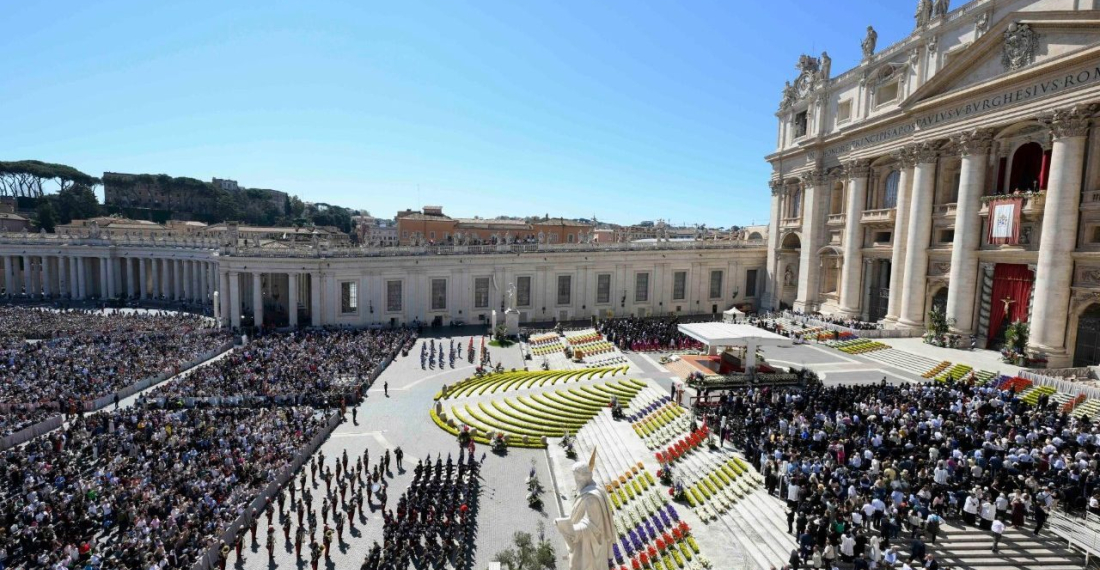
Pope Leo XIV, has called on world leaders to lay down their weapons and choose “encounter” over domination

The leader of the Catholic Church, Pope Leo XIV, has called on world leaders to lay down their weapons and choose “encounter” over domination.

“Let those who have weapons lay them down!”, the Pope urged on Easter Sunday in his traditional Urbi et Orbi message.

Speaking to the tens of thousands of pilgrims gathered in St Peter's Square, Pope Leo urged "those who have the power to unleash wars" to chose peace. 

This should not be a peace “imposed by force”, he stressed, but one achieved through dialogue – “not with the desire to dominate others, but to encounter them”.

Pope Leo warned that the world is “growing accustomed to violence”.

We are “becoming indifferent”, he said, not only to the deaths of thousands of people, but to the “hatred and division” war causes, as well as its “economic and social consequences”.

Borrowing a phrase from the late Pope Francis, Pope Leo warned of the “ever-increasing ‘globalisation of indifference’”.

“We cannot continue to be indifferent!”, he urged. “We cannot resign ourselves to evil!”.

For this reason, he said, he would be leading a prayer vigil for peace next Saturday, April 11th, in St Peter’s Basilica.

source: commonspace.eu with Vatican News (Vatican City)

Related articles

Editor's choice
News
Russian warship "greets" Andy Burnham's premiership with live fire in the English Channel

Russian warship "greets" Andy Burnham's premiership with live fire in the English Channel

A Russian warship, shadowed by a Royal Navy vessel, carried out a live-fire artillery exercise just 46 miles (74km) south of Plymouth on Monday, as Andy Burnham was taking office as the new British prime minister. The Royal Navy monitored the exercise and is tracking "the vessel's activity closely", a UK Ministry of Defence spokesperson said. The BBC has been told that, prior to opening fire, Russian frigate Neustrashimy (English: Dauntless) had informed the Royal Navy Offshore Patrol Vessel, HMS Tyne, of its intention to conduct gunnery activity. Newly appointed Defence Secretary Wes Streeting called the exercise "performative and irresponsible". The Kremlin has signalled there was no link between the exercise and Andy Burnham taking office as prime minister. "All [military] exercises and all actions undertaken by our warships are carried out in strict compliance with international and maritime law," Kremlin spokesman Dmitry Peskov told BBC News. "Therefore, there is no need to see any signals in this," he said. However, Peskov added that Burnham had sent signals to Russia, saying: "One of the first things the new British prime minister did as he took office was to declare his unconditional support for Ukraine and, accordingly, declare the UK's intention to continue doing everything it possibly can to continue the war."

Popular

Editor's choice
Interview
Thursday Interview: Murad Muradov

Thursday Interview: Murad Muradov

Today, commonspace.eu starts a new regular weekly series. THURSDAY INTERVIEW, conducted by Lauri Nikulainen, will host  persons who are thinkers, opinion shapers, and implementors in their countries and spheres. We start the series with an interview with Murad Muradov, a leading person in Azerbaijan's think tank community. He is also the first co-chair of the Action Committee for a new Armenian-Azerbaijani Dialogue. Last September he made history by being the first Azerbaijani civil society activist to visit Armenia after the 44 day war, and the start of the peace process. Speaking about this visit Murad Muradov said: "My experience was largely positive. My negative expectations luckily didn’t play out. The discussions were respectful, the panel format bringing together experts from Armenia, Azerbaijan, and Turkey was particularly valuable during the NATO Rose-Roth Seminar in Yerevan, and media coverage, while varied in tone, remained largely constructive. Some media outlets though attempted to represent me as more of a government mouthpiece than an independent expert, which was totally misleading.  Overall, I see these initiatives as important steps in rebuilding trust and normalising professional engagement. The fact that soon a larger Azerbaijani civil society visits to Armenia followed, reinforces the sense that this process is moving in the right direction." (click the image to read the interview in full)


