


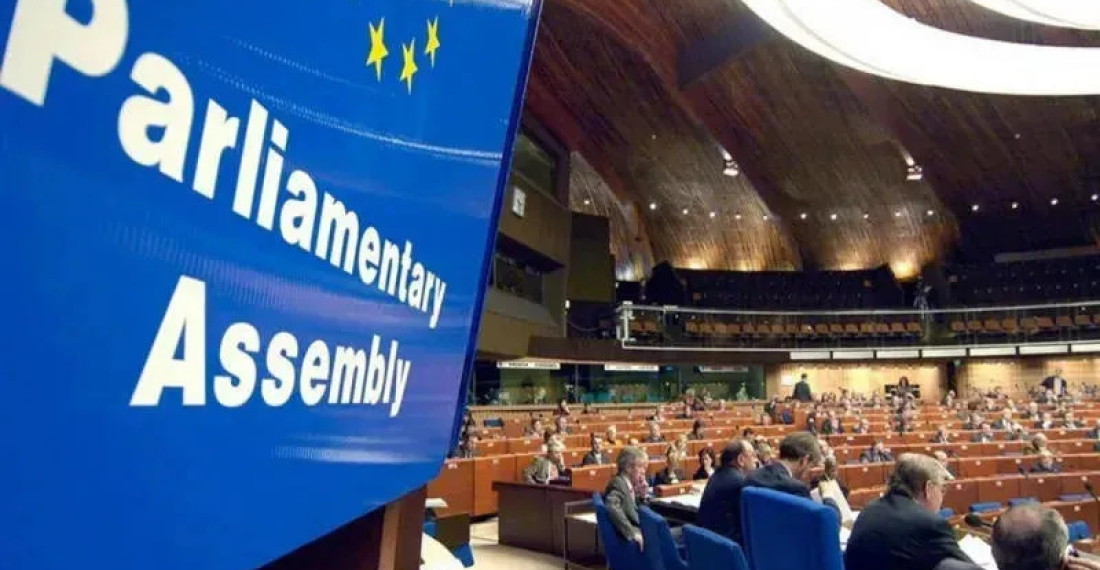
Parliamentary Assembly of the Council of Europe expressed deep concern over Georgia

The Parliamentary Assembly of the Council of Europe (PACE) has expressed deep concern over Georgia’s continued democratic backsliding, warning of growing pressure on civil society, the political opposition, independent media and dissenting voices.

Adopting Resolution 2664, “The functioning of democratic institutions in Georgia,” PACE said the Georgian authorities had failed to act on earlier recommendations and raised serious doubts about their commitment to Council of Europe obligations.

The Assembly warned that efforts to ban opposition parties and prosecute their leaders on politically motivated grounds could push Georgia toward one-party rule. It called on the authorities to end such prosecutions, protect political pluralism, and launch an open dialogue with the opposition and civil society.

PACE also said the conditions for genuinely free and democratic elections had been seriously undermined by political pressure, deep polarisation and restrictions on democratic freedoms. It criticised curbs on freedom of expression and assembly, and called for the repeal of legislation it considers repressive, including the Law on Transparency of Foreign Influence and the Law on the Registration of Foreign Agents.

The Assembly further raised concern over reports of police violence, torture and ill-treatment of detainees during and after demonstrations, and called for credible investigations into allegations of excessive force.

PACE also condemned what it described as transnational repression against Azerbaijani journalist Afgan Sadigov, who was deported from Georgia in April despite an interim measure from the European Court of Human Rights.

The resolution was adopted by 83 votes in favour, 5 against and 4 abstentions. PACE said it remained committed to dialogue with Georgia, while stressing that Council of Europe membership carries non-negotiable obligations on democracy, human rights and the rule of law.

Source: commonspace.eu with JAMnews, Interpressnews, and the Parliamentary Assembly of the Council of Europe

Related articles

Editor's choice
News
10th anniversary of a failed coup that redefined Turkiye

10th anniversary of a failed coup that redefined Turkiye

Ten years ago, parts of the Turkish military attempted to overthrow the government of President Recep Tayyip Erdogan. The consequences of the failed coup continue to shape Turkiye to this day.  It was the evening of July 15, 2016. A warm summer day was coming to an end. Many people were spending their Friday evening with friends or family, looking forward to the weekend. There was nothing to suggest that Turkiye was about to be fundamentally transformed. Then, just a few hours later, tanks were rolling through the streets. Fighter jets flying over Ankara and Istanbul. Soldiers blocking the Bosphorus Bridge, the link between Europe and Asia. The parliament in Ankara came under fire. Turkish President Recep Tayip Erdogan called on the public via a video call broadcast to take to the streets and stop the coup. The coup attempt failed that very night, but its political consequences continue to impact the country The Turkish government blamed the Gulen movement for the coup attempt. Its founder, the Muslim cleric Fetullah Gulen was based in the United States. The government accused Gulen of having infiltrated the judiciary, police, military, and other state institutions with followers over decades in an effort to undermine the state. Gulen and his followers denied any involvement in the coup. Many high-ranking military officials with alleged ties to Gulen were arrested.. Gulen died in the US aged 83 in the US in 2024. In Turkey, July 15 is now a national holiday. The former Bosphorus Bridge was renamed the "Bridge of the Martyrs of July 15." It commemorates the people who lost their lives that night. According to official figures, 253 people died, most of them civilians. Many streets, squares and schools also bear the name "July 15". However, the anniversary is not just about commemorating the victims. It also marks a profound political turning point. The Gulen movement was designated a terrorist organization, and its alleged supporters were largely extracted from the state apparatus. Six days after the coup, parliament approved a state of emergency. It was initially limited to three months but did not end until July 19, 2018. During those two years, the president governed largely by emergency decrees, issuing 32 decrees in total. The consequences of these political purges have been enormous. More than 125,000 members of the civil service and the armed forces were dismissed. According to official figures, approximately 390,000 people had been detained or arrested between 2016 and 2025 on suspicion of ties to Gulen.

Popular

Editor's choice
Interview
Thursday Interview: Murad Muradov

Thursday Interview: Murad Muradov

Today, commonspace.eu starts a new regular weekly series. THURSDAY INTERVIEW, conducted by Lauri Nikulainen, will host  persons who are thinkers, opinion shapers, and implementors in their countries and spheres. We start the series with an interview with Murad Muradov, a leading person in Azerbaijan's think tank community. He is also the first co-chair of the Action Committee for a new Armenian-Azerbaijani Dialogue. Last September he made history by being the first Azerbaijani civil society activist to visit Armenia after the 44 day war, and the start of the peace process. Speaking about this visit Murad Muradov said: "My experience was largely positive. My negative expectations luckily didn’t play out. The discussions were respectful, the panel format bringing together experts from Armenia, Azerbaijan, and Turkey was particularly valuable during the NATO Rose-Roth Seminar in Yerevan, and media coverage, while varied in tone, remained largely constructive. Some media outlets though attempted to represent me as more of a government mouthpiece than an independent expert, which was totally misleading.  Overall, I see these initiatives as important steps in rebuilding trust and normalising professional engagement. The fact that soon a larger Azerbaijani civil society visits to Armenia followed, reinforces the sense that this process is moving in the right direction." (click the image to read the interview in full)

