


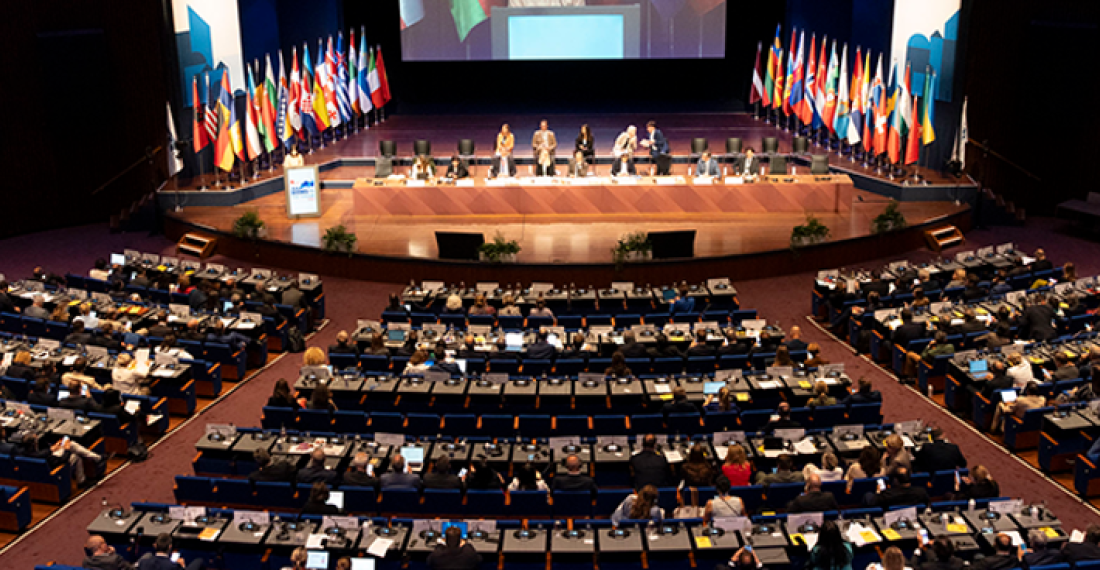
The OSCE Parliamentary Assembly concluded its 33rd Annual Session today in The Hague, adopting the wide-ranging Hague Declaration and accompanying resolutions. Some 250 parliamentarians from OSCE participating States and Partners for Co-operation gathered from 4 to 8 July under the general theme “International Law and Shared Principles: Foundations for Security and Co-operation in the OSCE Area.”
The Declaration addresses top security, economic, environmental, and human rights challenges facing the Euro-Atlantic and Eurasian regions, reaffirming the foundational principles of the Helsinki Final Act and underscoring the OSCE’s role in promoting comprehensive, co-operative, equal, and indivisible security.
The main focus of the Declaration is the Russian Federation’s continued war of aggression against Ukraine, described as “a clear, gross and uncorrected violation of the Helsinki Final Act, the Charter of the United Nations and the fundamental principles of international law.”
Parliamentarians “demanded that the Russian Federation immediately, completely and unconditionally ceases its war of aggression against Ukraine, withdraws all its forces and military personnel from the entire territory of Ukraine within its internationally recognized borders,” and called for the immediate release of three detained OSCE officials — Vadym Golda, Maksym Petrov, and Dmytro Shabanov.
The Declaration condemns deliberate attacks on civilians and civilian infrastructure, including energy systems, as serious violations of international humanitarian law amounting to war crimes, and expresses deep alarm over the abduction and deportation of Ukrainian children.
Additional measures urged include sustained multidimensional support for Ukraine, stronger sanctions enforcement, preparations for post-conflict OSCE involvement, and full accountability for violations of international law.
The Assembly expressed serious concern over democratic backsliding across the OSCE region, the erosion of the rule of law, restrictions on fundamental freedoms, and the importance of parliamentary pluralism, independent institutions, and genuine elections. The Declaration notes challenges to electoral integrity, including misuse of administrative resources and vote buying.
Parliamentarians addressed instability in the Middle East, noting its direct implications for the OSCE area through migration pressures, energy market disruptions, and heightened security risks. They called for de-escalation, protection of civilians, and diplomatic engagement while condemning terrorism and the proliferation of missiles and drones.
Other security priorities include growing hybrid threats, attacks on critical infrastructure, the role of AI in amplifying threats, weakening arms control frameworks, and online radicalization. The Declaration stresses maritime security and the need to preserve the Arctic and High North as areas of peaceful co-operation.
In the economic, science, technology, and environment chapter, the Declaration underscores the need for sustainable growth, energy diversification, climate action aligned with the Paris Agreement, and resilience against economic coercion and supply chain vulnerabilities. It highlights environmental damage from the war in Ukraine and conflicts in the Middle East, and calls for stronger action on biodiversity, water security, and responsible AI governance.
On human rights and humanitarian issues, the text addresses the plight of vulnerable groups, gender-based violence, human trafficking, and restrictions on civil society, journalists, and political prisoners.
The Assembly welcomed the adoption of the 2026 OSCE Unified Budget after a five-year impasse but expressed concern that funding levels remain insufficient. It called for renewed high-level political engagement, adequate financing for OSCE institutions and field operations, and stronger support for the OSCE PA itself, including election observation.
“The OSCE remains an indispensable instrument for dialogue, conflict prevention and co-operation across the Euro-Atlantic and Eurasian regions,” the Declaration states, while noting challenges posed by financial constraints and insufficient political attention.
The full The Hague Declaration and resolutions serve as a unified parliamentary voice urging OSCE participating States to uphold Helsinki principles, support Ukraine, defend democracy, address hybrid threats, and tackle climate and economic challenges through co-operative action.
souce: commonspace.eu with OSCE PA (Copenhagen)



