


NKR president visits Washington

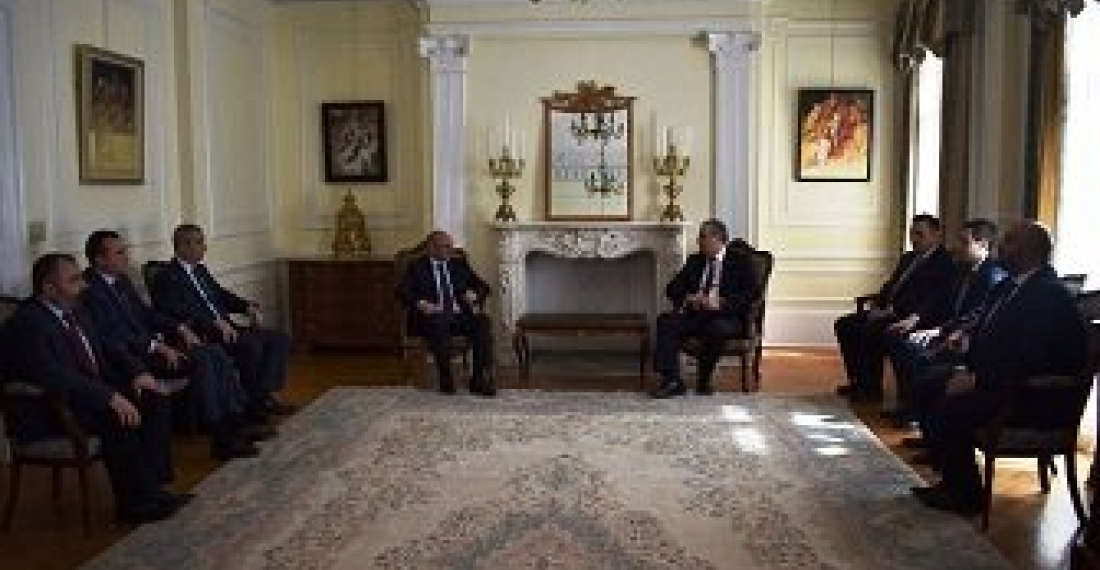
The president of the self-declared Nagorno-Karabakh Republic, Bako Sahakian has arrived in Washington DC on what has been described as a "working visit". On Tuesday (13 March) Bako Sahakyan visited the Embassy of the Republic of Armenia in Washington, and met with the ambassador of Armenia to the United States, Grigor Hovhannissian and the diplomatic staff at embassy.  A range of issues related to the cooperation between the USA and Armenia and nagorno-Karabakh were discussed.

"President Sahakyan stressed the importance of close cooperation between Artsakh, Armenia and the Diaspora, underlining that it was one of the crucial factors for successful implementation of the scheduled programs", the website of the NKR de facto authorities stated.

Nagorno-Karabakh Republic is not recognised by any state, and Bako Sahakyan's Washington visit was criticised by Azerbaijan.

In an article in the journal National Interest, published on the eve of the visit, the former US Ambassador to Armenia, John Evans said that

"This week, the democratically-elected president of Artsakh, Bako Sahakyan, will visit Washington. He will not be received by the administration, in part because the United States is silent on the question of whether Artsakh should eventually be independent of Azerbaijan, to which it was allocated by Josef Stalin in 1921. Washington does not recognize Artsakh-in fact no country yet does-but President Sahakyan's predecessor who visited in 1999 and 2002 met with State Department officials at the working level, and there is an unofficial representative of Nagorno-Karabakh/Artsakh resident in Washington. For this visit, Sahakyan will have to be content with meetings on the Hill and a private lunch at the Center for the National Interest."

The former American diplomat added:

"It is time for the international community to welcome the Republic of Nagorno-Karabakh-Artsakh-into the community of nations. As the deputy foreign minister of Artsakh, Armine Aleksanyan, put it recently at the European Parliament, "Karabakh is a country, not a conflict." The people of Artsakh just want to live their lives in peace and freedom. Even though the status of the Republic of Artsakh has not yet been finally determined, the people of Artsakh possess, and should enjoy, the same rights as all the rest of us, and ought not to be quarantined by the rest of humanity."

source: commonspace.eu with agencies

photo: Bako Sahakian, President of the self declared nagorno-Karabakh Republic at the Embassy of Armenia in Washington DC on Tuesday, 13 March, at the start of a visit to the United States.


Related articles

Editor's choice
News
Pope on Christmas Day: "Peace is a shared responsibility"

Pope on Christmas Day: "Peace is a shared responsibility"

In his Christmas address on St Peter's Square, Pope Leo XIV renewed his plea for peace, reminding the world that it is both God’s gift and humanity’s shared responsibility. Pope Leo XIV renewed his appeal for peace, dialogue, and responsibility, turning to those regions where violence and instability continue to claim innocent lives. The Pope prayed for “justice, peace, and stability for Lebanon, Palestine, Israel, and Syria,” and urged that the promise of peace rooted in righteousness be renewed. He appealed in a particular way for Ukraine, asking that “the clamor of weapons cease,” and that all those involved, with the support of the international community, find the courage to engage in “sincere, direct, and respectful dialogue.” Remembering conflicts that risk being forgotten, Pope Leo XIV expressed closeness to the victims of war and violence in Sudan, South Sudan, Mali, Burkina Faso, and the Democratic Republic of Congo, as well as to all those who suffer as a result of injustice, political instability, religious persecution, and terrorism. The Pope also prayed for Haiti, calling for an end to violence and progress along the path of peace and reconciliation. He also invoked peace for Myanmar, asking that the country be guided towards reconciliation and hope, especially for its younger generations. Turning to Latin America, he encouraged those with political responsibilities to give space to dialogue for the common good, rather than to ideological and partisan divisions. The Pope also prayed for the restoration of the "ancient friendship" between Thailand and Cambodia, and entrusted to God the peoples of South Asia and Oceania, who have been severely affected by recent natural disasters, calling for renewed commitment to assisting those who suffer.

Popular

Editor's choice
News
Pope on Christmas Day: "Peace is a shared responsibility"

Pope on Christmas Day: "Peace is a shared responsibility"

In his Christmas address on St Peter's Square, Pope Leo XIV renewed his plea for peace, reminding the world that it is both God’s gift and humanity’s shared responsibility. Pope Leo XIV renewed his appeal for peace, dialogue, and responsibility, turning to those regions where violence and instability continue to claim innocent lives. The Pope prayed for “justice, peace, and stability for Lebanon, Palestine, Israel, and Syria,” and urged that the promise of peace rooted in righteousness be renewed. He appealed in a particular way for Ukraine, asking that “the clamor of weapons cease,” and that all those involved, with the support of the international community, find the courage to engage in “sincere, direct, and respectful dialogue.” Remembering conflicts that risk being forgotten, Pope Leo XIV expressed closeness to the victims of war and violence in Sudan, South Sudan, Mali, Burkina Faso, and the Democratic Republic of Congo, as well as to all those who suffer as a result of injustice, political instability, religious persecution, and terrorism. The Pope also prayed for Haiti, calling for an end to violence and progress along the path of peace and reconciliation. He also invoked peace for Myanmar, asking that the country be guided towards reconciliation and hope, especially for its younger generations. Turning to Latin America, he encouraged those with political responsibilities to give space to dialogue for the common good, rather than to ideological and partisan divisions. The Pope also prayed for the restoration of the "ancient friendship" between Thailand and Cambodia, and entrusted to God the peoples of South Asia and Oceania, who have been severely affected by recent natural disasters, calling for renewed commitment to assisting those who suffer.

