


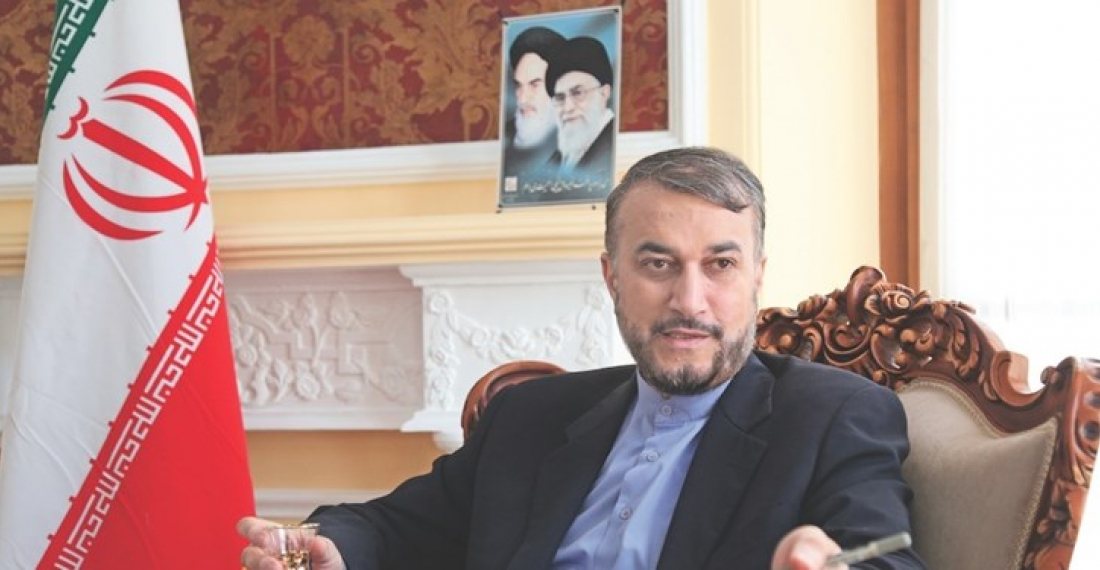
Iranian foreign minister says relations with neighbours are a priority

The Iranian foreign minister, Hossein Amir Abdollahian, has said that the new government in Iran attaches great importance to relations with the neighbouring states.

In a tweet on Wednesday (1 September) referring to the meeting he had with the vice president and prime minister of the United Arab Emirates (UAE), Sheikh Mohammed bin Rashid al Maktoum, in Baghdad on Sunday, foreign minister Abdollahian said:

"On the sidelines of the cooperation and participation summit in Baghdad, I had a positive and cordial conversation with UAE PM Mohammed bin Rashid Al Maktoum. Iran and the UAE can take big steps towards cooperation and the realization of neighborhood policy and diplomacy".

"During this meeting, we spoke about the positive intentions and will of the leaders of the two countries to strengthen relations and emphasized the fraternal relations between the two countries," Amir Abdollahian noted.

"We consult and cooperate with our neighbors to advance our relations and achieve regional cooperation," he added, saying, "Cooperation with neighbors is a priority of the 13th administration."

Amir Abdollahian had also earlier said that he would pursue a balanced and active diplomacy and prioritise relations with the neighboring countries and Asian states.

"My honor to be confirmed by the parliament to represent the great nation of Iran in the arena of foreign policy and international relations," Amir Abdollahian wrote on his twitter page late last month after receiving the vote of confidence from the parliament.

"Determined to follow balanced, active and smart diplomacy based on principles of dignity, wisdom and prudence," he added, stressing, "Neighbors and Asia first priority."
 

source: commonspace.eu with FARS news agency (Tehran)
photo: Iranian foreign minister Amir Abdollahian

Related articles

Editor's choice
News
NATO's Ankara summit in July likely to be the most important in the history of the organisation

NATO's Ankara summit in July likely to be the most important in the history of the organisation

Preparations are going on in earnest ahead of what is likely be the most important summit in the history of the North Atlantic Treaty Organisation (NATO), scheduled to be held in Türkiye in July. NATO Secretary General Mark Rutte visited Ankara, Türkiye (21-22 April 2026) to engage with national leadership and visit an ASELSAN Technology Base. In his meeting with President Recep Tayyip Erdoğan, Mr Rutte highlighted Türkiye’s contribution to the Alliance and discussed preparations for the upcoming Summit in Ankara. During his visit, the Secretary General also met with Foreign Minister Hakan Fidan and Defence Minister Yaşar Güler.  US president, Donald Trump, has been very vocal in recent weeks criticising NATO countries for not supporting the US-Israel war against Iran. The issue is likely to dominate discussions at the Ankara summit, and many have described this as the most challenging time in the history of the alliance, since it was established in 1949. (click the picture to read more)

Popular

Editor's choice
Interview
Thursday Interview: Murad Muradov

Thursday Interview: Murad Muradov

Today, commonspace.eu starts a new regular weekly series. THURSDAY INTERVIEW, conducted by Lauri Nikulainen, will host  persons who are thinkers, opinion shapers, and implementors in their countries and spheres. We start the series with an interview with Murad Muradov, a leading person in Azerbaijan's think tank community. He is also the first co-chair of the Action Committee for a new Armenian-Azerbaijani Dialogue. Last September he made history by being the first Azerbaijani civil society activist to visit Armenia after the 44 day war, and the start of the peace process. Speaking about this visit Murad Muradov said: "My experience was largely positive. My negative expectations luckily didn’t play out. The discussions were respectful, the panel format bringing together experts from Armenia, Azerbaijan, and Turkey was particularly valuable during the NATO Rose-Roth Seminar in Yerevan, and media coverage, while varied in tone, remained largely constructive. Some media outlets though attempted to represent me as more of a government mouthpiece than an independent expert, which was totally misleading.  Overall, I see these initiatives as important steps in rebuilding trust and normalising professional engagement. The fact that soon a larger Azerbaijani civil society visits to Armenia followed, reinforces the sense that this process is moving in the right direction." (click the image to read the interview in full)

