There is widespread shock in Georgia after news emerged of a possible attempt to poison the Catholicos Patriarch of All Georgians, Ilya II. The Patriarch, a hugely respected figure in Georgian society, is currently in Germany for medical treatment.
Georgian Chief Prosecutor Irakli Shotadze held a special briefing this afternoon where he said that archpriest Giorgi Mamaladze, deputy head of the Patriarchate's Property Management Service and director general of the Patriarchate's medical centre, was arrested at Tbilisi International Airport from where he intended to depart to Germany on February 10.
Police searched the archpriest and found the poisonous substance cyanide on his person.
Citing "the interests of the investigation", Shotadze did not identify the person Mamaladze allegedly planned to murder. Shotadze however said that the person whose murder was allegedly being planned "is a very important person for our country".
He added that upon receiving the information about the alleged preparation of the crime, he phoned Prime Minister Giorgi Kvirikashvili, following which guards from the State Security Service of Georgia were sent to Germany to bolster the Patriarch's security.
Ilia II underwent a laparoscopic gallbladder surgery at one of Germany's prestigious clinics in Berlin this afternoon. His surgeon said the procedure was successful and the Patriarch is in good health now.
At today's briefing the Chief Prosecutor also said that Mamaladze is exercising his right to silence and is not pleading guilty to the alleged crime, which, if proven, could send him behind bars for 7-15 years.
Shotadze said that police received information about the alleged preparation of the crime from someone who knew Mamaladze and from whom the archpriest had asked for help in obtaining cyanide. Shotadze did not identify this person either but said the information was received on February 2 and an investigation had been launched immediately.
The Chief Prosecutor also said that police searched the archpriest's home and found an unregistered handmade firearm with six cartridges.
Shotadze said he made today's statement due to high public interest in the matter, but he refused to reveal further details of the case. He said that there are several versions as to why the archpriest was allegedly planning the murder, and who else could have been involved in the plot.
Commonspace.eu political editor said in a comment that the news has shocked Georgian society where Ilya II is venerated by large sections of the population. The Patriarch is seen as a symbol of national unity and continuity that helped to keep Georgian society together in difficult times over the last three decades. Although in frail health the Patriarch continues to conduct regular public functions. Last year he received in Georgia Pope Francis. There are concerns in Georgia about the future of the Georgian Orthodox Church and issues of succession. The Church's synod is divided and strong personalities are often seen tearing the church apart. No one was however prepared for today's news which, if confirmed, is bound to have serious implications for the Church and its future.
source: commonspace.eu with agenda.ge.
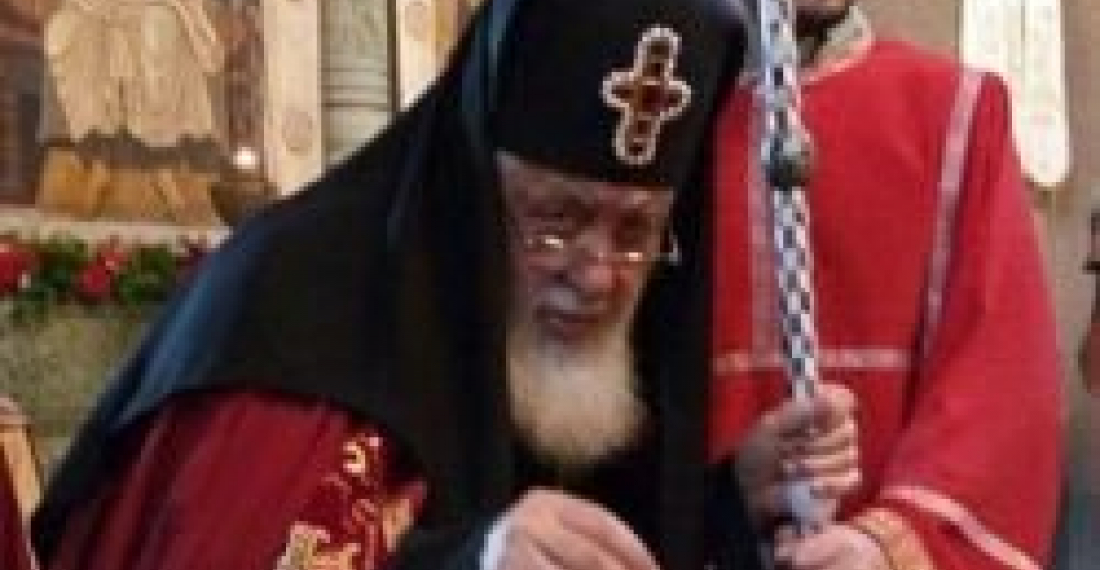
photo: Catholicos Patriarch of all Georgians Ilya II (archive picture)